


Oct 6, 2025 7:00 AM
Updated Oct 9, 2025 10:36 PM
Beyond the neon lights, Las Vegas has quietly become a laboratory for sustainability, labor justice, and housing reform.
Introduction
Real change in America has never started in Congress — it’s always begun in neighborhoods, community meetings, and city councils. From civil rights to climate action, local experiments have forced national conversations, proving that when people organize where they live, Washington eventually follows.
Today, with inequality soaring and trust in federal institutions sinking, progressive cities are stepping up again. They’re not waiting for permission; they’re testing bold policies in housing, climate, labor, and justice — and the results are reshaping what’s possible nationwide.
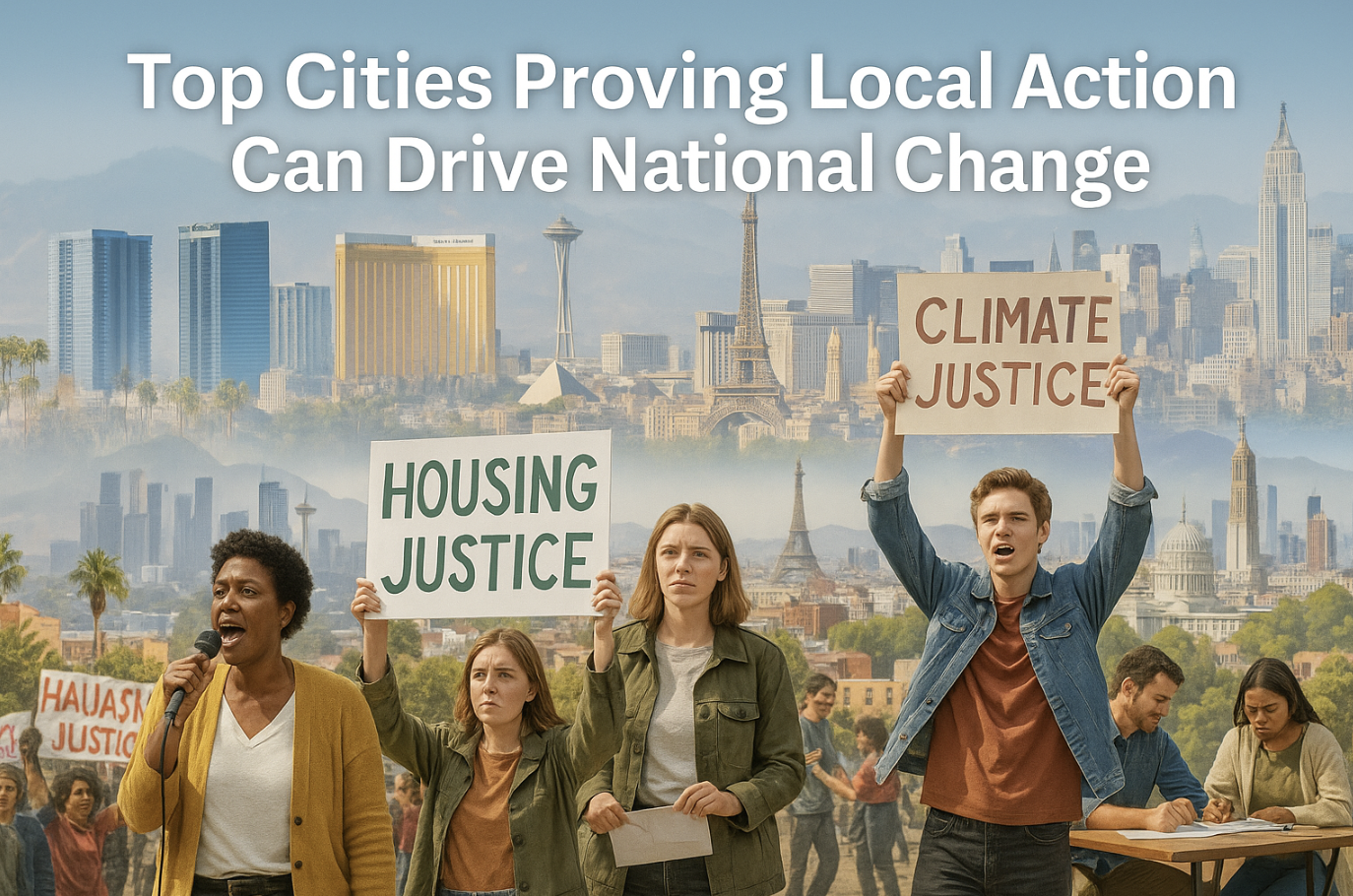
Here are seven cities where local action is rewriting the national playbook — not through slogans, but through measurable results.
1. Las Vegas, Nevada – A City of Contrasts Turning Pressure Into Policy
Beyond the neon lights, Las Vegas has quietly become a laboratory for sustainability, labor justice, and housing reform. The city’s rapid growth and extreme inequality have forced innovation — not as a choice, but as survival.
Related stories
Housing is perhaps the most visible contradiction. On one hand, Las Vegas faces rising homelessness and affordability struggles that mirror national trends. On the other hand, luxury properties such as Panorama Towers for sale and upscale high-rises like Sky Las Vegas highlight the sharp divide between wealth and need. This stark contrast has fueled local advocacy for stronger affordable housing policies, tenant protections, and redistribution of tax revenues from high-end real estate into community support programs.
On climate, Las Vegas has become a national model in water conservation, recycling nearly 100% of indoor water and banning ornamental lawns — the kind of policies other U.S. cities will soon need. Combined with a strong hospitality union presence and grassroots labor movements, Las Vegas is redefining what local resilience looks like in the face of national neglect.
Why It Matters Nationally:
- Stark contrasts between wealth and homelessness expose housing policy failures nationwide.
- Water-saving and drought policies are being studied across the Southwest.
- Labor and climate activism in a tourism hub show grassroots power can thrive anywhere.
2. Los Angeles, California – Taxing Wealth to Fund Justice
Los Angeles has always been a paradox — billion-dollar mansions beside sprawling homeless encampments. But unlike many cities, LA is doing something about it. In 2022, voters approved Measure ULA, a 4% tax on property sales above $5 million, projected to generate $600–900 million annually for affordable housing and eviction prevention. It’s one of the boldest redistributive efforts in local U.S. history.
LA’s environmental policies are equally ambitious. The city is on track to run on 100% renewable energy by 2035, investing heavily in solar infrastructure, zero-emission buses, and clean-energy job training. These efforts show that massive metros can move the needle on climate while addressing equity — not one or the other.
LA’s fight is far from easy, but it’s proving that when local governments take real swings at inequality, they can reshape national conversations around who pays, who benefits, and who finally gets a seat at the table.
Why It Matters Nationally:
- Measure ULA’s wealth tax is a first-of-its-kind model for local housing revenue.
- 2035 renewable goal shows cities can lead on climate faster than states.
- Coalition politics — tenants, labor, climate groups — are defining the next era of power.
3. Minneapolis, Minnesota – Reimagining Public Safety
After the murder of George Floyd in 2020, Minneapolis became a catalyst for national reckoning. But the story didn’t end with protests — the city began transforming what “public safety” actually means.
Instead of defaulting to policing, Minneapolis has expanded violence prevention programs, mental-health crisis teams, and community response networks that de-escalate before tragedy. While its 2021 ballot initiative to replace the police department failed narrowly, the push changed national language — from “defund” to “re-fund communities.”
Data now drives the effort: reduced armed dispatches, shorter response times for crisis calls, and cost savings redirected toward youth programs. For a city once seen only through tragedy, Minneapolis is becoming a case study in how to humanize safety.
Why It Matters Nationally:
- Sparked a nationwide movement on policing and accountability.
- Community-based safety programs are now being replicated in 20+ cities.
- Proves local data can redefine national public safety policy.
4. Seattle, Washington – The City That Raised the Floor
Seattle’s progress didn’t come from slogans — it came from city ordinances that redefined work. In 2014, Seattle became the first major U.S. city to pass a $15 minimum wage. Critics predicted disaster; instead, studies show that low-wage workers’ incomes rose without widespread job loss. Today, $15 is the national baseline for labor debates.
Seattle also took aim at the gig economy. The city passed paid-sick-leave and fair-pay protections for Uber and Lyft drivers — groundbreaking moves in a country still struggling to regulate app-based work. Now cities like New York, Denver, and Chicago are following its lead.
Seattle’s willingness to challenge corporate giants — from Amazon to delivery apps — has made it a blueprint for worker-first governance in a digital economy that often treats humans as expendable.
Why It Matters Nationally:
- $15 minimum wage started here and reshaped national wage debates.
- First major city to protect gig workers with benefits and pay standards.
- Proves city ordinances can outpace federal labor law.
5. New York City, New York – Scaling Policy for Millions
With 8.5 million residents, New York City doesn’t experiment quietly. Every local reform is a stress test for national replication.
NYC pioneered the 2003 indoor-smoking ban, now a national norm. It launched universal pre-K in 2014, giving more than 70,000 children free early education each year — influencing federal childcare debates. Its public-health programs — from free mental-health counseling to food-access initiatives — show how a megacity can implement social equity at scale.
Even in housing, where challenges persist, New York’s inclusionary zoning and rent-stabilization models remain frameworks for affordability nationwide. The city doesn’t get everything right, but its experiments ripple across the U.S. because its problems mirror the country’s — only magnified.
Why It Matters Nationally:
- Public-health innovations like smoking bans and food access became national policy.
- Universal pre-K reshaped federal education discussions.
- NYC’s density forces real-world tests of policies other cities only theorize.
6. Austin, Texas – Blueprints in Red Territory
Austin might be the boldest example of progressive resilience in America. Surrounded by a conservative state government, it continues to push for climate, housing, and justice reforms with national consequences.
The city adopted a net-zero-emissions target by 2040, investing in renewables even as Texas remains the largest oil-producing state. In 2021, Austin redirected portions of its police budget to mental-health, homelessness prevention, and social services, triggering backlash from state lawmakers — but sparking national discussion about reallocating resources.
Despite state-level hostility, Austin’s housing activists have advanced tenant protections, eviction prevention programs, and community land-trust efforts. The message is clear: progressive ideas can grow anywhere if leaders stay grounded in local needs, not partisan fear.
Why It Matters Nationally:
- Net-zero plan proves climate policy can survive in oil country.
- Budget reallocation reframes safety as social investment, not punishment.
- Inspires other “purple” metros to act locally despite state resistance.
7. Oakland, California – Where Justice Meets Experimentation
Oakland’s activist DNA runs deep — from the Black Panther Party to today’s community-wealth and basic-income pilots. It’s a small city with an outsized legacy.
The Oakland Promise program provides scholarships and mentorship for low-income students, helping thousands enter college. The city has piloted guaranteed-income programs giving unconditional cash to struggling families — studies show participants report higher stability and job security. Oakland also supports community land trusts, transferring property into collective ownership to prevent displacement.
Even in criminal justice, Oakland leads: restorative-justice schools and diversion programs are replacing punitive systems with community healing. For a city with deep racial and economic divides, Oakland’s experiments represent hope made practical.
Why It Matters Nationally:
- Guaranteed-income pilots now inspire programs in over 20 U.S. cities.
- Education and land-trust initiatives directly combat structural inequality.
- Shows that racial-justice legacy can evolve into measurable policy wins.
Conclusion – The Map of America’s Next Revolution
Progress in America has always been bottom-up, not top-down. These seven cities remind us that democracy’s future depends not on federal gridlock, but on the courage of local leaders, organizers, and everyday citizens willing to test bold ideas.
Las Vegas proves that even a city defined by spectacle can lead on housing, water conservation, and labor rights—with contrasts like Panorama Towers and upscale living at Sky Las Vegas underscoring why redistribution and equity remain urgent. Los Angeles models housing and climate reform on a massive scale. Minneapolis reframes public safety. Seattle champions worker rights that later spread nationwide. New York City sets benchmarks in health and education. Austin challenges the status quo in conservative terrain. Oakland pioneers racial and economic justice programs that could transform federal policy.
- Las Vegas exposes inequality and models water sustainability.
- Los Angeles taxes wealth to house the unhoused.
- Minneapolis redefines safety as care, not control.
- Seattle proves workers can win through city ordinances.
- New York sets national precedents by scaling justice to millions.
- Austin builds climate resilience under conservative fire.
- Oakland keeps America honest about equity and repair.

For readers of LaProgressive, these stories aren’t just updates — they’re invitations to act. Every city has the power to challenge entrenched interests, prove new models, and expand what’s politically possible.
Local progress is national progress. The question isn’t whether cities can lead — it’s how soon the rest of the nation will catch up.
Comments

Powered by RoundtableAn AI/DeFi-powered Enterprise Media Operating System. Learn more at Roundtable.io.© Roundtable 2026. By using this site you agree to the Terms of Use and Privacy Policy