


Nov 14, 2025 8:00 AM
Updated Nov 18, 2025 9:21 PM
In the United States, CEO pay has soared 1,209 percent since 1978 while typical worker compensation rose only 15 percent (Economic Policy Institute, 2023).
Where Inequality Meets Innovation
The 2020s have become a case study in global economic contradiction. According to Oxfam (2024), the world’s richest 1 percent now own almost half of all global wealth, while the poorest 50 percent share just 0.75 percent. In the United States, CEO pay has soared 1,209 percent since 1978 while typical worker compensation rose only 15 percent (Economic Policy Institute, 2023). The ten largest corporations now hold more wealth than 150 nations combined.
Yet, below this towering imbalance, cities are emerging as laboratories for fairness. Municipal governments, unions, and cooperatives are proving that just economies can take root locally —even when global systems remain unjust. In these places, dignity is designed into budgets, equity is embedded in policy, and workers are treated as partners, not costs.
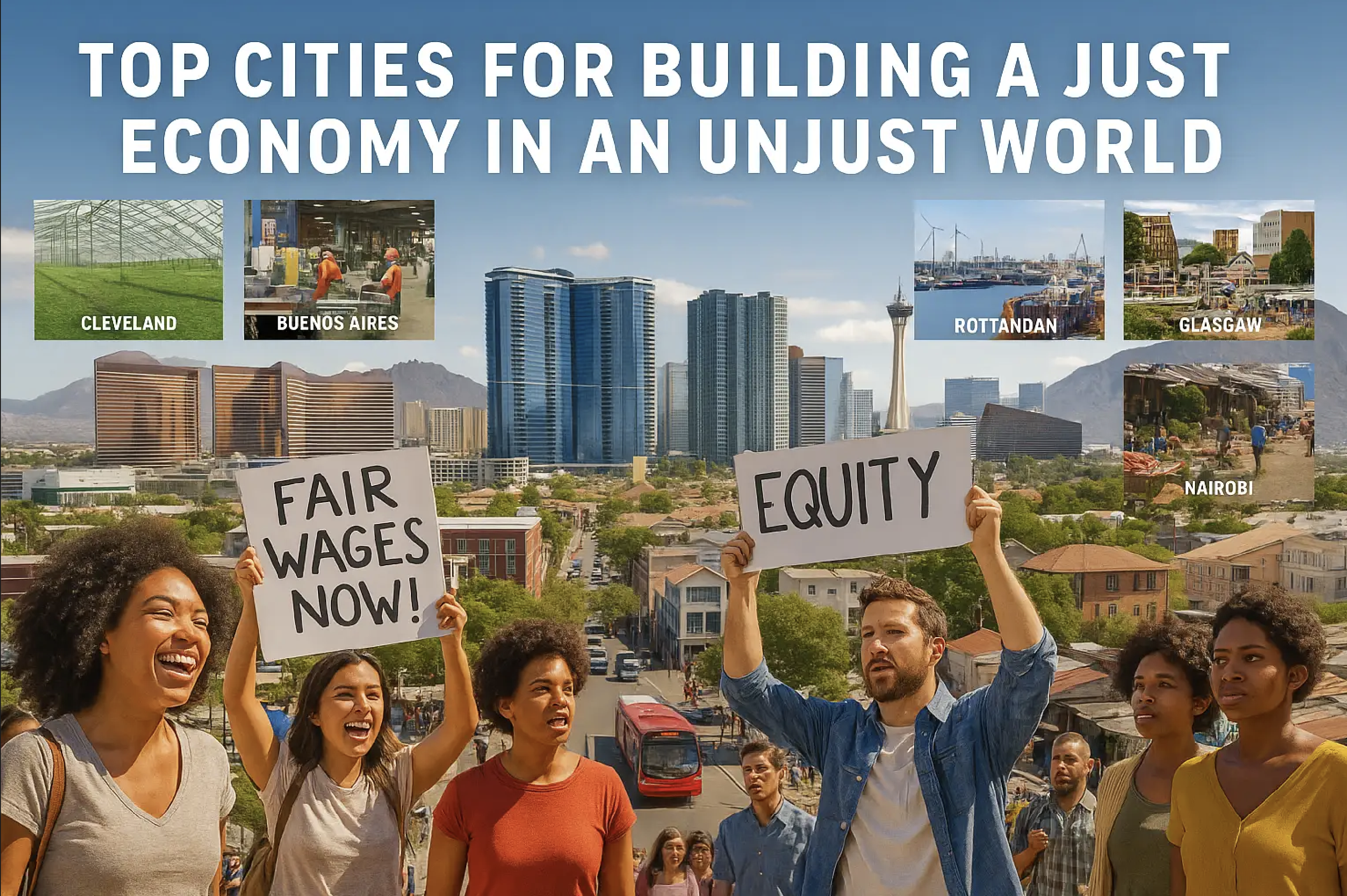
Here are seven cities demonstrating how justice can be engineered from the ground up.
1. Las Vegas, Nevada – Labor Power in the Desert
Las Vegas is often portrayed as the city of excess—a $65 billion tourism economy powered by 42 million annual visitors. Behind that glitter, however, stands one of the most successful labor movements in America. The Culinary Workers Union Local 226, founded in 1935, represents over 60,000 hospitality workers—nearly one in five private-sector employees in southern Nevada.
Their contracts guarantee family health coverage, pensions, and $28–$32 per hour total compensation, figures that far exceed industry norms in comparable cities. In 2023, the union’s coordinated strike threat across 22 major resorts secured a historic five-year agreement raising wages by 10 percent in year one.
Related stories
Many Californians are using 1031 Nevada rules to reinvest in Nevada, where no state income tax and lower property prices stretch their equity further. By selling high-priced California assets and buying in Nevada, investors can defer capital-gains taxes and often boost their returns by 25% or more. With median home prices roughly $850,000 in California vs. $450,000 in Nevada, the exchange can nearly double buying power. For many, it’s a move toward greater cash flow, lower taxes, and a more secure financial future.
Why Las Vegas Leads
- Union density ≈ 15 percent (state average ≈ 9 percent).
- 98 percent of hotel-casino workers receive employer-paid healthcare.
- Region has diverted 1 billion gallons of water annually through recycling.
Las Vegas has also advanced sustainability justice: the Southern Nevada Water Authority cut per-capita water use by 48 percent since 2002 while the city ranks #1 nationally for LEED-certified hotel square footage.
Las Vegas proves that even in a city built on spectacle, collective bargaining and climate innovation can build justice side by side.
2. Cleveland, Ohio – Anchoring Wealth in Communities
Once synonymous with deindustrialization, Cleveland has reinvented itself as a hub for “anchor-institution economics.” The Evergreen Cooperatives, launched in 2008, connect worker-owned businesses to large nonprofits like the Cleveland Clinic and Case Western Reserve University. Their laundry co-op processes 10 million pounds of hospital linens per year, paying living wages and employee ownership shares that build household wealth instead of extracting it.
Cleveland’s anchor model retains nearly $65 million per year that would otherwise leave local neighborhoods. According to the Democracy Collaborative, each Evergreen employee builds ≈ $15,000 in equity within five years of tenure. The city has also passed a Racial Equity and Inclusion Action Plan mandating diversity benchmarks for city contracts.
Why Cleveland Matters
- 80 percent of Evergreen revenues stay within Cuyahoga County.
- 50+ U.S. cities have replicated its co-op template.
- 37 percent of city contracts now go to minority- or women-owned firms.
Cleveland illustrates how urban policy and community ownership can convert rust-belt decline into shared prosperity.
3. Buenos Aires, Argentina – Worker Cooperatives and Resistance
Few cities embody economic resilience like Buenos Aires. Following Argentina’s 2001 collapse, more than 200 abandoned factories were reclaimed by workers and converted into “empresas recuperadas.” Today over 16,000 Argentines work in these self-managed co-ops, producing everything from textiles to printing to metals.
The iconic Zanon ceramics factory (now FaSinPat — Fábrica sin Patrones, “Factory Without Bosses”) has operated under worker control for over 20 years and exports globally. Nationally, co-ops contribute around 9 percent of GDP and represent more than 20,000 enterprises. They have won legal protections ensuring collective ownership and priority in public procurement.
Why Buenos Aires Inspires
- 200 + worker-recovered companies employ > 16 k people.
- Sector produces ≈ $4 billion annually.
- Proof that crisis can spark worker-led industrial policy.
In a world where corporate abandonment is routine, Buenos Aires offers a template for democratic production.
4. Rotterdam, Netherlands – Green Economy with Equity
Rotterdam is Europe’s largest port and one of its lowest-lying cities — 80 percent of its area lies below sea level. Climate justice is thus existential. The city invests over €5 billion through 2050 in its Climate Adaptation Plan, creating 50,000 new green jobs with training pipelines for low-income and immigrant residents.
Programs like “Rotterdam South Works” match green infrastructure projects with unemployed youth and refugees, while the city’s PortXL accelerator supports clean-tech startups focused on zero-emission shipping. By 2023, renewables supplied 36 percent of Rotterdam’s energy mix — double the EU average a decade earlier.
Why Rotterdam Matters
- €5 billion in resilience investments to 2050.
- 50 k green jobs with equity targets for marginalized communities.
- 36 percent renewable energy share and rising.
Rotterdam proves that the climate transition can be a vehicle for social mobility rather than displacement.
5. Curitiba, Brazil – Transit and Social Equity
Curitiba transformed urban planning through its Bus Rapid Transit (BRT) system pioneered in 1974. Today it carries 2.3 million passengers daily at one third the cost of a subway. Fares remain flat citywide, so residents from low-income districts pay the same as the wealthy for fast, reliable transport.
Transit access has cut household transportation expenses by up to 12 percent of income and reduced CO₂ emissions by ≈ 30 percent compared to similar Brazilian metros. The city pairs its transit network with zoning that prioritizes affordable housing along corridors, ensuring growth remains inclusive.
Why Curitiba Inspires
- 2.3 M daily riders; 85 percent of trips by public transport.
- 30 percent less CO₂ than peer cities.
- Transit-oriented housing keeps rents ≈ 20 percent below national urban average.
Curitiba proves that justice can ride on wheels — mobility as a human right, not a luxury.
6. Glasgow, Scotland – From Post-Industrial Decline to Fair Work
Once a symbol of industrial collapse, Glasgow has become the UK’s first designated Fair Work City. Through its £1.1 billion City Deal, it invests in transport, housing, and digital infrastructure tied to Fair Work criteria: living wages, job security, and worker voice.
Scotland’s Fair Work Convention targets a 90 percent living-wage coverage by 2025; Glasgow already exceeds 87 percent. The city’s social enterprises generate £2.3 billion in annual turnover and employ more than 50,000 people (Scottish Government 2024). Gender pay gaps have narrowed to below 3 percent, one of the lowest in Europe.
Why Glasgow Stands Out
- 87 percent of workers earn a living wage.
- £2.3 B social-enterprise sector employs 50 k people.
- Gender pay gap < 3 percent.
Glasgow’s revival demonstrates that industrial justice is not nostalgia—it’s modern policy with measurable outcomes.
7. Nairobi, Kenya – Informal Economy, Collective Power
Roughly 80 percent of Kenya’s labor force works informally, contributing 35 percent of GDP. In Nairobi, market vendors, artisans, and minibus operators have organized into hundreds of co-ops and savings groups. The Kenya National Alliance of Street Vendors (KENASVIT) represents over 16,000 members in 11 towns, providing micro-loans and legal advocacy.
Women’s table-banking groups mobilize more than $300 million per year in rotating savings, funding education and micro-enterprise. Even ride-share drivers have formed digital co-ops to negotiate better rates with apps. In a city where formal protections are scarce, mutual aid becomes the infrastructure of survival.
Why Nairobi Inspires
- 80 percent informal employment → 35 percent of GDP.
- $300 M annual community finance via table-banking.
- 16 k members in national street-vendor network.
Nairobi proves that solidarity is a currency stronger than inflation.
Conclusion – Justice Is a Local Currency
An unjust world does not mean justice is impossible. Each of these cities translates moral conviction into measurable policy.
- Las Vegas shows union power can reshape a service economy.
- Cleveland anchors capital in communities that once lost it.
- Buenos Aires proves workers can reclaim production itself.
- Rotterdam turns climate peril into green-job equity.
- Curitiba makes mobility synonymous with fairness.
- Glasgow weaves dignity into industrial recovery.
- Nairobi builds security through mutual trust where formal systems fail.
Across continents, the pattern is clear: justice is not granted by markets or states—it’s built by organized communities.
Las Vegas demonstrates that even in an economy built on spectacle, unions can carve out dignity while its skyline of Las Vegas penthouses and MGM Signature condos sparks conversations about equity. Cleveland shows the power of anchor institutions and cooperatives. Buenos Aires proves that workers can reclaim businesses in crisis. Rotterdam links climate action with fairness. Curitiba makes mobility equitable. Glasgow ensures recovery is rooted in fairness. Nairobi proves resilience thrives in solidarity.

Together, these cities remind us that progress is not handed down from above—it is built from the ground up. In an unjust world, they are beacons proving that justice can thrive when communities insist on equity in everyday economic life.
Comments

Powered by RoundtableAn AI/DeFi-powered Enterprise Media Operating System. Learn more at Roundtable.io.© Roundtable 2026. By using this site you agree to the Terms of Use and Privacy Policy