


Jan 12, 2023 3:47 PM
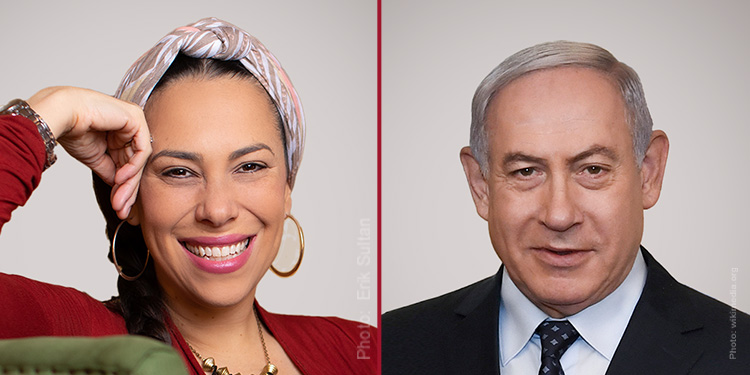
Netanyahu shares with Yael his ideas on living a life with purpose and vision, and about the people who encouraged him to do that.
Yael Eckstein, IFCJ President and CEO, oversees all ministry programs and serves as the international spokesperson for the organization.
Prior to her present duties, Yael served as Global Executive Vice President, Senior Vice President, and Director of Program Development and Ministry Outreach. Based in Israel with her husband and their four children, Yael is a published writer and a respected social services professional.
Yael Eckstein has contributed to The Jerusalem Post, The Times of Israel, and other publications, and is the author of three books: Generation to Generation: Passing on a Legacy of Faith to Our Children, Holy Land Reflections: A Collection of Inspirational Insights from Israel, and Spiritual Cooking with Yael. In addition, her insights into life in Israel, the Jewish faith, and Jewish-Christian relations can be heard on The Fellowship’s radio programs.
Yael Eckstein has partnered with other global organizations, appeared on national television, and visited with U.S. and world leaders on issues of shared concern. She has been a featured guest on CBN’s The 700 Club with Gordon Robertson, and she served on a Religious Liberty Panel on Capitol Hill in May 2015 in Washington, D.C., discussing religious persecution in the Middle East. Her influence as one of the young leaders in Israel has been recognized with her inclusion in The Jerusalem Post’s 50 Most Influential Jews of 2020 and 2021, and The Algemeiner’s Jewish 100 of 2019. She was also featured as the cover story of Nashim (Women) magazine in May 2015.
Related stories
Born in Evanston, Illinois, outside of Chicago, and well-educated at both American and Israeli institutions – including biblical studies at Torat Chesed Seminary in Israel, Jewish and sociology studies at Queens College in New York, and additional study at Hebrew University in Jerusalem – Yael Eckstein has also been a Hebrew and Jewish Studies teacher in the United States.
On her podcast, Conversations with Yael, Yael Eckstein speaks with Benjamin Netanyahu, Israel’s Prime Minister. Benjamin Netanyahu shares with Yael his ideas on living a life with purpose and vision, and about the people who encouraged him to do that. He also shares his thoughts on the historic relationship between Christians and Jews and the role this friendship has played in the founding of the Jewish State, as well as the long-standing bond between Israel and the United States.
Can you introduce your guest, Benjamin Netanyahu?
YE: My guest today needs no introduction, other than his name. I am so proud and honored beyond words to have on the podcast Benjamin “Bibi” Netanyahu, the newly elected Prime Minister of Israel. As Israel's longest-serving Prime Minister, Benjamin Netanyahu has served the country and the people he loves for his entire adult life. He was the first Prime Minister to have been born in Israel after it declared independence in 1948, and he proudly served from 1967 to 1972 in the Elite Special Forces Unit of the IDF (the Israel Defense Forces), known as The Unit. A graduate of MIT, he was appointed as Israel's ambassador to the UN from 1984 to 1988, and then was elected to Parliament as a member of the Likud party in 1988, launching his resilient political career. He served as Prime Minister from 1996 to 1999, and from 2009 to 2021. He has worked with three U.S. Presidents and in 2020 led the brokering of one of the most groundbreaking peace agreements with four of Israel's Arab neighbors: the historic Abraham Accords.
What should readers of Prime Minister Benjamin Netanyahu’s memoir, titled “Bibi,” take away from it?
BN: I describe the transformation of Israel under the success of governments that I led, from a 70s socialist economy to a free market economy. From an isolated country to a country that accomplished four historic peace agreements with four Arab countries recently. That says that if Israel, if the Jewish people can forge this raging river between virtual annihilation and salvation, then there's hope for all humanity, for all people. I think that's what people glean in Israel. The inspiration for the realization of, frankly, biblical prophecy, the ingathering of the exiles, and the rebirth of Israel. This is something that is an inspiring story for everyone. I weave my own personal story as a soldier in a special unit, as a diplomat, as a statesman, and as a political leader, with the story of Israel. I think people will glean a lot of insights from it, and for my own life, which is a life of purpose. The purpose was how to assure the security, prosperity, and permanence of the one and only Jewish state. If you're looking for a life of purpose, I think you'll glean a lot of insight from my book.
Could you tell us a little bit about your secret of how you somehow managed to get along, inspire, and create effective strategic relationships with such diverse leaders?
BN: Well, first of all, we have to understand that the alliance between America and Israel is first an alliance between peoples. The overwhelming majority of Americans see Israel, really as a forward bastion of Western civilization in the heart of the Middle East. They see it not merely in terms of national interest, but in terms of common interests and common values. This is the original promised land. America was created as the new promised land, the new Jerusalem. Well, I'm speaking to you from the original Jerusalem right now, from our Knesset, our parliament. That is something that creates a bond that I would say is above and below everything. It is the connecting glue.
When I had arguments, and I did... I had differences of opinion with American presidents, that's inevitable. But as we say, it was arguments in the family. You have arguments in your family, right? You do, but it's in the family. It doesn't shatter these powerful bonds. But when I needed to take a stand on things that I thought would endanger the survival of Israel, I did it, including on the dangerous Iran deal. I didn't lightheartedly go to a joint session of Congress, challenging President Obama's position favoring this deal, which I thought would pave Iran's path with gold to a nuclear arsenal. I thought about it a lot, and I described my dilemma because I respected President Obama, even though I disagreed with him, and it wasn't a simple thing to go into the lion's den, but I did it because I thought the survival and future of my country was at stake. There have been periods of disagreement, areas of disagreement, but there is an area of agreement of a common bond of values and also of interests.
Israel provides enormous intelligence to America. It saved many American lives, and by the way, the lives of the citizens of many nations against terrorist attacks, dozens and dozens of terrorist attacks. Israel also is the bulwark in the Middle East that prevents Iran, that chants of death to Israel and death to America, where the small Satan is their way to the great Satan, which is the United States. Israel holds the Middle East together. Without Israel, the Middle East would've collapsed to Iranian aggression. There is a bond of values and a bond of interest, and Americans and American presidents recognize that. That's how you overcome things.
YE: World leaders are people too, with real relationships, but a deeper interest that's not only for yourself but for your entire country, and every relationship is deeply rooted in that.
What leaders in modern times have inspired you most?
BN: The one that inspired me most was our modern Moses. The man who, like Moses, opened the gates, and opened the idea of a Jewish state for the Jewish people, was Theodor Herzl, who 120 years ago, envisioned the Jewish state when people thought he was mad. He said that the Jewish people have to come out of bondage. Modern Egypt was Europe, which was going to be overtaken by the forces of antisemitism, Nazism. He saw that in his mind's eye and he said, there's only one solution. We have to create a Jewish state as a safe haven for millions of Jews.
Well, Herzl died too early. He died when he was 44 in 1904. The Holocaust that he predicted would happen, did happen, but somehow we had created enough of a bridgehead in our ancestral homeland to be able to take in the remnants after this horrible mass murder and created what is now ranked as the eighth most powerful state in the world, and we're 1/10 of 1% of the world's population, and yet the University of Pennsylvania annually surveys 17,000 people, opinion leaders in 20 countries, and they consistently rank tiny Israel as the eighth most powerful country in the world. You can explain that. You can do that with a lot of things; our ingenuity, our innovations, our incredibly courageous army, but I think it goes deeper than that. I think it's our faith, our confidence that we are realizing the dream of ages, and that we are bonded by the rebirth, this miraculous rebirth of the Jewish state, and that we're not going to let anyone, not least these Ayatollahs, to bring this to an end. They may come to an end, but we won't.
YE: I love the piece of data that you brought in that we are one of the most powerful because I think coupled with the other statistic that I love, that we're also one of the happiest people, is a real key to everything that you've been saying about when you're deeply rooted in faith, and values, and survival, and both having that human connection, that brotherhood, but also not losing sight of the larger picture that we are fighting for our survival every day. It leads to a life of purpose. So we’re powerful and influential, and we're also happy people.
What advice do you think your father would tell you if he was alive today?
BN: I once told my father I intend to run for Prime Minister. He was a great historian of the Jewish people and a great historian period. So I asked him, "What do you think, father, is the most important quality that a Prime Minister of Israel should have?" He asked me, "Well, what do you think?" I said, "You'll have to have a clear vision of what you want to achieve for the country, and you have to have both the resoluteness to pursue it, but also the flexibility to navigate through the shoals and rapids of political life."
He said, "Well, that's true of any leader. If you are a dean of a university, or if you're a head of a company or even a military leader, they'd give the same answer." So I said, "So what is it that you think is important?" He answered with one word, which initially stunned me because I thought, well, that's what he said. He said, "What you have to have is a broad and deep education." When he said that, he meant that you not only have to be grounded in economic affairs or military affairs, but you really need to have three things that you have to know. It's history, history, and history. Because if you don't understand how he got here, you're not going to understand how we go forward. But in our case, history, history, history begins with three words, Bible, Bible, Bible.
There's no meaning to the Jewish people without the Bible. There's no meaning to our future without our past. I think that's what my father instilled in me and in my older brother, my younger brother, for that matter too. It is the Jewish heritage, the heritage of the Bible that informs everything that we're doing today in the modern world. Theodore Herzl, our modern Moses, wrote a book he called, Old New Land. We're an old land. We're an ancient people, thousands of years old, and yet we seize the future. It's the combination. It's the roots and the branches that make Israel so unique and such an inspiring model for millions and millions of people around the world.
Do you have any advice on how we can engage the next generation of Christians, to have them be as inspired and passionate about standing shoulder-to-shoulder with their Jewish brothers and sisters as their parents and grandparents have been?
BN: Well, I think the best thing is to get them to come here because once they come here, I think they're astounded because all the places they read in the Old Testament, in the Gospels, I mean, it's real places. They're here. It all happened here. I'm about a kilometer away, less than a mile away maybe, from the Temple Mount where Jesus turned the money tables of the money changers. Nazareth and Bethlehem are right here. These are real places. The Sea of Galilee, real places. When they come here and they see where Christianity originated from, the common roots with Judaism, that bond is strengthened. So number one, if you can come here and walk in the footsteps of Jesus, that is no small experience if you are a Christian. Quite apart from anything, take part. Take part in communal organizations in the churches and the congregations of the Christian believers who are exposed to Israeli visitors, and I hope also, to this broadcast. One other way is to read my book. You'll see a lot of references to Christian communities. I always say that I think my Christian friends are astounded when they come here. I like to send them to places where they actually walk in the footsteps of Jesus, in places that are categorical that he was there. There's no question about it. We know that for a fact. It's just coming here and discovering this old, new land that has so many common roots with the people in America and elsewhere around the world. I think that's the best connection that I could offer.
Can you share with us a scripture that's your go-to verse for encouragement and inspiration?

BN: Well, I end my book with a phrase from Samuel II. I think it's in the second book of Samuel that says, "The eternity of Israel shall not falter," which means that the people of Israel live. Despite the Holocaust, the pogroms, the exile, the displacement, and the horrors that were directed against our people, the ancient prophecies materialized. We came back to our land, reestablished our one and only Jewish state, and turned it into an amazing dream realized, and it tells me that sentence, that phrase in Samuel, was right. It didn't falter.
Comments

Powered by RoundtableAn AI/DeFi-powered Enterprise Media Operating System. Learn more at Roundtable.io.© Roundtable 2026. By using this site you agree to the Terms of Use and Privacy Policy