


Apr 15, 2023 7:00 AM
Updated Apr 19, 2023 3:39 PM
Mining bitcoin (and other cryptocurrencies) consumes the same amount of energy in a year as whole nations.
How can we move forward if we don't address the issues that are holding us back? Bitcoin irrevocably altered the financial and technological landscapes. It can make significant changes by introducing DeFi (decentralized finance).
However, mining bitcoin (and other cryptocurrencies) consumes the same amount of energy in a year as whole nations.
Crypto skeptics see this as very reckless and wasteful, contributing to ethical and security problems.
Rapid technological advancements seem to leave such big carbon footprints. Will this undermine governments' and organizations' attempts to become green? To discover fundamental difficulties, we must first analyze the underlying causes.
Related stories
In this post, we'll look at how much energy is used as a result of bitcoin and why: https://the-newsspy.org/
How Does Bitcoin Make Use of Energy?
It could be hard to comprehend how something without a visible representation can use so many resources. The "new gold rush" is another name for this.
The Bitcoin network relies on thousands of miners running power-hungry equipment constantly to confirm and add transactions to the blockchain. "Proof-of-work" is what this is known as.
The quantity of miners that are online on the network at any one time controls how much energy Bitcoin uses.
These miners must compete to be the first to add the next block to the blockchain and collect incentives unless they want to lose money on equipment maintenance and energy bills, which will force them to search for emergency cash immediately bad credit in the search bar.
The competitive structure wastes a lot of energy since every 10 minutes, only one miner may add a new block.
To maintain a competitive advantage over other miners, many larger firms are being driven to scale up or enhance their equipment.
As a result, there are now dozens of mining operations throughout the world, with hundreds, if not thousands, of rigs always in operation.
One of the byproducts of these large-scale operations is heat. ASIC miners, the most popular kind of specialized computer equipment used for cryptocurrency mining, create a lot of heat while performing hashing operations and must be kept cool to prevent becoming less efficient or burning out.
Smaller operations may just need fans and a chilly environment to keep temperatures under control, but larger mining operations may require industrial-style cooling systems. This increases the amount of energy consumed even further.
How Much Energy is Required for Mining?
According to the Digiconomist's Bitcoin Energy Consumption Index, one bitcoin transaction consumes 2,188 kWh or the equivalent of about 75 days of electricity for the typical US family.
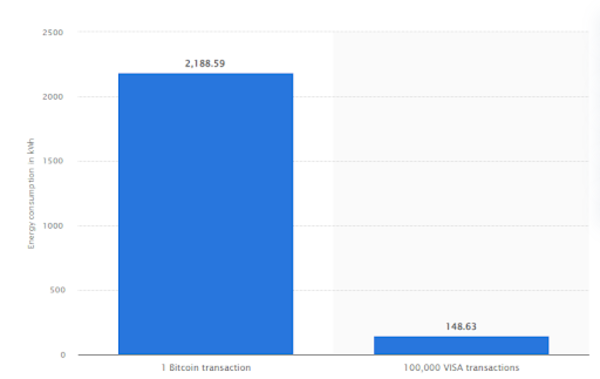
Bitcoin average energy consumption per transaction compared to that of VISA as of April 25, 2022
The average price per kWh in the United States is close to 12 cents. That indicates that a bitcoin transaction would result in a $262 energy bill.
According to the Bitcoin Energy Consumption Index, bitcoin mining consumes almost the same amount of energy as Argentina, and at that yearly level of 131.26 terawatt-hours, crypto mining would rank in the top 30 nations in terms of energy consumption.
Bitcoin mining used the most energy towards the end of 2021 and the beginning of 2022, using more than 200 terawatt-hours.
It is anticipated that cryptocurrencies used 70-90 TWh of power worldwide in 2019, with Bitcoin mining accounting for 60-70 TWh of it.
In contrast, in 2020, all data centers globally utilized between 196 and 400 TWh of energy (although the latter figure includes some crypto).
These figures, however, are very speculative. Some estimate a range of 60 TWh - 204 TWh for Bitcoin and 17 TWh - 105 TWh for Ethereum (as of April 2022), although there are hundreds of crypto assets with varying energy characteristics.
According to the analysis of these other assets, Bitcoin accounts for 66% of all crypto-related energy consumption, with the difference in energy usage relating to whether the hashing algorithm can be operated on specialized equipment or not.
The Environmental Effect of Bitcoin
While the mining industry is moving toward greener energy, a considerable percentage of the Bitcoin network's electricity is still derived from nonrenewable sources, such as coal-burning power plants.
It is commonly established that burning fossil fuels such as coal emit massive quantities of carbon dioxide into the atmosphere, which is the primary cause of climate change.
That is the more mining machines that join the network, the greater the need for energy creation and consumption.
Energy use on its own is neither helpful nor detrimental to the environment. Bitcoin's power use does not reveal anything about its carbon impact.
There is no question that bitcoin miners use a lot of power. However, to comprehend the environmental effect, information on where miners get their energy is required.
Bitcoin does not generate additional carbon emissions since it may be powered by any source of energy.
According to Cambridge, 62% of worldwide miners use hydropower for at least part of their energy; 38% use coal; and 39% use a mix of solar, wind, and geothermal.
However, it is crucial to remember that these figures are all educated estimations based on a variety of assumptions and are subject to seasonal and bitcoin price fluctuations.
Conclusion
We already generate a lot of electricity, which powers our laptops and other smart gadgets. It is difficult to avoid being entirely responsible for the harm caused by fossil fuels. Going green needs more than individual solutions.
Bitcoin, like practically anything else in our society that provides value, consumes resources.

The crypto community must understand and solve these environmental issues, rigorously fight to lower Bitcoin's carbon footprint, and eventually show that the social value Bitcoin delivers is worth the resources needed to support it, just like any other energy-intensive enterprise.
Comments

Powered by RoundtableAn AI/DeFi-powered Enterprise Media Operating System. Learn more at Roundtable.io.© Roundtable 2026. By using this site you agree to the Terms of Use and Privacy Policy