



Mar 8, 2023 8:00 AM
Updated Mar 9, 2023 5:07 PM
Description: Let’s consider the importance of HIE software in modern clinics and its prospects.
The Importance of Health Information Exchange Software in Modern Healthcare
Imagine a disoriented elderly woman admitted to an emergency room. She does not understand where she is and cannot answer simple questions about her health. There is no accompanying person and no phone to contact her relatives. How do doctors find out if the patient is allergic to certain drugs, has chronic diseases, and what medications she regularly takes? Without relevant information, they would rather hurt the woman than cure her. However, if the hospital possesses a health information exchange platform (HIE), this problem can be easily solved. What is HIE software, and why is it so important for modern healthcare facilities?
HIE Software: fast and secure exchange of patient data
Healthcare is an industry with massive amounts of data growing exponentially. In 2013, it generated 153 exabytes of data, in 2020, it amounted to 2314 exabytes. The data flow will keep on growing. According to RBC Capital Markets, by 2025, medical data will account for 36% of the global volume.
Healthcare faces the challenge of collecting, storing, and sharing patient information securely. In the digital age, this is essential for the stable operation of medical institutions. And this allows healthcare professionals to improve services by offering personalized care. Data transmission by fax or email no longer meets modern requirements for efficiency, so clinics and hospitals are trying to join HIE platforms.
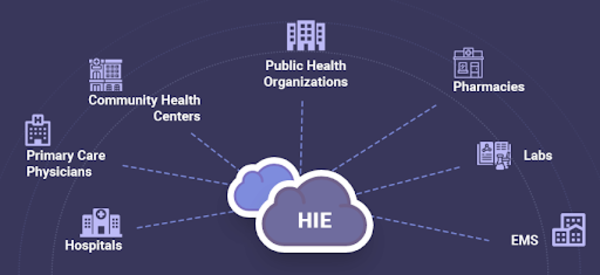
The term “health information exchange” refers to software solutions that collect and transfer information between users and apps. HIE data comes from hospitals, home care facilities, EMSs, pharmacies, research labs, and more. HIE collects various patient data “under the same roof”, from allergies and medications to physiological parameters and demographic information.
Related stories
HIE software contains data from EHRs/EMRs, clinical notification services, PDMPs, predictive analytics, and other sources. These data are common to the medical systems of separate regions and unite all participants in a medical community. Thus, doctors, nurses, pharmacists, and patients can easily, quickly, and securely exchange information online.

HIE architecture: the peculiarities of information exchange
Innovative HIE software solutions provide the medical community with quality data for better care coordination. There are three forms of information exchange within an HIE system:
- Request-based exchange. A doctor receives information after requesting it. For example, when a tourist from another country is admitted to a hospital, medical workers need to inquire about relevant health data from their attending physician.
- Consumer exchange. There is an intermediary in an HIE system. A patient controls data transfer themselves, tracks their medical care, and gives doctors access to personal information.
- Direct exchange. This process goes without intermediaries and means round-the-clock secure access of providers to patient data. For example, two medical providers trust each other and send encrypted information via email.
HIE solutions vary in infrastructure models that also define how data is stored and transferred. In a centralized model, data is in a common repository, and healthcare providers can access it. In a decentralized model, data is stored by a medical facility, and the clinic agrees to share the information it possesses with other healthcare providers such as Andersen. A hybrid model is a combination of the first two: some data is in a shared repository, and some must be requested through a record lookup service.
There has emerged a new technology. Blockchain can solve the shortcomings of the three models described above. Experts consider it a safer and more efficient way to exchange data on a network because of decentralization, hashing, and a powerful consensus mechanism.
Benefits of HIE platforms for the healthcare sector
Seamless sharing of medical data means improved collaboration between clinics and hospitals in delivering first aid. HIE software ensures that every healthcare professional involved in patient care works with the same information. And this means fewer errors in the diagnosis and treatment of patients. In addition to this obvious advantage, there are others:
- Less paperwork. Clinical information is recorded electronically, so doctors do not need to spend time filling out paper documents. It also means that data can be sent faster by request than by fax.
- Instant first aid. Physicians do not have to wait until a service provider sends the data they need for treatment (laboratory results, medical history, information about allergies, and so on). When a patient is admitted to an emergency department, doctors quickly turn to HIE software to help the patient in time and reduce the risk of complications.
- Elimination of unnecessary tests. According to the requested information, a doctor determines whether a patient has undergone any examination lately. This is important so as not to prescribe the same procedure repeatedly and not waste time treating a disease.
- Fewer expenses. Patients don’t have to undergo repeated examinations, and documentation is kept electronically. All this is a significant saving for healthcare. The National Academy of Medicine estimates that the cost of unnecessary tests and services means a loss of about $765 billion a year. And this is a quarter of the amount spent on healthcare annually.
- More opportunities. HIE Software improves the quality of medical services, supports people with HIV, provides data for emergency patient search, and allows epidemic detection.
What holds back the widespread use of HIE
The main obstacle to implementing HIE software is the risk of violating the confidentiality of patient data. Organizations using HIE systems must comply with national data protection laws. It is impossible to guarantee 100% protection with a continuous flow of information. Therefore, organizations prefer to keep data inside as it is easier to protect it.
Furthermore, the spread of HIE solutions is hindered by:
- Lack of standards. Common standards are needed to ensure that physicians receive complete information. For example, some HIE systems may classify allergies as a disease, while others classify them as a side effect. This disparity in reporting creates risks. A doctor runs the risk of missing important information and mistakenly prescribing a drug, which leads to a patient developing an allergic reaction. It is critical that HIE solutions maintain standards regarding transport, content, and media types.
- Different privacy laws. Different states and countries have different privacy laws. Accordingly, it is difficult to organize data exchange considering the existing conditions and restrictions. In addition, some data (psychiatric information, HIV test results, surrogate motherhood, and others) is considered top secret and is not displayed in a general database.
- Difficulties in matching patients with their medical records. Patients need additional identification because there are people with the same first name, last name, year of birth, and place of residence. Accordingly, if you mix up medical records, you can seriously harm a person.
- Incomplete HIE information. Some information exchange systems include a final document without details about a patient's health. Such gaps hinder high-quality and prompt treatment.
- Patients’ reluctance to share personal information. A recent survey conducted by the University of Pennsylvania shows that only 13.3% of people are willing to share personal health information. The rest are either not sure about the possibility of sharing or are not ready to do this. The more patients loyal to HIE software there are, the greater the chances for healthcare development. A Statista poll shows optimistic results: more than 60% of Americans are ready to transfer their data to professionals for good purposes.
However, organizations manage to overcome these barriers. As Grand View Research predicts that by 2025, the global market for health information exchange will amount to $2,427.7 million, with an annual growth of 9.4%.
Conclusion

HIE software is making the healthcare industry advance and bringing humanity closer to precision medicine. HIE solutions improve the quality of medical services and reduce the gap between patients and doctors. As this format of digital medicine becomes popular, healthcare can become more efficient, safer, and less costly.
Comments

Powered by RoundtableAn AI/DeFi-powered Enterprise Media Operating System. Learn more at Roundtable.io.© Roundtable 2026. By using this site you agree to the Terms of Use and Privacy Policy