


Dec 10, 2025 8:00 AM
Updated Dec 14, 2025 12:45 AM
Across the United States, civic leaders, developers, and residents are rethinking what it means to build cities for the future and redefining metrics of urban success using data, equity, and long-term resilience.
For decades, growth and inclusivity were often treated as opposing forces. Cities that expanded rapidly tended to see rising rents, declining affordability, and widening social gaps. In 2025, however, a new model of urban development is emerging—one that proves economic progress and community-centered planning can reinforce each other instead of collide. Across the United States, civic leaders, developers, and residents are rethinking what it means to build cities for the future and redefining metrics of urban success using data, equity, and long-term resilience.
The five cities highlighted here—Las Vegas, Austin, Denver, Minneapolis, and San Diego—are demonstrating how sustainability, affordability, and opportunity can coexist within vibrant, growing metropolitan areas. Their strategies vary, but the underlying principle is the same: equitable growth is not only possible, it is increasingly essential. These cities show that when inclusivity becomes part of the blueprint, the result is stronger economies, healthier neighborhoods, and measurable improvements in quality of life supported by hard numbers rather than optimistic slogans.
1. Las Vegas, Nevada — From Boomtown to Balanced City
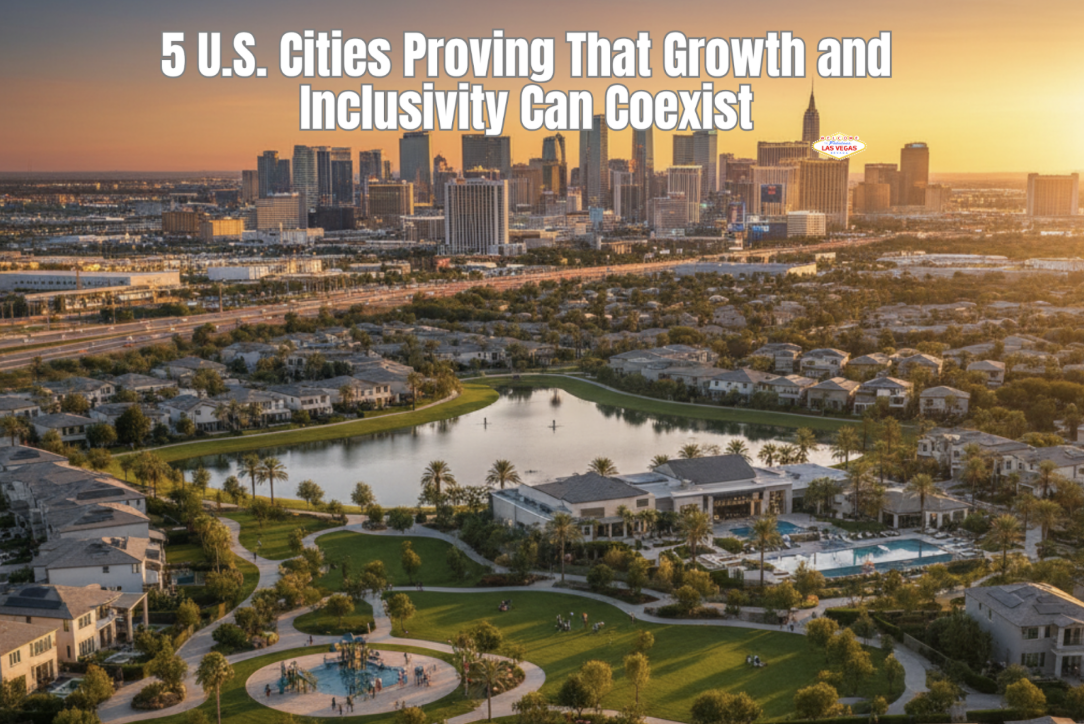
Las Vegas has undergone one of the most compelling transformations in modern urban America. While it remains globally known for entertainment and hospitality, the real story is happening off the Strip, where new master-planned communities, green infrastructure, and mixed-income housing developments are reshaping the region. Areas such as Summerlin, Henderson, and homes for sale Lake Las Vegas have introduced walkable communities, renewable energy systems, and zoning that emphasizes long-term stability. For example, one in three new residential projects in Clark County now incorporates green design standards.
Economic diversification has also been fundamental. Las Vegas added thousands of jobs in technology, healthcare, logistics, and film production between 2022 and 2025, reducing its long-standing dependency on casino tourism. The population grew 2.3% in 2024—steady, sustainable expansion rather than an overheated surge. The region has also risen into the top ten U.S. metros for minority-owned startups, illustrating a broader ecosystem of inclusion. With Nevada’s zero state income tax and an expanding clean-energy sector, Las Vegas is demonstrating that cities can grow quickly without pushing residents out.
Related stories
Inclusive Growth Highlights
- 2.3% population growth in 2024
- Workforce diversification across five major industries
- One in three new residential projects includes green design
- Top ten U.S. metro for minority-owned businesses
2. Austin, Texas — Creativity as a Common Good
Austin’s creative identity has long set it apart, but a decade of tech-driven population growth—nearly 30% in ten years—brought pressure on affordability and cultural preservation. In response, the city created programs designed specifically to stabilize cost-burdened workers and protect local character. The Austin Housing Conservancy Fund purchases multifamily buildings to preserve affordability, while the city’s Complete Communities initiative strengthens transit-oriented districts where housing, jobs, and services grow together. Since 2022, more than $350 million has been committed to housing affordability, signaling a deliberate shift in how Austin manages rapid growth.
What makes Austin notable is that inclusivity isn’t treated as an economic casualty—it is treated as a competitive advantage. The city plans for 10% of its entire housing stock to be permanently affordable by 2030, one of the most ambitious affordability goals in the nation. Public art, small-business corridors, music heritage districts, and community markets continue to anchor local identity even as global companies like Tesla, Apple, and Oracle expand operations. Mobility improvements, including electric bus networks and shared micromobility, further support residents across income ranges.
Inclusive Growth Highlights
- $350 million invested in affordable housing since 2022
- Target: 10% permanently affordable housing by 2030
- Expanding mobility through electric buses and micromobility
3. Denver, Colorado — Building Sustainability from the Ground Up
Denver has emerged as a national model for sustainable and equitable development. The city’s Affordable Housing Fund, launched in 2016, has produced more than 5,000 below-market units and continues to grow. Its policy incentives encourage developers to include affordable units in high-end projects, creating intentionally mixed-income communities. This strategy has made a measurable impact: one in four new homes is reserved for middle-income buyers, helping stabilize a population whose median household income now sits at $93,000.
Denver’s dedication to sustainability is equally significant. More than 60% of new multifamily construction in 2025 meets LEED or WELL standards, and 40% of all new housing permits include sustainable design. Renewable energy is also expanding, with 15% of total city energy now sourced from solar or wind power. Green infrastructure investments—especially in historically underinvested neighborhoods—ensure that environmental progress does not concentrate benefits only in affluent sectors of the city. Denver’s policies show that environmental resilience and social equity can advance together.
Inclusive Growth Highlights
- $93,000 median household income; one in four new homes reserved for middle-income buyers
- 40% of new housing permits include sustainable design
- 15% of total city energy sourced from solar or wind
4. Minneapolis, Minnesota — Zoning Reform for the People
Minneapolis has taken some of the most ambitious steps toward equitable housing of any major U.S. city. In 2020, it eliminated exclusive single-family zoning, allowing duplexes and triplexes in neighborhoods previously restricted to detached homes. This shift dramatically increased the housing pipeline: more than 5,000 permits for small multi-unit buildings have been issued since the reform. The result is a measurable rise in affordability and access, with median rent growth staying below 2%—far lower than the national average of 5%.
Reform did not stop with zoning. Minneapolis paired these changes with climate-conscious incentives, including rebates for energy-efficient retrofits and policies that encourage transit-oriented development. These efforts have sparked an 18% increase in minority-owned developer participation, expanding opportunity for groups historically excluded from real estate investment. By aligning zoning, sustainability, and equity, Minneapolis proves that well-designed policy can generate broad community benefit—and real numbers to back it up.
Inclusive Growth Highlights
- Median rent growth below 2% (vs. 5% national average)
- Over 1,200 affordable units created via duplex/triplex conversion
- 18% increase in minority-owned developer participation
5. San Diego, California — Wellness and Access in Balance
San Diego continues to redefine inclusive coastal living by combining ambitious policy with practical implementation. Its Housing First Collaborative has become a statewide model, pairing housing with wraparound services to reduce homelessness. Meanwhile, a $3 billion affordable housing bond is underway to support long-term development across multiple income brackets. Mixed-use zoning reforms ensure that high-value neighborhoods incorporate affordable units rather than pushing lower-income residents to the periphery.
Sustainability is equally central to San Diego’s vision. The city reached 50% renewable electricity usage in 2024 and is on track for 100% by 2035. This transition reduces energy costs over time and improves long-term climate resilience. Public-access initiatives—from free beach shuttles to expansive urban tree planting—reaffirm that inclusivity is not limited to housing but extends to the ability of all residents to enjoy the region’s natural assets. San Diego’s strategy shows how public health, environmental well-being, and affordability intersect.
Inclusive Growth Highlights
- $3 billion affordable housing bond in progress
- 50% renewable electricity milestone reached in 2024
- Annual rent growth capped at 6% citywide
A Progressive Vision for Urban America
The evolution of these five cities reflects a broader cultural shift in how Americans define progress. Urban success is no longer measured solely by skyline height or corporate relocations but by whether a city provides access to jobs, housing, transit, and public space for residents of all income levels. Metrics like affordability ratios, renewable-energy usage, mixed-income permits, and minority-owned startup rates are becoming the new markers of civic health. This shift represents a move away from winner-take-all growth toward inclusive, data-driven planning.
And while cities like Las Vegas continue to attract global investors — from high-rise buyers browsing Palms Place condos for sale to relocation families exploring homes for sale in Lake Las Vegas — the deeper narrative is about evolution. Las Vegas, once defined almost entirely by entertainment, is now investing heavily in sustainability, master-planned communities, and opportunities for long-term residents. It’s proof that a city can reinvent itself without losing its identity — and that economic ambition can coexist with inclusivity.
Around the country, similar practices are emerging. Cities are adding affordability requirements to luxury developments, aligning public and private capital to build mixed-income districts, and rewriting zoning codes to remove decades-old barriers. Environmental resilience planning is being tied directly to housing and transportation policy. Public engagement—once an afterthought—is becoming a prerequisite. These trends are early indicators of a national realignment toward long-term, people-first urban development.
Comments

Powered by RoundtableAn AI/DeFi-powered Enterprise Media Operating System. Learn more at Roundtable.io.© Roundtable 2026. By using this site you agree to the Terms of Use and Privacy Policy