


Mar 26, 2026 7:00 AM
Updated Mar 30, 2026 11:41 PM
Find the most commanding creature you can imagine, then station it between yourself and whatever might come through the door.
The Great Sphinx has watched the sunrise over Giza for roughly 4,500 years. Three thousand miles east, a pair of five-legged creatures once flanked the gates of an Assyrian palace. Another 4,000 miles beyond that, stone lions appeared at Han Dynasty temples — in a country where no wild lion had ever lived.
Guardian lions are one of archaeology's strangest recurring patterns. Cultures separated by entire oceans, unrelated languages, and thousands of years all arrived at the same conclusion: put a lion at the threshold. Not a bear. Not an eagle or a wolf. A lion — even in places where nobody had ever seen one in the flesh.
Six civilizations. Zero coordination. The same animal every time. What drove that?
The Oldest Threshold Guardians Had Wings
Related stories
Mesopotamia produced the first known lion guardians around 3000 BCE. The Assyrians shaped them into monumental guardian sculptures called lamassu — hybrid creatures with a human head, eagle wings, and the body of a lion or bull. Some stood over 4 meters tall and weighed more than 40 tons. They flanked the narrow gateways of citadels and royal palaces, positioned exactly where an invading force would funnel into a chokepoint.
The psychological message was inseparable from the architecture. Cross this threshold and you enter a king's domain. The power behind these walls is not entirely human.
Five Legs and an Optical Illusion
Face a lamassu head-on and you count two legs, planted firmly. Step to the side and four legs suddenly appear, caught mid-stride. Assyrian sculptors carved five legs into each figure — a deliberate trick that made the guardian appear both standing still and advancing toward you, depending on your angle. That level of engineering for a single statue tells you how seriously Mesopotamians treated their threshold protectors.
And lamassu weren't reserved for royalty. Ordinary families engraved lamassu images on small clay tablets and buried them beneath their doorsteps. A home with a lamassu under the threshold was considered safer and happier than one without. The guardian instinct scaled down from 40-ton citadel sculptures to palm-sized household charms — without losing any of its meaning.
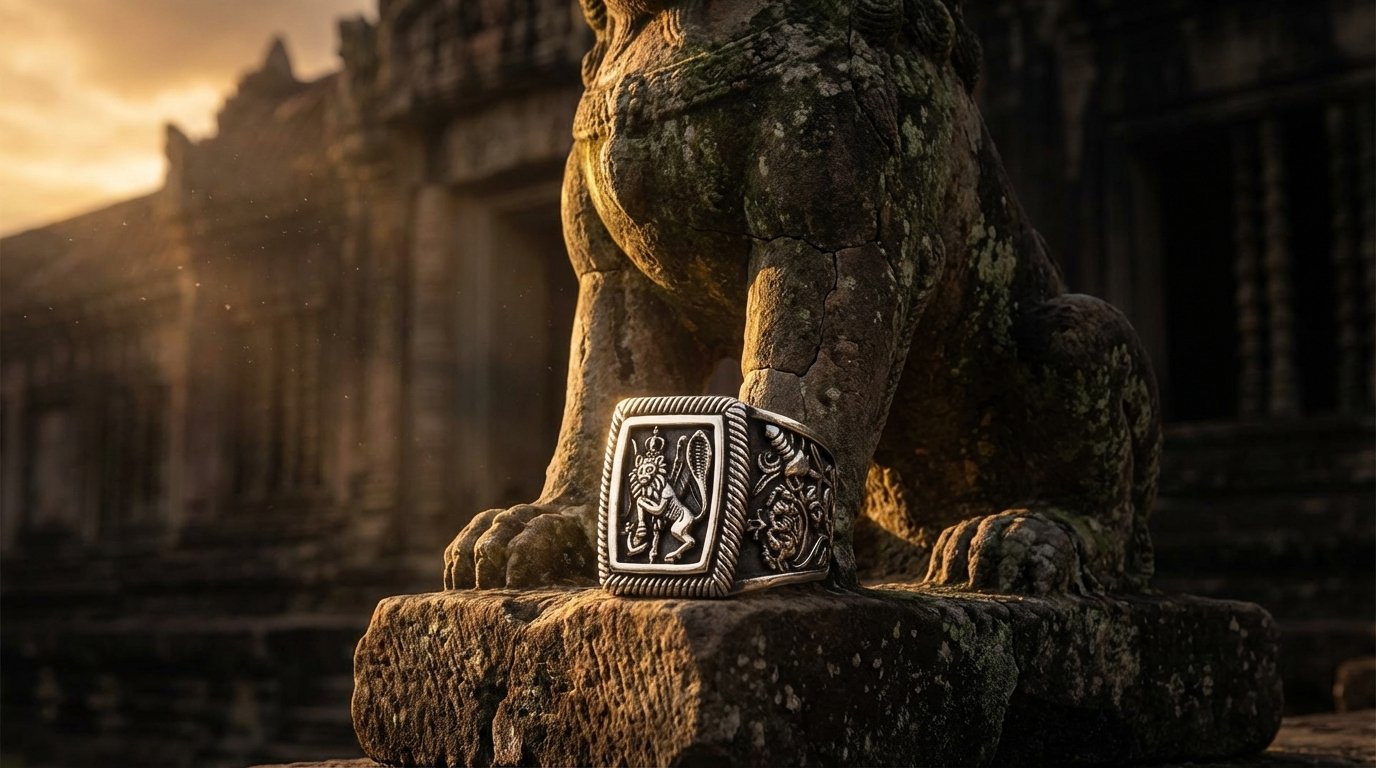
The same instinct that drove Mesopotamians to carve 40-ton guardians now fits on a single finger — lion symbolism scaled from citadel gates to sterling silver.
Egypt's Sphinx Guarded Knowledge, Not Treasure
Egypt took a different approach. The sphinx — a lion's body joined to a pharaoh's head — merged raw animal power with human intelligence. The Great Sphinx of Giza, carved around 2500 BCE, faces due east toward the rising sun. It aligned with the Egyptian solar cult, where lions were sacred to the sun god Ra.
But the sphinx's real job wasn't protecting gold or tombs. Ancient texts describe sphinxes lining temple approaches "to warn those who penetrated within that they should conceal knowledge of them from the uninitiated." The lion body at the door didn't say keep out. It said something more pointed: you're not ready for what's inside.
The commitment to this concept was enormous. The Avenue of Sphinxes at Luxor once stretched nearly 3 kilometers — over 1,000 statues forming an unbroken processional corridor between Karnak and Luxor Temples. Pharaohs had their own faces carved onto sphinx bodies, fusing their personal identity with the lion's protective power.
Meanwhile, the lioness goddess Sekhmet — depicted with a woman's body and a lion's head — ranked as the most feared deity in the Egyptian pantheon. She could bring plague, fire, and destruction on the pharaoh's enemies without warning.
How Lions Conquered Asia Without Ever Living There
This is where the pattern turns genuinely strange. Lions are not native to China. No wild lion has ever roamed Chinese territory. Yet by the Han Dynasty (206 BCE – 220 CE), stone lions were already standing guard at palace gates and Buddhist temples across the empire.
They arrived on the Silk Road — not as living animals, but as pelts, diplomatic gifts, stories, and artistic concepts carried by traders from Persia and Central Asia. When Buddhism spread from India to China during the same era, it carried the lion as a spiritual symbol. In Buddhist teaching, the lion represents the Buddha's voice — powerful enough to silence every other creature in the room.
A guardian lion in miniature — the shield ring sits alongside a traditional bronze foo dog, connecting jewelry craft to centuries of Eastern protective symbolism.
Chinese artisans transformed these secondhand descriptions into something entirely their own. The resulting guardian lions look almost nothing like actual lions — bulging eyes, spiral manes, exaggerated musculature. These were architectural creatures, not zoological ones. By the Ming Dynasty, imperial regulations dictated the exact number of bumps on each lion's mane according to the building's rank. Thirteen bumps meant an imperial palace. Twelve, a first-rank prince. A temple with the wrong count risked an accusation of sedition.
The scale of production was staggering. Beijing's Forbidden City alone has over 60 stone guardian lions positioned at gates, bridges, and courtyard entrances. The Lugou Bridge — built in 1189 — carries 501 individually carved lion statues, each with a different expression. Marco Polo called it the finest bridge in the world when he crossed it in the 13th century. No other guardian tradition produced anything at that density.
The symbol kept traveling east. Japan, Korea, Thailand, Myanmar, Cambodia — every culture along the transmission route adapted the lion to local aesthetics. Thai singha sprouted wings and serpentine features. Cambodian lions at Angkor Wat became squat and heavily stylized. The Okinawan shisa merged the lion with local protective spirits. Each adaptation looked less like an actual lion and more like the culture that sculpted it — but the placement at gates and thresholds never changed.
Guardian lion statues still stand at Buddhist temples, royal palaces, and government buildings across Southeast Asia today. Bikerringshop's guide to lion symbolism in jewelry traces how this same protective instinct eventually moved from architectural stone into personal adornment — a thread running unbroken from Silk Road carvings to modern rings.
From Babylon to Bangkok — six thousand years apart, the function never changed. Only the face did.
Venice Gave the Lion Wings
European guardian lions followed a completely different evolutionary path. Rather than protecting sacred thresholds, they became instruments of political identity and territorial power.
The most dramatic transformation happened in Venice. After the city acquired Saint Mark's relics from Alexandria in the 9th century, a winged lion holding an open book became the republic's official emblem. The book carried a loaded inscription — Pax tibi Marce, evangelista meus ("Peace to you, Mark, my evangelist").
But Venice didn't just print the lion on flags. The republic placed winged lion statues at the gates of every territory it conquered across the Mediterranean. Crete, Cyprus, the Dalmatian coast, the Greek Peloponnese — a winged lion at the entrance meant you were standing on Venetian ground. Some statues showed the lion with front paws on land and hind legs in water, representing the republic's mastery over both elements.
European heraldic tradition meets modern craftsmanship — a winged lion signet ring carrying 800 years of symbolic vocabulary.
England's heraldic approach was equally deliberate. Richard the Lionheart adopted three lions passant guardant — walking lions that face the viewer — as England's royal arms in the 1190s. The three may have represented his domains: England, Normandy, and Aquitaine. Over 800 years later, that same design still appears on every England football shirt.
Medieval heralds eventually codified more than 75 distinct lion poses, each communicating specific traits — rampant (rearing up) signals readiness for battle, passant conveys authority in motion, guardant means direct confrontation. Specialty jewelers still draw from this vocabulary today, crafting lion rings with heraldic and rampant designs rooted in the same 12th-century symbolic language.
India bridged both traditions. Emperor Ashoka erected lion-topped pillars across his empire around 250 BCE. The most famous — four Asiatic lions standing back to back at Sarnath — became India's national emblem in 1950, nearly 2,300 years after it was carved. Four lions facing the four cardinal directions, broadcasting authority to every corner of the earth. That ancient guardian symbol now appears on every Indian passport and banknote in circulation.
Why the Lion and Not Something Else?
Bears are stronger pound-for-pound. Eagles see farther. Wolves coordinate pack hunts with more sophistication. So why did humans — independently, across six unrelated civilizations — choose the lion?
Three explanations hold up under scrutiny:
The roar travels. A lion's roar hits 114 decibels and carries across 8 kilometers — roughly 5 miles of open terrain. No other land predator produces a warning signal with that range. For a guardian, being heard across a distance matters more than raw physical dominance.
Lions don't hide. Bears retreat to caves. Wolves den underground. Eagles roost on unreachable cliffs. Lions rest in the open, fully exposed across the savanna. A protector that conceals itself undermines its own function. Lions patrol and sleep in plain view — precisely what you'd want from something guarding your front gate.
The mane functions as a built-in crown. The male lion's mane frames the face in a way that reads instinctively as royalty. Researchers have noted that this visual effect gave ancient sculptors a ready-made symbol for authority and divinity — no crown, halo, or added ornamentation required. The animal came pre-designed for the job.
There's a fourth factor that rarely gets discussed. Lions are social predators. They live in prides and defend territory collectively. An eagle protects only its nest. A bear defends only its den.
A lion defends its entire pride — every member, every cub, every boundary. That collective defense instinct — fierce protection of family above self — may be the deepest reason humans across every inhabited continent reached for the same animal when they needed a symbol of guardianship.
Frequently Asked Questions
Q: Why are guardian lion statues always placed in pairs?
The pair represents complementary protective forces. The male — typically with a ball or globe under one paw — symbolizes authority over the outside world. The female, with a cub, protects those within. This convention appears in Chinese shi lions, Egyptian sphinx avenues, and Venetian gate sculptures alike. Cultures separated by thousands of miles arrived at the same pairing principle independently.
Q: How large were the biggest guardian lion statues ever built?
The Cangzhou Iron Lion in Hebei, China — cast in 953 CE — stands 5.78 meters tall and weighs approximately 40 tons. Assyrian lamassu at Nineveh reached over 4 meters and 30-40 tons each. The Great Sphinx of Giza dwarfs everything at 73 meters long and 20 meters high, though it's technically a sphinx rather than a pure lion form. Modern examples tend to be smaller but not always — the MGM Grand's bronze lion in Las Vegas stands 14 meters tall.
Q: Do modern buildings still use guardian lions at their entrances?
Widely. HSBC's headquarters in Hong Kong has a famous pair of bronze lions named Stephen and Stitt — rubbed smooth by decades of visitors touching them for luck. The New York Public Library's marble lions, Patience and Fortitude, have guarded the entrance since 1911. Banks, government buildings, and luxury hotels across Asia still commission guardian lion pairs as standard architectural elements. The function — projecting authority and protection at a threshold — never became obsolete.
Q: Did civilizations without lions use different gate guardians?
Some did. Mesoamerican cultures used jaguars as threshold protectors. Norse traditions favored wolves and dragons. But across regions connected by the Silk Road, Indian Ocean trade, or Mediterranean commerce — which includes most major civilizations in recorded history — the lion became dominant. The symbol traveled along trade routes, adapting to local aesthetics while keeping its guardian function fully intact.

Four thousand years of carved stone, cast bronze, and hammered metal — all built around one idea. Find the most commanding creature you can imagine, then station it between yourself and whatever might come through the door. Mesopotamians did it with 40-ton lamassu. Egyptians did it with thousand-statue avenues. The Chinese did it with an animal they'd never once seen in person. The continent changed. The material changed. The instinct held. Every civilization asked the same question about protection — and the lion was the answer that stuck.
Comments

Powered by RoundtableAn AI/DeFi-powered Enterprise Media Operating System. Learn more at Roundtable.io.© Roundtable 2026. By using this site you agree to the Terms of Use and Privacy Policy