
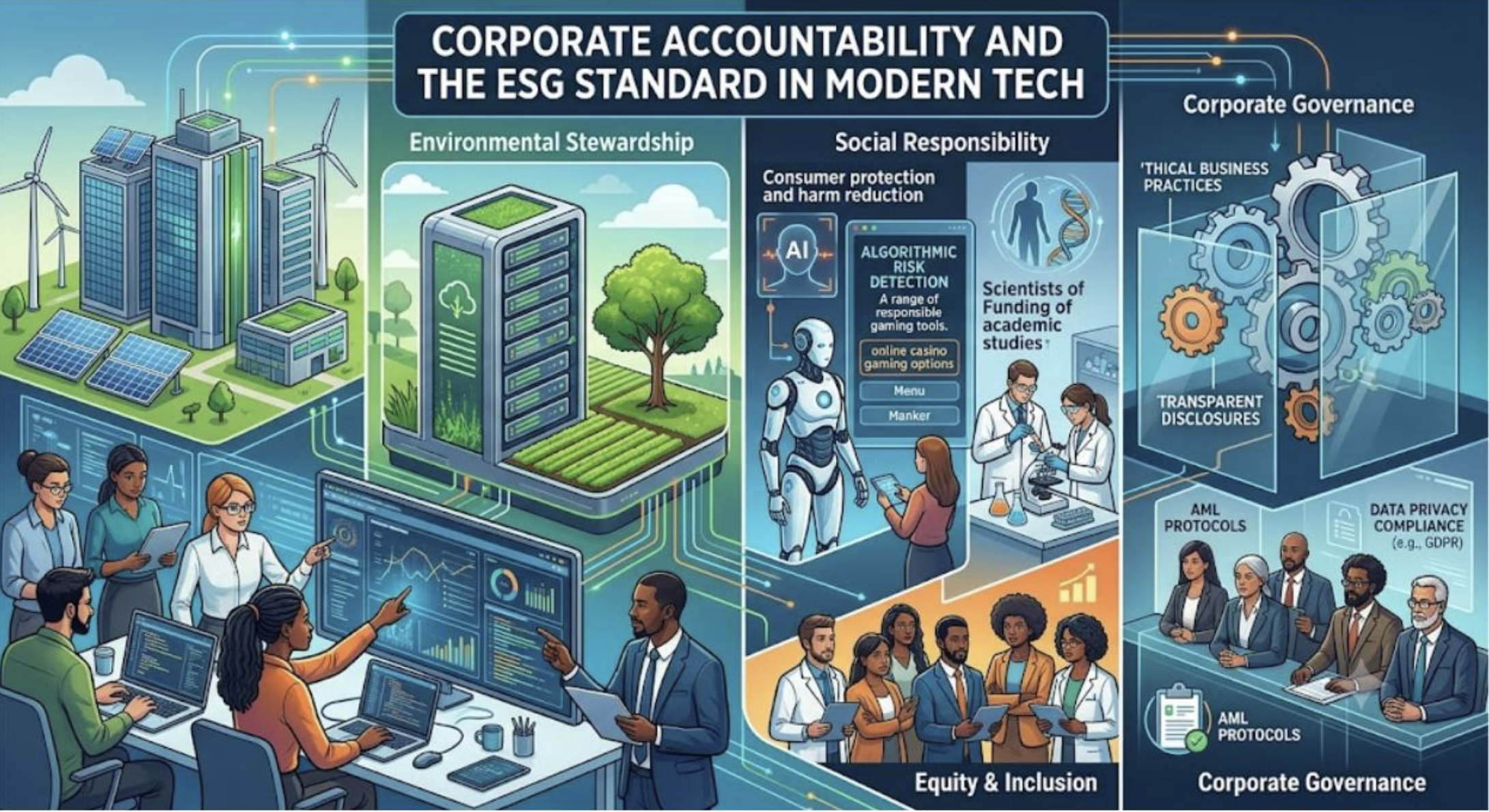
Image Credit - Gemini


Aug 17, 2026 7:00 AM
Updated Aug 22, 2026 12:18 AM
Tech companies generally brag about their low carbon footprints compared to heavy manufacturing. The reality is much messier when we look closely at data centers.
The Unwinding of the "Sin Stock" Premium
You have to remember how much Wall Street used to adore a profitable vice. Back in the day, major institutional money actively boycotted controversial spaces—think tobacco, guns, or casinos—strictly because of moral hang-ups. This widespread avoidance artificially depressed those stock prices, a dynamic that birthed the "sin stock anomaly." Ethical investors essentially paid a financial penalty for their morals, while those willing to stomach the reputational damage harvested a massive unethical premium in the form of higher risk-adjusted returns. Times have changed entirely. Trillions of dollars are currently locked inside ESG-mandated funds, a reality that is fundamentally rewriting the cost of capital. You cannot just coast on historical resilience anymore, especially when advanced technology collides with historically restricted industries.
Tech companies generally brag about their low carbon footprints compared to heavy manufacturing. The reality is much messier when we look closely at data centers. Hyperscalers like Google, Meta, and Microsoft are projected to burn through $700 billion in capital expenditures just to fuel artificial intelligence buildouts. Energy and water consumption are skyrocketing, turning the environmental pillar of ESG into a massive operational vulnerability rather than a slick PR talking point. Operators must now push for "ESG momentum"—a demonstrable, verifiable upward trajectory in their sustainability scores—just to convince institutional money to stick around.
The $3.9 Billion Marketing Problem
Friction between aggressive commercial expansion and institutional compliance is most obvious when we look at the balance sheets of modern digital operators. Let's be real for a second. The repeal of PASPA triggered an absolute tidal wave of customer acquisition spending in the United States. Recent audits of the digital gaming landscape reveal that the U.S. industry blew roughly $3.9 billion on marketing in a single year alone. You would naturally assume a highly scrutinized industry would balance that ledger responsibly. Instead, we see operators spending $520 million on athlete and celebrity endorsements while tossing a mere $60 million toward responsible gambling programs.
Look at Big Booze. They voluntarily maintain a 4-to-1 ratio for responsible consumption messaging. Pharma? They hover near a strict 1-to-1 baseline. Gaming is sitting on a disastrous 8.7-to-1 ratio.
Related stories
Risk assessors at MSCI and Sustainalytics flag this exact imbalance as a critical management gap. Failure to meet these thresholds triggers automatic index downgrades. Publicly traded companies suddenly face massive capital exclusions if they cannot empirically prove they are mitigating consumer harm. This immense institutional pressure forces legacy operators to pivot aggressively.
Buying Back the Social License to Operate
Progressive pressure practically demands that controversial tech companies throw capital at independent clinical research to survive. We are watching market leaders realize that long-term business viability is inextricably linked to proactive corporate citizenship. A prime example of this operational shift is DraftKings and their S.E.R.V.E.S. initiative. Management deliberately funnels massive chunks of corporate revenue directly toward specific social initiatives just to plug the exact gaps ESG monitors are looking at. Take their environmental metrics, for example. They teamed up with the Arbor Day Foundation to literally plant a million trees. That specific maneuver was mathematically engineered to eat up hundreds of thousands of metric tons of carbon, instantly buffing their green credentials.
Frankly, cutting checks for independent academic research used to be unheard of around here. Now it is a strict requirement for basic operational survival. DraftKings deliberately funnels massive grants into the International Center for Responsible Gaming and the Kindbridge Research Institute. They are actively funding seminal studies on the complex nexus between military veterans, trauma, and problem gaming through the 50x4 Vets project. The industry is finally moving from a reactive posture of treating existing disorders to a proactive stance of promoting positive health behaviors. Modern online casino gaming options are increasingly tethered to these exact types of community outreach and independent academic studies to maintain their operating licenses. You simply cannot launch a digital product today without proving to regulators that you are simultaneously funding the safety net.
The Frictionless Fallacy and Algorithmic Hard Stops
Historical harm reduction relied almost entirely on voluntary self-limit tools. Players received static pop-ups suggesting they set their own deposit limits or opt into a voluntary self-exclusion program. The catch? Human psychology completely ruins the model. Look at the actual numbers, and you will see that a microscopic fraction of the player base (we are talking 0.27% to 1.3% at best) will proactively lock down their own spending unless the platform forces the issue. The reality gets even uglier when excluded players feel an itch. Those users simply bounce over to some shady, unregulated offshore book the moment a craving hits. Relying on voluntary willpower is a joke when dealing with highly vulnerable groups who literally cannot hit the brakes before their bank accounts hit zero.
Modern governance mandates require active, algorithmic intervention. Artificial intelligence completely changes how operators manage consumer risk on the backend. We are talking about highly specific Random Forest models monitoring tiny, frantic behavioral shifts. The code looks for things like "card-hopping"—when a guy frantically tries four different Visas after getting declined—or crazy spikes in deposit velocity. A well-tuned backend catches the spiral weeks before the customer ever realizes they are in trouble. DraftKings recently appointed the industry's first Chief Responsible Gaming Officer to spearhead sophisticated tools like "Gamalyze." Mindway AI built this neuroscience-based assessment to evaluate actual decision-making mechanics and loss sensitivity during a simulated game, completely bypassing the inherent flaws of subjective self-reporting.
Aggressive behavioral tracking introduces a massive regulatory headache regarding international data privacy laws. The European Union’s GDPR explicitly prohibits decisions based solely on automated processing if they produce significant legal or personal effects on the user. Tech platforms have to walk a precarious tightrope here. They deploy deepfake-resistant biometric KYC to block synthetic identities, while simultaneously implementing "explainable AI" to ensure automated risk flags can be audited by human compliance teams. The line between a protective algorithmic safeguard and predatory data profiling is razor thin.
Regulatory Patchworks and the LTV Paradox
None of these technological safeguards matter without a functional regulatory framework forcing their adoption. The European market is currently pushing for trans-national standardization through the CEN standard (EN 18144), establishing universally agreed-upon behavioral markers of harm. European operators can now align their risk-scoring models across borders to protect consumers effectively. Meanwhile, the United States operates as a chaotic, heavily fragmented state-by-state patchwork. Massachusetts stands out with its progressive public health-oriented model, directly allocating 9% of online sports betting taxes into a dedicated Public Health Trust Fund. The state's GameSense program places trained advisors directly on-site, though regular engagement remains surprisingly low due to the pervasive stigma surrounding responsible gaming tools.
Skeptical Wall Street analysts often argue that introducing this kind of friction—mandatory cooling-off periods and algorithmic hard stops—will inevitably destroy Customer Lifetime Value (LTV). The exact opposite is true. Unrestricted frictionless journeys lead directly to catastrophic financial losses and permanent customer churn. Players who maintain budget control through deliberately designed friction exhibit much higher emotional commitment and brand trust. Actuarial data firmly proves that a customer who wagers modest amounts consistently over several years generates a significantly higher LTV than someone who blows their bankroll in a weekend and vanishes forever.
Ethical design is not some philanthropic luxury cooked up for a boardroom press release. Corporate accountability is a ruthless, mathematically verified defense mechanism designed strictly to protect your balance sheet. You either build the friction to keep your whales swimming safely over a decade, or you bleed them dry in a weekend and watch institutional capital completely shred your valuation by Monday morning.
Comments

Powered by RoundtableAn AI/DeFi-powered Enterprise Media Operating System. Learn more at Roundtable.io.© Roundtable 2026. By using this site you agree to the Terms of Use and Privacy Policy