


Jul 10, 2026 7:00 AM
Updated Jul 17, 2026 1:30 AM
This guide spotlights ten leaders reshaping records clearance, re-entry, and sentencing, ranked by our transparent Justice Reform Impact Score
Picture an economy where 70 million Americans, one in three adults, are a single box-check away from jobs, housing, or education denial. The machinery that sustains those barriers siphons at least $182 billion from governments and families every year.
But a new wave of nonprofits, policy shops, and tech coalitions is proving we don’t have to accept that drag on people, or on profit. This guide spotlights ten leaders reshaping records clearance, re-entry, and sentencing, ranked by our transparent Justice Reform Impact Score so you can see who delivers maximum impact for every dollar. Ready? Let’s meet the changemakers turning justice reform into smart business.
Our methodology: The Justice Reform Impact Score
Before we name names, we owe you a peek under the hood. Any top-ten list is only as solid as its scoring system, so we built one that mirrors what executives look for when they vet new partners: results, reach, and rigor.
First, we narrowed the field. An organization had to operate in the United States, focus mainly on criminal-record relief, re-entry, or sentencing policy, and publish verifiable impact data from the last five years. Groups working only on policing or innocence cases fell outside this article’s lane.
Related stories
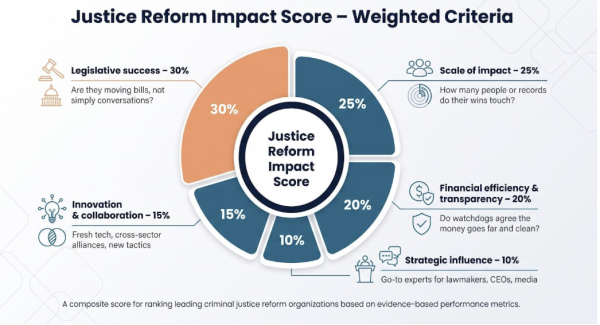
Next, we graded each finalist across five weighted criteria:
- Legislative success (30 percent). Are they moving bills, not simply conversations?
- Scale of impact (25 percent). How many people or records do their wins touch?
- Financial efficiency & transparency (20 percent). Do auditors and watchdogs agree the money goes far and clean?
- Innovation & collaboration (15 percent). Are they using fresh tech, cross-sector alliances, or new advocacy tactics?
- Strategic influence (10 percent). Do lawmakers, CEOs, and media outlets treat them as go-to experts?
We collected raw numbers, laws passed, records cleared, dollars saved, Charity Navigator scores, then normalized everything on a 100-point scale for apples-to-apples comparison. Finally, policy analysts and philanthropic advisors pressure-tested the rankings to be sure the score felt right in the real world, not only on a spreadsheet.
The result is a Justice Reform Impact Score that shows, at a glance, which organizations punch hardest relative to their size and funding. It is not perfect, no single metric captures every nuance, but it grounds the list in evidence, not preference. That way, when you decide where to invest capital, talent, or brand halo, you are working from the same objective playbook we used.
1. Clean Slate Initiative: automating second chances at scale
If criminal records act as digital scarlet letters, the Clean Slate Initiative (CSI) is busy hitting delete. Launched in 2019, this Washington-based coalition writes and passes laws that require states, not individuals, to seal eligible convictions once a crime-free period ends.
In three years, CSI helped six states flip the switch on automatic record clearance, unlocking relief for roughly three million people. Today that momentum has grown to twelve states plus Washington, D.C., positioning more than 16 million people for automated relief, a scale made possible by disciplined Implementation of Clean Slate Legislation.
Then came a $75 million commitment from TED’s Audacious Project to fund a six-year plan that targets another 14 million Americans across all 50 states. The model is simple: pass bipartisan legislation, upgrade court tech, and make relief the default rather than a paperwork marathon.
Why it matters to business: record sealing raises workforce participation and household spending. When Pennsylvania ran the first Clean Slate law, cleared workers saw annual wages rise by several thousand dollars, exactly the kind of lift local employers and chambers cite.
CSI’s coalition mindset adds value. It pairs justice advocates with Chambers of Commerce, payroll firms, and background-check vendors to be sure new laws work on the ground. Support here buys systemic leverage: one statute, one IT patch, millions of lives and résumés reset.
Justice Reform Impact Score: 94/100
Highest marks in Legislative Success and Innovation; strong bipartisan credibility keeps bills moving quickly.
2. The Sentencing Project: data that drives down prison walls
When lawmakers on Capitol Hill quote incarceration statistics, chances are they came from The Sentencing Project. Since 1986, this lean Washington think tank has supplied the hard numbers and sharp analysis that push reform bills into law.
Their research often becomes policy. Crack-cocaine disparity? Their briefing spurred the Fair Sentencing Act. Juvenile life-without-parole? Their data underpinned the Supreme Court’s ban. Their latest push, “second-look” resentencing, has already opened doors in 25 states and the District of Columbia.
Scale matters, too. By spotlighting racial gaps and excessive sentence lengths, the Project fuels changes that ripple through entire systems. Youth incarceration alone has fallen nearly 75 percent since 2000, a trend reformers and budget hawks both credit to the group’s steady stream of evidence.
For executives, partnering here means backing the intel everyone else relies on. One well-timed report can shave years off negotiations, unlock bipartisan sponsorship, and save taxpayers and businesses billions in avoidable prison spend.
Justice Reform Impact Score: 90/100
Top marks for Research Credibility and Legislative Success; small budget, outsized influence.
3. Vera Institute of Justice: the systems engineer for safer communities
Think of Vera as the consultancy you call when you are ready to replace expensive incarceration hardware with smarter, human-centered software. Founded in 1961, the Institute embeds researchers and policy specialists inside jails, prisons, and city halls to test reforms that government can later scale with its own funds.
Their record stretches from restoring Pell Grants for people in prison, a shift that opened college doors to more than 700,000 incarcerated students, to guiding New Orleans and Los Angeles through jail-population cuts that saved millions without raising crime. When leaders need proof that decarceration and public safety can coexist, Vera hands them real-world dashboards, not just white papers.
Corporate relevance is clear. By moving public dollars from bricks and bars to education, treatment, and housing, Vera frees budget that can flow into infrastructure, workforce development, and local procurement. Their data show every dollar diverted from unnecessary incarceration returns multiple dollars in public value, the kind of multiplier CFOs track.
Vera’s reach is broad: a $150 million annual budget, projects in more than forty states, and a knack for forging public-private coalitions. Backing them places your brand alongside a powerhouse that turns bold ideas into statewide policy.
Justice Reform Impact Score: 88/100
Highest score for Scale of Impact; extensive government contracts demonstrate trust and staying power.
4. Equal Justice Initiative: saving lives, shaping conscience
Walk into EJI’s Legacy Museum in Montgomery and you feel history breathe down your neck. That emotional punch is intentional. Bryan Stevenson’s team pairs courtroom victories with cultural truth-telling to show that facing our past is the fastest route to a fairer future.
On the legal front, EJI has overturned or reduced sentences for more than 135 people on death row, and its Supreme Court wins ended mandatory life-without-parole for children nationwide. Each precedent frees real people and rewrites the rulebook for thousands more.
EJI does not stop at case law. Its memorials and best-selling reports link slavery, lynching, and today’s incarceration patterns in ways business leaders cannot ignore. The result is a shift in public opinion that clears political space for reform, and for companies to speak out without fearing they are ahead of their customers.
For investors, EJI offers a rare dual return: immediate human impact plus long-term narrative change. Back their legal work and someone walks out of prison; support their education efforts and millions rethink what justice should look like.
Justice Reform Impact Score: 86/100
Unrivaled in Strategic Influence; high marks for Litigation Success and public engagement.
5. FAMM: families turning mandatory minimums on their head
Picture a congressional hearing. On one side sit policy analysts quoting sentencing charts. On the other, a mother explains how a rigid drug statute stole decades of her son’s life. That mom is likely there with FAMM, and her story often changes minds faster than any statistic.
Since 1991, Families Against Mandatory Minimums has fused kitchen-table testimony with Capitol-Hill strategy to chip away at one-size-fits-all sentences. Their fingerprints are on the federal safety valve of 1994, the Fair Sentencing Act of 2010, and the First Step Act of 2018. Together, these reforms shortened or ended prison terms for tens of thousands.
FAMM’s model is lean and high leverage. A staff of two dozen trains impacted families to advocate, drafts bipartisan bill text, and keeps negotiations focused on human impact. Lawmakers credit them with saving taxpayers billions by eliminating sentences that do nothing for safety yet balloon prison costs.
Why should business care? Fewer years behind bars mean quicker reentry into the labor market, reduced public spending, and stronger family stability, all drivers of consumer demand and workforce readiness. Supporting FAMM is a bet that smart policy beats expensive punishment every time.
Justice Reform Impact Score: 84/100
Top of the chart for Financial Efficiency; unmatched grassroots storytelling meets disciplined lobbying.
6. REFORM Alliance: probation reinvented for the 21st century
Most people in the justice system are not behind bars; they are on probation or parole, one missed check-in away from reincarceration. REFORM Alliance launched in 2019 to fix that overlooked pipeline, powered by celebrity attention and sharp policy work.
Their playbook is quick. Spotlight a state with bloated supervision rules, draft a bill that caps terms and rewards work or school, then flood the airwaves with human stories until legislators act. The strategy worked in California, where AB 1950 cut probation terms in half and immediately freed tens of thousands from endless supervision cycles. Michigan and Florida followed, slashing jail time for technical violations and letting people earn early discharge through employment.
These wins add up: nearly one million Americans now live under shorter, fairer supervision because of REFORM’s campaigns. The group’s next step is tech. It is piloting an app that lets people check in remotely, saving travel time and allowing probation officers to focus on support, not paperwork.
For employers, that means more stable workers who are not stuck juggling court visits during business hours. For investors, it shows that precise policy tweaks can unlock large human and economic dividends.
Justice Reform Impact Score: 82/100
High marks for Innovation and Bipartisan Reach; momentum suggests scores will climb as more states sign on.
7. Code for America: writing the software of redemption
Passing a Clean Slate law is only half the battle. The real test starts when courts must comb through millions of records and seal them without error. That is where Code for America (CFA) excels.
The San Francisco tech nonprofit treats criminal justice like any other legacy system ready for an update. Its Clear My Record platform parses conviction data in minutes, flagging every case eligible for automatic relief. In Los Angeles County alone, the tool helped prosecutors erase or downgrade 66,000 cannabis convictions in one sweep. That task would have taken clerks years.
CFA now serves as the implementation partner for the Clean Slate movement. A dozen states use its open-source code, data standards, and engineering talent to be sure new laws do not buckle under outdated IT. Analysts expect roughly 13 million records to disappear from background checks as these systems go live.
For employers, that means a deeper talent pool arriving without the red flags that trip automated screening. For governments, it means delivering second chances at the speed citizens expect from modern apps, not paper forms.
Justice Reform Impact Score: 81/100
Best in class for Technical Innovation; strong scores in Scale thanks to multistate adoption.
8. Homeboy Industries: jobs, not jails, in the heart of Los Angeles
Step into Homeboy Bakery at 5 am and you will smell redemption: fresh bread and second chances rising together. Father Gregory Boyle’s organization began as a small parish project in 1988; today it is the world’s largest gang-rehab and reentry enterprise.
The formula is simple. Hire the people society fears most, surround them with therapy, legal aid, education, and tattoo removal, then pay them to master real jobs inside Homeboy-run businesses, from cafés to electronics recycling. The payoff is clear: participants cut their two-year recidivism rate from about 70 percent to roughly 30 percent. That shift saves California tens of millions in prison costs and returns dependable workers to the regional economy.
Corporate partners notice. Starbucks sources pastries, Farmers Insurance recruits graduates, and Patagonia prints T-shirts at Homeboy’s silkscreen shop. Each deal funds more trainee wages and shows that formerly incarcerated talent is not a charity case; it is smart workforce strategy.
For executives exploring second-chance hiring, Homeboy offers a living blueprint, complete with hard metrics, leadership coaching, and site tours that turn skeptics into champions.
Justice Reform Impact Score: 79/100
Leads in Direct Service Depth; social-enterprise revenue covers nearly half the program’s budget, proving sustainability at scale.
9. Prison Policy Initiative: the think tank that everyone cites
Every movement needs reliable numbers. Prison Policy Initiative (PPI) supplies them with relentless precision. From its small office in Northampton, Massachusetts, a team of data wonks produces the charts that show up in court opinions, governor briefings, and front-page stories.
Their signature “Whole Pie” graphic breaks down who is locked up, where, and for what, exposing how much incarceration costs taxpayers: at least $182 billion each year. When advocates needed ammunition to end prison gerrymandering, PPI mapped the distortions. A dozen states have since redrawn their districts, returning political power to home communities.
PPI’s influence far outpaces its budget. With roughly $3 million a year, it releases free, open-source research that everyone from ACLU lawyers to Wall Street analysts relies on. That leverage makes it a dream grantee for foundations and CSR teams seeking maximum impact per dollar.
Support here does not buy billboards or rallies. It funds the quiet spreadsheets that win debates before they start. Sometimes the sharpest reform tool is a well-labeled bar chart.
Justice Reform Impact Score: 78/100
Perfect score for Transparency; unrivaled cost-effectiveness in the research lane.
10. Right on Crime: conservative voices, cost-smart justice
In the early 2000s, “tough on crime” was gospel inside most statehouses. Then Texas conservatives looked at the balance sheet: prison expansion was draining billions without making streets safer. That fiscal wake-up call birthed Right on Crime (ROC), a campaign that frames reform as a pro-taxpayer, pro-public-safety priority.
ROC persuades by pedigree. Former governors, prosecutors, and faith leaders sign its statement of principles, then testify, write op-eds, and brief Republican caucuses on why shorter sentences, diversion, and re-entry programs deliver better returns than more cells. Texas proves the case. After ROC-backed reforms, the state closed 11 prisons and saved about $4 billion while crime fell to 50-year lows.
Since going national in 2010, ROC has supported legislative wins in more than 30 red and purple states, from Georgia’s juvenile overhaul to Oklahoma’s drug reclassification. Their presence often gives cautious lawmakers the cover they need to vote yes on bills they privately support but fear will look “soft.”
For business leaders, ROC builds a bridge to conservative stakeholders who value budgets and safety. Partner here when you need a right-of-center coalition to move policy that benefits communities and balance sheets alike.
Justice Reform Impact Score: 76/100
Highest in Bipartisan Credibility; strong marks for Cost Savings delivered across multiple states.
Conclusion: How the leaders stack up
Look across our top ten and a few themes jump off the page.
First, policy wins scale faster than direct service. Clean Slate laws, led by the Clean Slate Initiative, will soon remove barriers for up to 14 million people with only a handful of state statutes. No single re-entry campus can touch that reach, which is why even service-heavy groups like Homeboy also lobby for legislative change.
Second, technology is the new force multiplier. Code for America’s record-clearance software already powers a dozen states and is set to help seal roughly 13 million records as back-end systems go live. Automation turns good policy into real-world relief far faster than paper filings ever could.
Third, data drives the money conversation. When Prison Policy Initiative tallied the annual cost of mass incarceration at $182 billion, budget hawks listened, and Right on Crime used those numbers to close prisons in Texas. Hard evidence keeps reform from stalling in partisan gridlock.
Finally, there is no single “best” approach. Want blockbuster legislative ROI? Back CSI or FAMM. Need credible analytics? PPI and The Sentencing Project sit at the center of every factsheet. Looking for hire-ready talent and a strong brand story? Homeboy has you covered. The smartest corporate portfolios mix and match, supporting systemic change while opening doors on the ground.
Comments

Powered by RoundtableAn AI/DeFi-powered Enterprise Media Operating System. Learn more at Roundtable.io.© Roundtable 2026. By using this site you agree to the Terms of Use and Privacy Policy