



Aug 7, 2026 7:00 AM
Updated Aug 10, 2026 11:38 PM
A child-free couple on $75,000 clears Tampa’s basic bills, but only if housing and commute together stay under control
Florida’s middle-class cost of living can feel upside-down. Even households earning $51,800 to $155,500, the band you get from applying Pew’s definition to Florida’s median household income, watch home prices, insurance premiums, and tolls devour paychecks faster than the Sunshine State’s no-income-tax headline suggests. The real test: can your salary cover six major bills and still leave cash for savings and lazy weekends on the water? Over the next few minutes, we’ll break down those expenses and attach today’s dollar figures so you can judge whether Florida truly fits your budget.
1. Housing and utilities come first
Housing and utility bills swallow the biggest share of a middle-class paycheck, often 30-40 percent of take-home pay in Florida.
Current rents. Metro rents tell the story: as of Zillow’s June 2026 rent index, a typical Miami rental runs about $2,695 a month, Tampa about $2,020, Orlando about $1,970, and Pensacola about $1,745. Where you land inside the state moves this line more than any other choice in your budget.
Home prices. Zillow’s June 2026 data put the typical Florida home value at $378,126, with wide city-level gaps: about $582,621 in Miami, $380,283 in Tampa, $375,175 in Orlando, and $268,527 in Pensacola. When you add interest, insurance, taxes, and HOA or CDD fees, an “affordable” listing can balloon fast.
Related stories
Utilities. Across the South Atlantic region, the average residential electric bill was $152.04 a month in 2024, and recent rate approvals mean first-summer bills can run higher. Air-conditioning alone can spike usage by 40 percent when afternoon highs sit above 90 °F.
Budget tip. Ask for the past 12 months of utility statements before signing, then layer property tax, homeowners or renters insurance, HOA dues, and a realistic July power bill into your spreadsheet. If you’re building that worksheet from scratch, this walk-through on creating your first budget lays out income tallies, expense categories, and the rainy-day buffer every Floridian needs. That full picture, not just rent or principal and interest, shows whether the beach commute still feels worth it.
2. Insurance, flood risk, and association costs deserve their own line
If housing is the heavyweight, property insurance is the uppercut many newcomers never see coming.
Premiums vary by county. Florida Office of Insurance Regulation market data puts typical 2025 homeowners premiums with wind coverage around $5,960 in Miami-Dade, $3,434 in Hillsborough, and $7,621 in Monroe, figures that already exceed many northern states.
Deductibles stack on top. Florida law requires insurers to offer hurricane deductibles of $500 or 2, 5, or 10 percent of the dwelling limit, a separate percentage-based deductible that applies before the flat one. At the 2 percent option, a $400,000 homeowner absorbs the first $8,000 of storm damage before coverage starts.
Condos add extra layers. After the Surfside collapse, lawmakers tightened reserve and inspection rules. HB 913 (2025) lets associations pause some reserve payments and seek new financing tools, but special assessments still reach unit owners.
Hidden charges to scout for
- Flood-insurance quotes, often required even outside FEMA high-risk zones
- HOA or CDD dues that can rise faster than CPI
- One-off special assessments tied to milestone inspections
- Wind-mitigation inspections that can lower or raise premiums
Credit history matters too. Florida insurers use credit-based insurance scores when they price policies. The effect is sharpest on auto insurance, where a driver with weak credit can pay possibly even twice as much as one with strong credit, so it is worth pulling your score before you shop either line.
Budget tactic. Ask for the seller’s declarations page, association budget, reserve study, and any pending assessment letters. Then build a sinking fund equal to one annual premium plus the hurricane deductible. Treat insurance and association costs as their own line item so surprises become planned expenses, not crises.
3. Transportation: more than gas and a car payment
Getting around Florida isn’t cheap: U.S. households spent an average of $13,318 on transportation in 2024, about 17 percent of all outlays, according to the Bureau of Labor Statistics.
True vehicle cost. AAA’s 2025 “Your Driving Costs” study prices a new car at 77 cents per mile, roughly $11,577 a year when you drive 15,000 miles. Depreciation tops the list, followed by financing, insurance, maintenance, and fuel.
Why Florida can cost extra
- Tolls and bridges. Orlando beltways and Tampa Bay bridges can add $50-$60 a month to a SunPass.
- Higher insurance in urban cores. Miami premiums often exceed national highs.
- Heat and hurricanes. Batteries, tires, and paint wear faster; evacuation fuel or a rental car can appear without warning.
- Long commutes. The typical Orlando-area worker spends about 29 minutes each way, according to Census data.
Budget checkpoint. Price every mile:
(payment + insurance + fuel + maintenance + tolls + parking) ÷ miles driven = cost per mile
Compare housing options by housing cost plus commute, not rent alone. A cheaper suburb can lose its savings once toll gantries and two tanks of fuel a week enter the picture.
4. Food: groceries, dining, and the storm pantry
Food costs swing more than any other major expense, but Florida still sits near the U.S. average. Households nationwide spent about $10,169 on food in 2024, with $6,224 at home and $3,945 away from home, the Bureau of Labor Statistics reports.
How Florida metros compare
Grocery prices track the national picture far more closely than housing or insurance do, so the Bureau of Labor Statistics figures above travel reasonably well across the state. What shifts the bill is what lands in the cart: a gallon of milk may be universal, yet pastelitos in Miami or smoked mullet on the Gulf tilt the final total.
What a family of four might spend
USDA’s May 2026 food plans price a moderate-cost diet for a reference family at roughly $1,387 a month, with the low-cost plan closer to $1,122 and the liberal plan near $1,675.
- Cook most meals and you drift toward the low-cost plan.
- Lean on takeout and weekend brunch and you approach the liberal plan quickly.
Storm-season twist
Stocking a three-day pantry bumps spending once a year. Rotate canned goods and shelf-stable items during buy-one-get-one weeks so hurricane prep never feels like a separate bill.
Budget checkpoint.
- Separate groceries, restaurant spending, and household supplies.
- Convert weekly food spending to a true monthly number by multiplying by 4.33.
- Refill the storm pantry as you shop, not in a last-minute spree.
5. Healthcare costs: premiums plus everything the plan misses
Health care in Florida can feel like a second rent. National health spending runs about $15,000 per person a year, according to the Centers for Medicare & Medicaid Services National Health Expenditure data. The headline number hides wide swings once you shop for a real plan.
1. The monthly premium
The Centers for Medicare & Medicaid Services puts the estimated 2026 benchmark Marketplace premium at roughly $683 before tax credits. What you actually pay turns on income and household size, and the enhanced subsidies that ran through 2025 are no longer in place, so price your own plan at open enrollment rather than carrying last year’s net premium forward.
2. Deductible and coinsurance
High-deductible plans look cheaper until an MRI or emergency visit appears. A $3,000 family deductible plus twenty percent coinsurance can erase months of premium savings.
3. Recurring prescriptions
Add every thirty-day refill and over-the-counter staple to the annual tally. A brand-name asthma inhaler can top $350 a year even on a preferred tier.
4. Routine but uncovered care
Think dental cleanings, vision exams, and any out-of-network specialist you cannot avoid.
Budget checkpoint
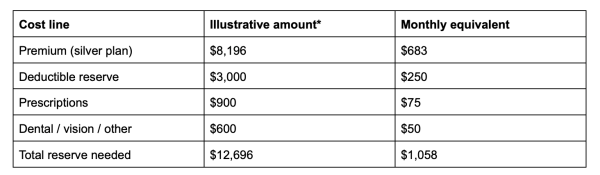
*Premium reflects the 2026 Florida benchmark before subsidies; actual cost varies by age, income, and plan.
Action steps
- Price the full year - not just the premium - during open enrollment.
- Confirm your clinic and prescriptions sit inside the 2026 network and formulary.
- Park one month of the deductible in a separate medical fund so an urgent-care visit stays an inconvenience, not a credit-card crisis.
Numbers will shift again in 2027, but a four-bucket framework keeps surprises off your statement.
6. Childcare, education, and student loans: the wild cards
Few costs flip a Florida budget faster than kids.
Childcare can top housing
MIT’s 2026 model prices full-time care for two children at $22,320 in Miami, $20,659 in Orlando, and $20,769 in Tampa - figures that rival each metro’s basic housing number.
- Infant rooms cost more because staff ratios tighten.
- School calendars end hours before most workdays; budget for after-care, summer camps, and random breaks.
- Convert every registration, supply, and field-trip fee into a twelve-month figure so “weekly tuition” does not mislead you.
College is more than tuition
Bright Futures still covers a healthy slice of in-state tuition, but housing, meal plans, and books often double the headline cost. Confirm award percentages and renewal GPA each year; the handbook changes.
Student-loan payments reset in 2026
The Department of Education’s Tiered Standard and Repayment Assistance plans took effect on July 1, 2026, trimming minimums for some borrowers but raising them for others if income climbs. Log in, recertify your plan, and rerun the simulator before assuming last year’s payment still stands.
Budget checkpoint
- Treat childcare and education as fixed costs - pay them first.
- Divide summer-camp and holiday care by twelve so cash flow stays even.
- Recertify income-driven repayment and scholarship eligibility every year.
- Adjust lifestyle choices around these non-negotiables; skipping them risks late-pickup fees, registration holds, or loan default.
Child-free households can redirect that money to savings or debt, but parents should expect childcare to compete with housing for the budget’s number-one slot.
What a middle-class salary really buys: three quick scenarios
The six costs behave very differently once we drop a real household into a real ZIP code. Here is how three common Florida paychecks stack up against MIT’s 2026 basic-needs thresholds.

*MIT Living-Wage Calculator, 2026 updates: Tampa-St. Petersburg-Clearwater, Orlando-Kissimmee-Sanford, Miami-Fort Lauderdale-West Palm Beach.
Conclusion
A child-free couple on $75,000 clears Tampa’s basic bills, but only if housing and commute together stay under control; HUD counts a household as cost-burdened once housing alone passes 30 percent of income. In Orlando, $100,000 feels middle class on paper yet still trails the basic-needs floor once two kids and paid care enter the picture. Even $120,000 in Miami barely outruns the metro’s baseline; insurance spikes and higher grocery costs trim any “no state income tax” advantage.
Run your own numbers through the six-cost lens before assuming a salary is comfortable.
This article is general information, not financial, tax, or insurance advice. Prices, premiums, and program rules move from year to year, and your own result depends on your metro, your household, and your coverage choices, so confirm the figures that matter to you before you commit to a move.
Comments

Powered by RoundtableAn AI/DeFi-powered Enterprise Media Operating System. Learn more at Roundtable.io.© Roundtable 2026. By using this site you agree to the Terms of Use and Privacy Policy