


concealed carry
Dec 17, 2023 8:00 AM
Updated Dec 20, 2023 3:35 PM
We’re witnessing an intriguing shift, an ongoing transformation in the world of defensive handgun sighting solutions that’s beginning to catch fire.
Looking back a handful of years, it felt almost abrupt how most defensive semi-auto pistols sported accessory rails on their dust covers. It became all the rage, a fashionable trend if you will, among both civilians and law enforcement personnel to slap on trigger finger-activated gadgets like lights or laser sights to these rails. These additions rose to prominence for their svelte profiles, negligible heft, and their knack for not breaking the bank.
Fast-forward to the here and now, and we’re witnessing an intriguing shift, an ongoing transformation in the world of defensive handgun sighting solutions that’s beginning to catch fire.
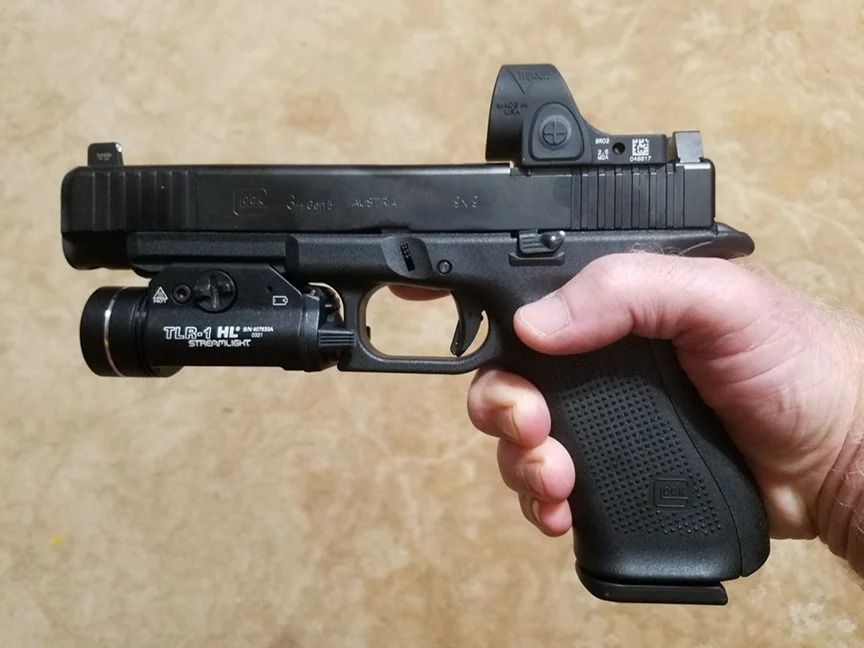
An unprecedented number of defensive sidearms boast slides prepped for micro red dot optics as a standard amenity. Buckle up; it's a prime moment to dive in and explore these nifty optics, gleaning insights into how they might weave into the tapestry of your personal defense stratagem.
So, what's the skinny on a Micro Red Dot Optic (MRDO)?
In essence, micro red dot optics are svelte reflex-type sights, meticulously tailored for semi-automatic handguns. You've got a crystal-clear, gently arched lens that doesn’t magnify; it serves as a stage for a sharply focused shaft of light beaming from a light-emitting diode (LED).
Related stories
A shooter peering through this sight will notice a vivid dot of color piercing the center of the lens, seemingly suspended in mid-air. This red dot morphs into an aiming fulcrum. Mimicking alternative scope varieties, red dots come equipped with dials for elevation and windage, allowing one to zero in the dot’s position for precise distances.
These MRDOs have seen their star rise within defensive ranks for the decidedly brisk and user-friendly sight picture they offer. They prove almost intuitive to a broad array of proficiency levels and are pliable across a spectrum of lighting scenarios.
Boasting either manual or automatic brightness controls—https://leadandsteel.co/product-category/optics/—they adjust effortlessly between the brilliance of daylight and the subtleties of dusk or dawn. The size of the dot that dances on the lens is typically gauged in either Minutes of Angle (MOA) or Milliradians (MRAD). Go for larger dots for sheer visibility, or dial it down to finer points for a clearer view of the target playing out at extended ranges.
Embracing disciplined shooting techniques, it's quite common for shooters to cluster their shots more neatly on target employing a red dot optic compared to the classical front and rear iron sight alignment. A smattering of esteemed optics producers, including notables like Trijicon, Leupold, Bushnell, TruGlo, and Crimson Trace, offer steadfast, durable red dots tailored for the discreet everyday carrier.
Mounting Systems
You essentially have a triad of strategies to magnetize the optic to the pistol. The initial approach embodies taking the proverbial plunge with your slide, entrusting it to the capable hands of a gunsmith. This artisan will meticulously mill, perforate, and thread the metal to craft a cradle for your MRDO. Frankly speaking, it’s the path less taken, for the cost and time it demands can be formidable. Moreover, it’s a game of compatibility, as not every slide is a willing participant in this transformation.
Shifting gears, the second avenue, which has won greater favor amongst the shooting circle, is snagging a pistol that’s already primed to join forces with an optic, straight out of the box—the so-called “optics ready” pistol. Normally, these firearms come chaperoned by a medley of screws and plates, essentially the “hardware” needed to secure the optic.
Yet, in this emerging field of tech, uniformity is a stranger; thus, tailoring is the name of the game here. Cross-check the specifications, ensure your optic and pistol are two peas in a pod, and verify if the requisite hardware’s included, or whether an additional shopping trip is on the horizon.
Now, for an enticing twist, we slowly wade into a growing trend: manufacturers preloading the optic right at the starting gate, essentially spoon-feeding you the handgun-optic package. I've personally navigated this terrain with reasonably priced offerings from SCCY Firearms and European American Armory.
Comparatively, these deals can ease the strain on your wallet more than when the optic and pistol are courted separately. When ambivalence clouds your decision on optic compatibility, don’t hesitate to extend a line to the manufacturer or a sagacious gunsmith for counsel.
Always-On vs. Manual Controls
We now find ourselves at the crossroads of operational designs: Always-On versus Manual Controls. As with many gadgetries you encounter, MRDOs don't march to a single beat when it comes to features or prices. However, they do fall into one of two broad camps.
Optics wielding external controls echo the promise of versatility. You’re at the helm, toggling power and illumination to your preference. It’s commonplace for such models to boast compartments or trays for depleted battery ejection.
These trays are designed for quick swaps without the need to detach the optic from its station—a convenience that does come at the expense of battery longevity, especially if you’re partial to a vivid display.
Conversely, Always-On models are the embodiment of simplicity—a monolithic housing without buttons or battery gates. Once the energy cell is nestled beneath and the unit is steadfastly anchored to the slide, the LED will persist indefatigably until the power source depletes.
These marvels may be equipped with sensors that auto-manage brightness relative to the surrounding light, coupled with protective covers that serve as sentinels for battery conservation.
The virtue of Always-On, initially off-putting to those acquainted with the voracious battery appetites of yore, has grown on me. Turns out these optics, when treated with care, e.g., tucked in with their covers, can outlast years on a single battery. But ain’t joy without a counterweight; when the eclipse of battery life happens, you’ll be unscrewing the optic for a replacement, potentially followed by a rendezvous with the range to recalibrate your point of aim.
Do Red Dots Need Iron Sights as a Trustworthy Backup?
The consensus among seasoned professionals suggests a steadfast adherence to equipping defensive handguns with a reliable set of iron sights to serve as a trustworthy backup for any electronic optic or laser sighting apparatus one might opt for. Such a configuration ensures that, should your tech-forward sighting aids suffer damage or a power failure, you're not left sighting blind but have a robust alternative to fall back on when it counts.
Having field-tested a couple of nuanced approaches for integrating iron sights into a concealment-friendly setup, I can attest to their effectiveness. One particularly clever method entails the use of towering sights.
These protrude enough to remain visible right through the optic, a design feature that's just ingenious. Aligning the point of impact for both the iron sights and the red dot into a seamless sight picture is what shooters refer to as “co-witnessing” the sights. It's a smooth, almost effortless handoff from the red dot to the iron in the event of a power-down.
Yet, the path to elevated sights isn't always clear. Some pistol designs necessitate excising the rear sight to accommodate the optic. Don't despair if that's your pistol's design. Certain optics come with their own clever workarounds, boasting housings crafted for mounting an auxiliary rear sight—though often an extra purchase—or they might integrate a rear sight enhancement, nifty as they are.
Take, for instance, the Crimson Trace optics that come bundled with the SCCY handgun showcased in this example. They sport a rear sight notch that's been ingeniously molded right at the back of the housing.
Now let's unravel the puzzle. What's a person to do when their optic goes dark at the most inopportune time? If your pistol is fitted with co-witnessed iron sights, seamlessly pivot to using those without skipping a beat—that's your ace in the hole.
But what if you're caught short without a rear sight and an immediate threat looms? Here's the countermove: trainers in self-defense circles suggest leveraging the metal housing encircling the lens as a makeshift sighting frame.
Absent the guiding red dot, you manipulate the unlit optic to box in the threat's central mass, as you would with a ghost ring. Admittedly, it's not the pinnacle of precision for distant targets, but in the realm of close quarters, it's a tactic that can decisively tip the scales.
Is a Red Dot Right For You?
Considering whether a red dot is the accessory to elevate your shooting prowess? The current generation of micro red dot optics offers compactness, robustness, and dependability in spades. When you nail the installation and keep them in tip-top shape, this top-notch gear is bound to give you a good run for years.
We're talking pinpoint accuracy over more generous ranges here, chiefly because they're a breeze to get the hang of compared to the classic iron sights, not to mention they stand out like a sore thumb under almost any light. These gizmos truly shine when you're shooting the breeze with both eyes wide open—critical during those tense moments when situational awareness is your best buddy.
But let's talk turkey—kitting out your daily carry with an MRDO isn't exactly a drop in the bucket, financially speaking. You're looking down the barrel of steeper prices for optics-ready handguns, while the optics themselves can ring up a bill anywhere from 200 to 600 smackeroos, depending on the fineness of your selection. And, just as with any sighting apparatus, shelling out for solid training is a smart play.

The holster game is inching closer to accommodating these tech marvels, though they haven't quite hit their stride with supply meeting demand just yet. For folks wrestling with visual quirks such as astigmatism, the red dot can, regrettably, seem a tad on the fuzzy or starbursty side. You'll also have to tweak your everyday carry drill to include giving your MRDO a once-over—ensuring it's spick and span, snug as a bug, and firing on all cylinders.
So if you're keen to work a red dot optic into your personal defense toolkit, hit the books, invest in the cream of the crop, and snap up some training to truly harness its full potential.
Comments

Powered by RoundtableAn AI/DeFi-powered Enterprise Media Operating System. Learn more at Roundtable.io.© Roundtable 2026. By using this site you agree to the Terms of Use and Privacy Policy