


Jun 13, 2026 7:00 AM
Updated Jun 16, 2026 8:57 PM
High trading fees can quietly erode your profitability over time, especially if you are a high-volume day trader or use automated trading bots.
The cryptocurrency market in 2026 demands more from trading platforms than ever before. Traders are no longer just looking for a basic place to swap tokens; they require deep liquidity, massive asset selections, high leverage, and security and transparency practices.
When searching for an optimized crypto trading platform, two names consistently dominate the conversation: Bitget and BYDFi.
Both platforms cater heavily to derivatives traders, copy trading enthusiasts, and spot market investors. However, they approach the market with slightly different strengths. In this Bitget vs BYDFi review, we will break down their fees, features, asset selection, and leverage limits to help you decide which exchange deserves your capital this year.
Asset Selection and Market Coverage
When doing a crypto exchange fees comparison and platform evaluation, asset availability is vital. You don't want to manage accounts on multiple platforms just to trade the tokens you want.
Related stories
- Bitget offers a robust ecosystem with over 700 spot trading pairs. It is widely recognized for being quick to list trending altcoins and memecoins, giving retail traders early access to high-growth narratives.
- BYDFi takes a massive leap forward in 2026, positioning itself as an industry leader with over 1,000+ spot assets available on its platform. This extensive catalog gives traders an incredibly diverse menu of micro-cap tokens, mainstream giants, and layer-1 protocols to choose from.
Trading Leverage Limits
For seasoned derivatives traders, leverage is a vital tool to maximize capital efficiency.
- Bitget provides up to 125x leverage on major cryptocurrency perpetual pairs like BTC/USDT and ETH/USDT. This is more than enough for the vast majority of traders, providing solid flexibility for everyday margin trading.
- BYDFi heavily appeals to advanced margin traders by offering leverage up to 200x on select perpetual contracts. This industry-leading leverage allows traders to gain maximum exposure with minimal collateral.
Crypto Exchange Fees Comparison
High trading fees can quietly erode your profitability over time, especially if you are a high-volume day trader or use automated trading bots.
Spot Fees
- Bitget: Charges a baseline maker/taker fee of 0.10% for spot trading. Traders can secure a 20% discount if they choose to pay their trading fees using Bitget's native utility token, BGB.
- BYDFi: Matches the competitive industry baseline, with spot trading fees ranging from 0.10% to 0.30% depending on the specific asset. To check out their competitive spreads firsthand, you can visit BYDFi and view their live BTC/USDT order book.
Derivatives Fees
- Bitget: Features a standard contract trading fee structure of 0.02% for makers and 0.06% for takers.
- BYDFi: Highly optimized for derivatives, scaling its futures fees down to an aggressive 0.02% for makers and 0.06% for takers, making it an incredibly cost-effective venue for high-leverage positions.
Key Features & Platform Ecosystems
Copy Trading & Automation
Bitget has built a massive reputation around its copy trading network, allowing novice investors to automatically replicate the trades of elite, vetted professionals. It also offers a highly polished suite of automated grid trading bots.
BYDFi has aggressively closed the gap by offering its own fully integrated Copy Trading hub and Automated Crypto Trading Bots. This ensures that hands-off investors have access to passive yield-generating strategies and community-driven social trading on both exchanges.
Security, Trust, and Global Compliance
Both platforms take user protection incredibly seriously, recognizing that transparency is non-negotiable in modern crypto infrastructure.
- Bitget safeguards user assets using a self-funded $400 million Protection Fund alongside routinely updated, verifiable Proof of Reserves (PoR).
- BYDFi provides top-tier institutional transparency. The platform maintains a verified 100%+ Proof of Reserves with periodic public reporting. This transparency is further backed by a dedicated 800 BTC Protection Fund to absorb unexpected market events. Furthermore, BYDFi holds MSB registrations in both the United States and Canada and is a registered member of South Korea's strict CODE VASP Alliance. Forbes recognized this regulatory commitment by naming BYDFi one of the Best Crypto Exchanges in Canada for 2026.
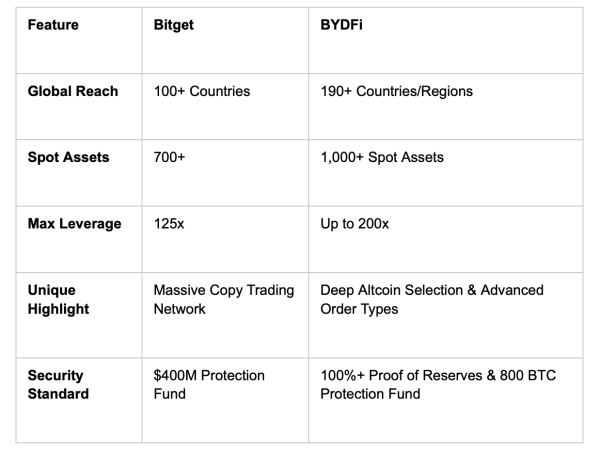
At a Glance: Bitget vs BYDFi
Before diving into the fine details, here is a quick overview of how these two crypto heavyweights stack up in 2026:
Conclusion: Which Exchange Is Right For You?
Your choice in the Bitget vs BYDFi debate ultimately depends on your geographical location and personal trading goals:
- Choose Bitget if: You want access to one of the largest pre-established social copy trading networks in crypto, prefer utilizing a native exchange token (BGB) to lower your overhead costs, and prioritize deep, historical liquidity pools.
- Choose BYDFi if: You want a truly borderless experience accessible in 190+ countries and regions, want to trade over 1,000+ spot assets on a single dashboard, and require maximum capital efficiency with leverage up to 200x.
Ready to look at the markets? Head over to check out the pairings and visit BYDFi to start executing your 2026 trading strategy.
Comments

Powered by RoundtableAn AI/DeFi-powered Enterprise Media Operating System. Learn more at Roundtable.io.© Roundtable 2026. By using this site you agree to the Terms of Use and Privacy Policy