


Jun 16, 2023 7:00 AM
Updated Jun 18, 2023 10:38 PM
To do its job, an autonomous robot must read its surroundings, comprehend its obstacles, and change its locomotion appropriately.
AI equips robots with ample computer insights and motion regulation to better understand their surroundings and behave accordingly. Machine learning also trains robots so that, with timely development, they learn from their own mistakes, eliminating the need for ongoing human intervention and repetitive effort or work.
Along with these characteristics, AI undoubtedly increases the efficiency of production operations, particularly for large labor-intensive organizations; it also increases the available potential of robots. Several disciplines of technology are integrated to train robots to this level of functionality, such as deep learning, image annotation methods, and semantic segmentation. The ability of quadrupedal robots to work in complicated conditions that are difficult or unavailable to humans is exceptional. A durable and adaptable quadrupedal robot proves to be highly useful in performing routine facility monitoring autonomously in places that are difficult, dangerous, or just dull for humans.
To do its job, an autonomous robot must read its surroundings, comprehend its obstacles, and change its locomotion appropriately. Many industries are working on robotics and implementing innovative applications of robots. ANYbotics, a Swiss robotics company, has produced legged robots (ANYmal & ANYmal X) to use in industrial processes. ANYbotics’ primary area of expertise is providing end-to-end robotic solutions for industrial inspection. Their four-legged robots are made to roam around in industrial settings while keeping an eye on the state of infrastructure and equipment, producing high-quality data for industrial operators.
The developments in perceptive locomotion have improved the capabilities of quadrupedal robots; most works focus on interior or urban situations, making them incapable of dealing with complex industrial and outdoor terrain. In these situations, the robots produced at ANYbotics comprehend the terrain shape and its contact qualities, which are critical for a robot’s locomotion skills. As the robot walks, the framework determines the locomotion skill, including speed and gait. The leg movement’s form and timing allow the robot to walk forcefully on a range of off-road terrains, such as rocks, pebbles, pipes, debris, slippery liquid, and more.
Related stories
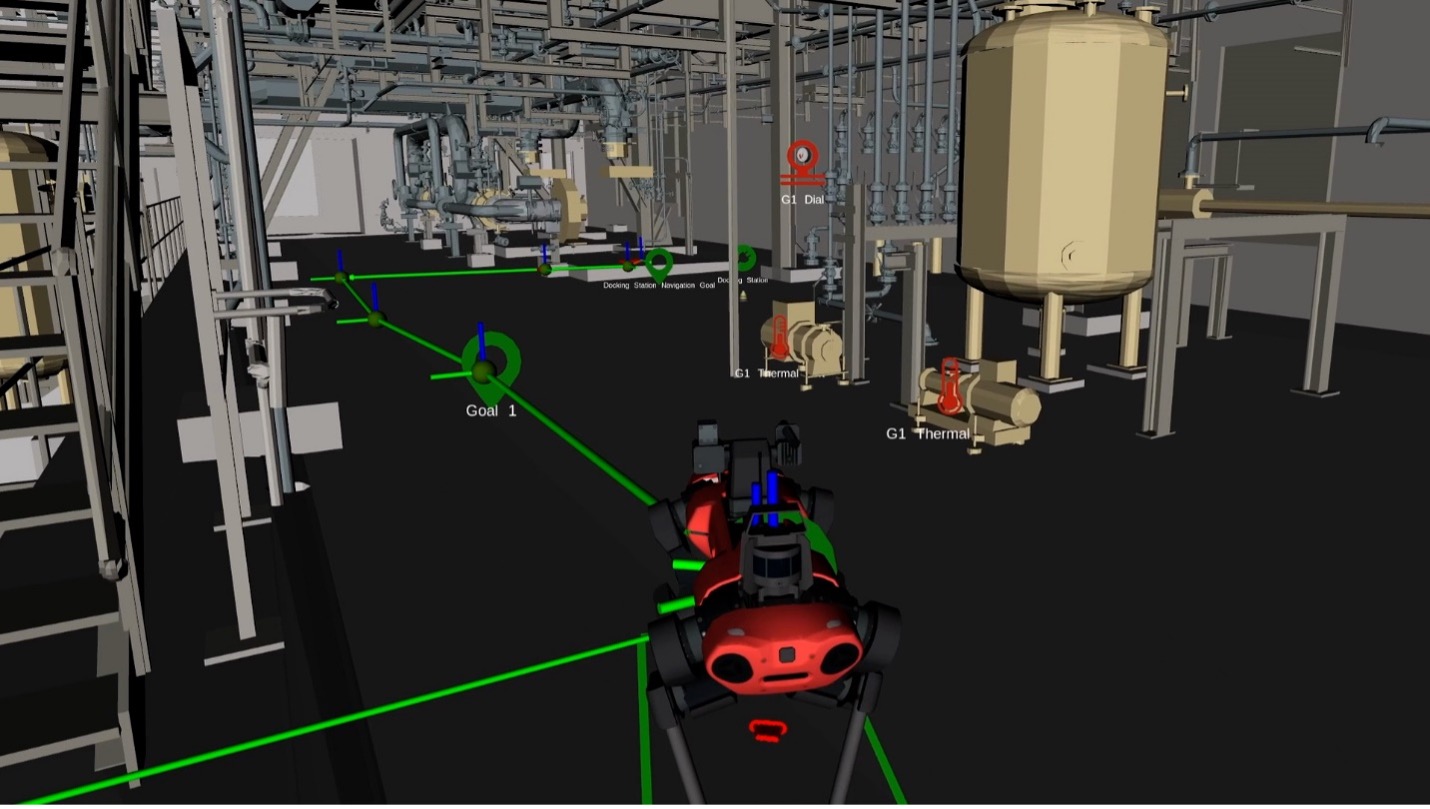
ANYmal navigates complicated multi-story environments independently. After being directed around the area, the robot recalls every detail from a self-created 3D map and seeks the shortest path to complete its task. The robot’s mechanism successfully avoids obstacles and goes through uneven terrain while in operation. ANYmal docks to multiple docking stations that allow ANYmal to recharge, extend its operating time, enable multiple inspection missions, and extend its range. For seamless navigation, built-in depth sensors detect impediments surrounding the robot. ANYmal localizes with centimeter precision in both tight and open spaces. This robot navigates the facilities securely because it knows its exact location in the surroundings because of “Pharos,” ANYbotics’ unique 3D SLAM engine. Integrating LiDAR and depth cameras results in a mapping accuracy of 1-3 cm. It has a full coverage of major facilities, with the capacity to create and develop 3D models of entire facilities in a single pass. There is no requirement for structural changes, navigation markers, QR codes, or GPS connectivity for the robot’s continuous functioning.
Three Major Features of AI on ANYmal
The Reinforcement learning-based locomotion is extremely strong and well-suited to difficult terrains. The Reinforcement Learning framework is beneficial for teaching legged locomotion to the robot while adhering to safety requirements. The primary objective is for the robot to deploy robust mobility skills autonomously in the actual environment without falling during the entire procedure.
Autonomous navigation in ANYmal helps in tight places, including obstacle avoidance and route re-planning. Autonomous navigation refers to the capacity to learn and execute course travel without human intervention. This technique is based on a deep neural network and necessitates using cameras, ultrasonic sensors, and 3D maps.
Inspection intelligence allows ANYmal to interpret signals on the edge. Inspection robots are mobile service robots that employ powerful vision sensors to assess essential and high-value infrastructure. Inspection robots can be semi-autonomous (trained predefined pathways) or completely autonomous.
ANYmal incorporates specifically created compliant joint modules with integrated electronics to deal with impulsive stresses during quick locomotion. The robot comprises a single lightweight carbon-fiber body with 12 identical joint modules and simple mechanical linkages.
Rotating line-lidar sensors and stereo and wide-angle cameras provide environmental perception. Sensors in the actuators offer haptic input, enabling safe mobility even if the robot is entirely blind. ANYmal has a pan-tilt head with multiple sensors, including an optical zoom and thermal camera, a gas detection sensor for gas leak detection, an ultrasonic microphone for acoustic measurements, and artificial LED illumination for industrial inspection.

Artificial Intelligence (AI) provides robots with computer vision to navigate, detect, and calculate their responses autonomously. Robots learn to do tasks from people via machine learning, which is another component of AI. These capabilities are shaping a new era in industrial inspection where intelligent, reliable, mobile, and autonomous legged robots like ANYmal only need to be taught what and how to inspect – once.
Comments

Powered by RoundtableAn AI/DeFi-powered Enterprise Media Operating System. Learn more at Roundtable.io.© Roundtable 2026. By using this site you agree to the Terms of Use and Privacy Policy