


Feb 1, 2026 8:00 AM
Updated Feb 9, 2026 12:41 AM
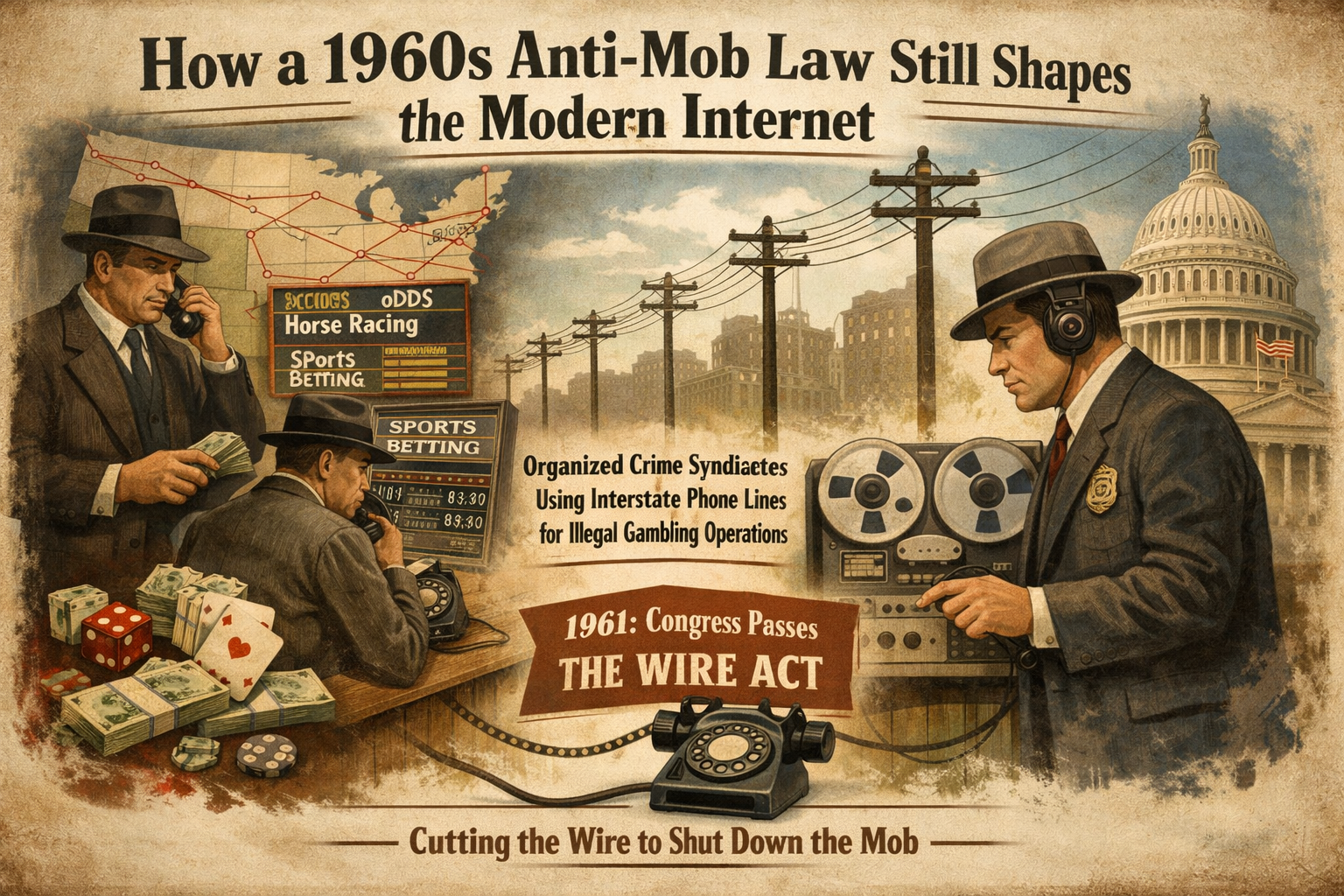
The Wire Act was crafted to disrupt mob-run bookmaking networks that relied on predictable, centralized communications systems
In the early 1960s, when Congress passed the Wire Act, the United States was responding to a very specific problem rooted in a very specific moment. Organized crime syndicates were using interstate telephone lines to run illegal betting operations, and federal lawmakers moved to cut off that infrastructure by targeting the communications channels themselves. At the time, the approach was both practical and narrowly focused, reflecting an era in which “the wire” meant a physical phone line and interstate commerce was easier to identify and contain.
More than sixty years later, that same law continues to exert influence over how parts of the modern internet are regulated, despite the fact that the technological, economic, and geopolitical environment in which it operates has changed almost beyond recognition. The persistence of the Wire Act is not an isolated curiosity, but a revealing example of how legislative inertia can quietly shape digital policy long after the original rationale has faded.
A Law Designed for a Different Infrastructure
The Wire Act was crafted to disrupt mob-run bookmaking networks that relied on predictable, centralized communications systems, with interstate phone calls providing a clear jurisdictional hook for federal enforcement. Its language reflected the assumptions of the time, when communications were linear, traceable, and largely domestic in nature, and when Congress could reasonably expect that technology would evolve slowly enough to be addressed through incremental amendments.
That assumption did not hold. The rise of the internet replaced discrete wires with packet-based networks, cloud infrastructure, and globally distributed systems in which data routinely crosses borders without regard for national or even physical boundaries. Yet while communications technology transformed, the statute designed to regulate one narrow slice of it remained largely untouched.
Related stories
Interpretation Becomes Policy
Rather than being rewritten to account for these changes, the Wire Act has been repeatedly reinterpreted, with its scope expanding or contracting depending on administrative priorities and judicial rulings. Over time, enforcement has relied less on clear legislative intent and more on evolving interpretations issued by executive agencies and later tested in the courts.
This process has effectively shifted policymaking away from Congress and toward regulators and judges, who are left to resolve ambiguities that were never intended to carry such weight. For industries operating online, the result is a regulatory environment defined not by clarity, but by uncertainty, in which legality often hinges on how an old statute is read rather than on what modern lawmakers have explicitly decided.
Gambling as a Case Study in Regulatory Drift
The effects of this ambiguity are perhaps most visible in online gambling, which has become a recurring flashpoint in debates over the Wire Act’s reach. As states have moved to regulate certain forms of online wagering within their own borders, questions about whether federal law permits or constrains those efforts have repeatedly surfaced, forcing courts and regulators to reconcile a mid-century statute with a twenty-first-century activity.
This has turned gambling into a kind of legal stress test, exposing how outdated laws can complicate modern governance even when states attempt to act transparently and within their own regulatory frameworks. Detailed analyses of the Wire Act’s history and interpretation illustrate how much of this uncertainty stems not from deliberate prohibition, but from legislative silence.
Federalism, Innovation, and the Cost of Uncertainty
The broader consequences extend well beyond gambling itself. When states attempt to regulate digital activity in areas ranging from payments to emerging financial technologies, federal ambiguity can undermine those efforts, discouraging innovation while failing to provide meaningful consumer protection. Smaller operators and startups are often the most affected, as they lack the resources to navigate shifting interpretations or absorb the risk of enforcement actions based on unsettled law.
This dynamic raises deeper questions about federalism in the digital age, particularly when states are left waiting for clarity that Congress has been unwilling or unable to provide. In practice, regulatory uncertainty becomes a form of policy, shaping behavior through hesitation rather than through democratic decision-making.
A Changing Global Context
The persistence of laws like the Wire Act also stands in contrast to the pace of technological competition on the global stage. As the United States positions itself in an intensifying race with China over artificial intelligence and advanced computing, and as the European Union moves more aggressively to define regulatory frameworks for blockchain technology and digital currencies, America’s reliance on decades-old statutes appears increasingly misaligned with its strategic ambitions.
Innovation does not occur in a vacuum, and legal clarity is a competitive advantage. When emerging technologies are governed by laws written for rotary phones and copper wires, uncertainty discourages responsible development while leaving room for arbitrary enforcement. In areas such as digital finance, this hesitation risks ceding both regulatory leadership and technological influence to jurisdictions willing to modernize their legal frameworks.
The Pattern Behind the Problem
The Wire Act is not unique in this regard. It reflects a broader tendency to govern the internet through statutes designed to address moral panic or criminal activity in earlier eras, rather than through legislation tailored to contemporary realities. Whether applied to gambling, financial transactions, or online platforms, the result is often the same: courts and agencies are forced to fill gaps that Congress has left open, and policy evolves through interpretation rather than deliberation.
For a democracy that prides itself on transparent governance, this is a costly trade-off.
Comments

Powered by RoundtableAn AI/DeFi-powered Enterprise Media Operating System. Learn more at Roundtable.io.© Roundtable 2026. By using this site you agree to the Terms of Use and Privacy Policy