


Jul 19, 2026 7:00 AM
Updated Jul 23, 2026 11:52 PM
The strongest setups usually layer a few things together. One layer handles semantic matching, another handles structured lookups, and a generation layer writes the final response.
Remember when search meant typing three words and scrolling through ten blue links until something looked right? That's basically gone now. People type full questions these days, sometimes messy, half-formed ones, and they expect a straight answer back. Not a list. An answer.
Any business running a website, an app, a help center, or whatever, feels this pressure now. Search that still behaves like it's 2015 gets noticed fast. Then people just leave.
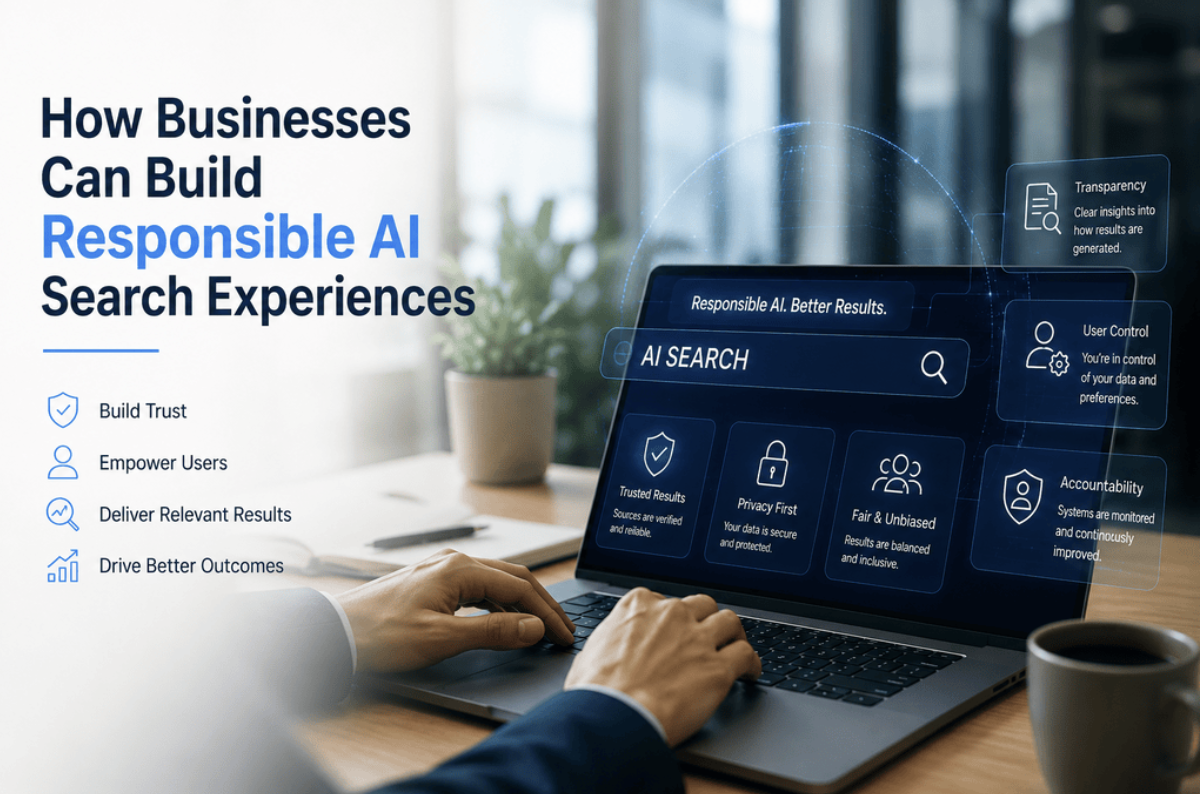
This is where a decent API search company earns its keep. A good one builds a search that actually gets what someone means, keeps their data safe, and admits when it doesn't know something instead of confidently making stuff up. Below, we'll get into what responsible AI search really looks like, how the tech works, and how to pick a partner that won't embarrass you six months in.
What Does "Responsible" Even Mean Here
It's not a slide from a pitch deck. It's a few concrete promises a company makes when it lets AI handle answers on its behalf.
Related stories
Three things matter most:
- It should say "I'm not sure" instead of inventing an answer.
- Users need some way to see where an answer came from.
- Data shouldn't get scraped, stored, or reused carelessly.
None of that shows up by accident. Someone has to build it in, and that starts with the architecture underneath the search box, long before a user ever types a query.
Okay, But How Does the Tech Actually Work
You don't need a computer science degree for this part. A few core pieces show up in almost every serious search stack, and knowing what they do helps when a vendor starts throwing jargon at you.
Start with semantic search. It cares about meaning over exact wording. Someone typing "cheap laptop for college" gets matched to a page about "affordable student computers" even though the words don't line up at all. Vector search is the machinery behind that trick, turning text into numbers so a system can measure how close two ideas sit to each other mathematically.
Then there's RAG, short for Retrieval-Augmented Generation. This one's important specifically for the responsibility angle. Instead of an AI model just guessing from whatever it memorized during training, RAG first retrieves real documents, then writes an answer grounded in those documents. There is a big difference between "the model thinks this is true" and "the model found this in your actual content."
NLP, natural language processing, handles the messy human stuff: typos, slang, half-sentences, regional phrasing that a rigid keyword system would choke on. And knowledge graphs connect related facts so the system knows "Paris" the city isn't the same as someone named Paris, based on context clues around it.
Stack all of that together and you get real information retrieval, not just a fancy autocomplete guessing at what you probably meant.
Why Everyone's Suddenly in a Hurry About This
The growth numbers are honestly a bit wild. Spending on AI-powered API infrastructure is expected to climb at over 30% annually for the next several years, based on recent market research. That kind of growth doesn't happen for a feature nobody uses.
Behavior backs it up too. A meaningful share of informational searches now go through conversational AI tools instead of a traditional search bar, according to 2026 reporting on search habits. If your site can't keep pace, someone else's will, and your visitor just goes there instead.
This is exactly why so many teams are now looking at an API Search Company’s Homepage rather than trying to build semantic search themselves. Standing up a vector database, tuning relevance, keeping a model current, that's a real job, not a side project. Most businesses would rather ship their actual product and hand the search layer to someone who does this all day.
Picking a Company Without Getting Burned
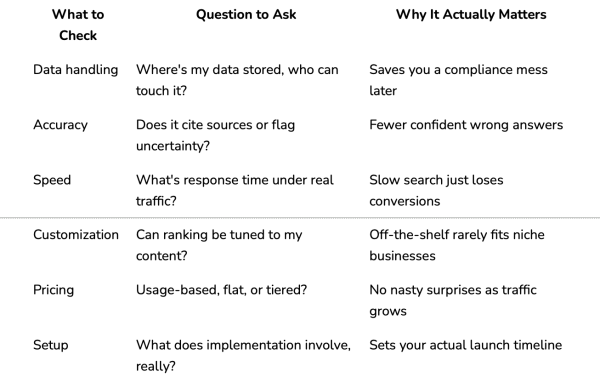
Not every vendor deserves the benefit of the doubt here. Run through this before signing anything:
Pay attention to how each search API provider explains its retrieval process. Vague documentation about ranking or sourcing is a warning sign. The better enterprise search API platforms tend to show their work, letting you actually inspect how an answer got put together.
Getting There Step by Step
- Audit your content first. Even the best AI-powered search API is only as good as what it's pulling from. Old, duplicate, or messy content produces messy answers, no matter how good the model is.
- Pick infrastructure built for grounding. A web search API or internal search tool that leans on retrieval-augmented generation, rather than pure generation, drifts into wrong territory far less often.
- Draw guardrails early. Decide upfront what the system should flatly refuse to answer.
- Test with actual customers, not your own team. Internal testers phrase things too cleanly. Real users throw weird, broken queries at a search bar constantly.
- Keep watching it. Search quality doesn't stay fixed. Content changes, so query logs and failed searches deserve regular review.
- Leave humans in the loop for anything sensitive. Legal, medical, financial questions still need a person checking, even with AI carrying most of the load.
Teams that skip steps three and six tend to regret it fastest. Responsible AI isn't a one-time policy doc you write and forget. It's closer to ongoing governance, the same way other responsible-business frameworks require continuous attention rather than a single checkbox.
Mistakes That Show Up Again and Again
Even teams with money and good intentions trip on these:
- Treating search like a checkbox. Bolting on an AI widget without testing real customer phrasing backfires almost every time.
- Ignoring speed. A great answer that takes six seconds is a great answer nobody waits around for.
- Hiding where answers came from. People trust results more when they can see the source. Hide that, and trust erodes fast.
- Assuming scale will just work out. Five hundred queries a day and fifty thousand a day are very different problems. Ask vendors directly about performance under real load.
These aren't just search problems. They're the same trust issues that show up whenever businesses adopt AI responsibly across any function, not just search.
What This Looks Like When Someone Gets It Right
The strongest setups usually layer a few things together. One layer handles semantic matching, another handles structured lookups, and a generation layer writes the final response. That layered approach tends to hold up better than expecting one single AI-powered search API to carry the entire job alone.
A solid intelligent search API should also fail gracefully. If it can't find a confident answer, it should just say so, or hand it off to a human, instead of filling the silence with something plausible-sounding but wrong.
Final Thoughts
AI search isn't really optional anymore. But careless AI search is worse than no AI search at all. The businesses doing well right now treat this as an ongoing responsibility, not a one-time feature launch.
Working with the right API Search Company gets you grounded answers, sourcing people can actually check, and infrastructure that scales without wrecking trust along the way. Pair that with regular content audits and human review for anything sensitive, and you end up with search people genuinely rely on.
Frequently Asked Questions
What is an API search company?
It's a company that builds and maintains search infrastructure other businesses plug into through an API, so they don't have to build semantic search, ranking, and retrieval systems from scratch themselves.
How is AI-powered search different from regular search?
Regular search matches keywords. AI-powered search, built on vector search and NLP, matches meaning instead, so people can type natural questions rather than hunting for exact phrasing.
Is RAG basically a chatbot?
Not quite. RAG is a technique for grounding AI answers in retrieved documents. A chatbot is just one interface that might use RAG behind the scenes, but the two aren't the same thing.
What does an enterprise search API usually cost?
It varies a lot based on query volume, data size, and how much customization you need. Most providers charge by usage, though some offer flat enterprise pricing for predictability.
Is this only for big companies, or can small businesses use it too?
Small businesses use the same underlying tech more and more, usually through simpler, cheaper tiers that search API providers build specifically for smaller teams.
What's the actual risk of AI search without any oversight?
Confidently wrong answers. Without grounding and clear sourcing, an AI search tool can mislead someone while sounding completely sure of itself.
How do I know if my current search setup is actually broken?
If it regularly returns nothing for perfectly reasonable questions, or your support team fields tickets that a working FAQ search should've caught, it's time to look elsewhere.
Comments

Powered by RoundtableAn AI/DeFi-powered Enterprise Media Operating System. Learn more at Roundtable.io.© Roundtable 2026. By using this site you agree to the Terms of Use and Privacy Policy