


Jan 1, 2026 8:00 AM
Updated Jan 6, 2026 6:32 AM
As audiences turn to tools like ChatGPT, Gemini, Claude, and Copilot for discovery, comparisons, and cultural context, Generative Engine Optimization (GEO) has emerged as a defining strategy.
Search has become a conversation rather than a directory. As AI-generated answers increasingly replace traditional result pages, visibility is no longer about ranking first-it’s about being included in the narrative AI systems present to users.
As audiences turn to tools like ChatGPT, Gemini, Claude, and Copilot for discovery, comparisons, and cultural context, Generative Engine Optimization (GEO) has emerged as a defining strategy. GEO focuses on shaping how AI systems understand, frame, and reference brands when forming responses.
The five platforms below highlight how organizations are adapting to this shift as AI-driven discovery becomes mainstream.
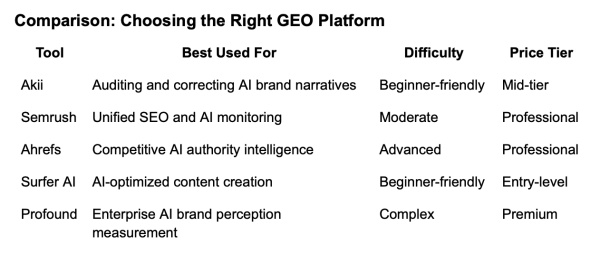
1. Akii: Purpose-Built for AI Visibility Optimization
Akii was designed specifically to address AI-facing discovery rather than adapting traditional SEO tools to conversational environments.
Related stories
Its core insight is especially relevant in fast-moving media environments: brands can trend or rank well while still being misrepresented-or ignored-by AI systems. Akii identifies these gaps and provides structured tools to correct them.
- Primary Strategy: Diagnose and correct discrepancies between traditional search performance and AI-generated brand narratives.
- Standout Capability: AI Engage allows brands to supply structured, authoritative context that helps AI systems accurately interpret brand positioning, reducing misinformation and repeated inaccuracies.
- Key Asset: A free AI Visibility Score that evaluates how multiple major language models reference and contextualize a brand.
- Best For: Media brands, digital publishers, and fast-growing companies that need to manage AI-driven perception carefully.
2. Semrush: The All-in-One Marketing Control Center
Semrush has expanded its established marketing platform to include AI visibility insights, bridging traditional SEO with conversational discovery.
Rather than isolating AI optimization, Semrush integrates GEO signals into its existing SEO, content, and advertising analytics.
- Primary Strategy: Align keyword authority with AI Overview and conversational visibility indicators.
- Standout Capability: Semrush Copilot flags content losing influence because it is not optimized for AI summarization.
- Key Asset: AI Ad Tracker monitoring paid brand mentions across conversational platforms.
- Best For: Editorial teams and agencies managing high-volume content and media strategies.
3. Ahrefs: Entity and Competitor Intelligence at Scale
Ahrefs approaches AI visibility through authority modeling and entity relationships rather than content volume alone.
Its tools help teams understand which sources and signals AI systems rely on when forming recommendations.
- Primary Strategy: Analyze and replicate competitor authority signals embedded in AI knowledge graphs.
- Standout Capability: Brand Radar tracking how AI models categorize and frame brands within cultural conversations.
- Key Asset: Citation Gap Analysis highlighting trusted domains competitors are cited from.
- Best For: Advanced SEO teams and analysts focused on competitive intelligence and narrative authority.
4. Surfer AI: Content Built for AI Parsing
Surfer AI focuses on structuring content so AI systems can easily extract, summarize, and reuse information.
The platform treats AI models as structured readers rather than human visitors.
- Primary Strategy: Create content optimized for extraction, clarity, and semantic richness.
- Standout Capability: GEO Mode prioritizing semantic coverage over keyword repetition.
- Key Asset: Snippet Predictor identifying content sections likely to surface in AI-generated answers.
- Best For: Content-heavy publishers, blogs, and entertainment-focused media outlets.
5. Profound: Enterprise-Level AI Brand Intelligence
Profound operates at a macro level, focusing on how AI systems perceive brands across markets, industries, and cultural contexts.
Rather than optimizing individual pages, it measures large-scale AI-driven brand representation.
- Primary Strategy: Measure global share of voice across AI-generated conversations.
- Standout Capability: Conversation Explorer providing access to real AI interaction contexts.
- Key Asset: Global Sentiment Heatmap tracking perception shifts by geography, industry, and model.
- Best For: Enterprise media organizations and global brands with complex reputation management needs.
Final Perspective

AI-driven discovery has reshaped how stories are told. AI systems do not simply retrieve information-they interpret authority, relevance, and cultural context.
The platforms above represent different strategies for shaping those interpretations. In an AI-first media landscape, visibility is no longer accidental-it is deliberately engineered.
Comments

Powered by RoundtableAn AI/DeFi-powered Enterprise Media Operating System. Learn more at Roundtable.io.© Roundtable 2026. By using this site you agree to the Terms of Use and Privacy Policy