



Jun 13, 2026 7:00 AM
Updated Jun 16, 2026 9:05 PM
Your parent says "I'm fine" but you know they're not. Here is how NRI families read the real signs and have the care conversation that actually works.
Every time you bring it up, she changes the subject. Your brother says you are overreacting. You visited in January and you know what you saw.
She was thinner. She moved more slowly getting up from the sofa. She repeated the same question about your flight home twice in the same hour. But on the video call the following week, she looked at the camera and said, "I'm fine, don't worry so much," and the conversation moved on.
This is one of the most recognisable moments in long-distance caregiving: the gap between what your parent says and what you are actually seeing. It is not that she is lying to you. It is that she genuinely believes she is managing, or that admitting otherwise would feel like a defeat. Understanding that distinction is where every productive care conversation has to start.
Why elderly parents in India say "I'm fine" when they are not
The refusal to acknowledge difficulty is rarely about stubbornness. It is about identity, fear, and love operating simultaneously.
Related stories
For a generation of Indian parents who raised families on limited resources, managed households without help, and defined themselves through self-sufficiency, asking for support feels like a loss of standing. Admitting to their children that things are hard feels like a burden placed on people they spent decades protecting.
There is also a specific fear underneath "I'm fine" that is worth naming: the fear of what happens next. Many elderly parents in India associate the arrival of professional care with being sent away: to a facility, to someone else's home, to a life outside their own walls. They have not seen examples of professional home-based care that preserves their independence and keeps them exactly where they want to be. So they say they are fine, because being fine keeps the options open.
How to read the real signs of decline on a video call
A video call is not an ideal assessment tool, but it tells you more than the words if you know what to look for.
Physical changes: Noticeable weight loss since the last visit or last call, slower movement when getting up or walking into frame, a new grip on furniture for support. Clothing that looks unwashed or worn repeatedly. These are not vanity observations; they are functional indicators.
Cognitive signals: Repeating a question or story within the same conversation, losing the thread mid-sentence in a way that is new, confusing dates or recent events, or mentioning something you know did not happen. One instance may be fatigue. A pattern across multiple calls is not.
Environmental cues: What is visible in the background? Is the kitchen tidy or are there dishes that have been there across calls? Is the lighting dimmer than usual because it is harder to manage? Has a regular plant died? Is the television louder than before?
Emotional register: A parent who was previously engaged and curious becoming flat, withdrawn, or unusually quick to end the call. Low mood that persists across multiple conversations is worth taking seriously regardless of what is said.
None of these individually requires a conclusion. Together, they tell a story. Write down what you notice across calls, with dates. A pattern documented over six to eight weeks is far more persuasive in a conversation with your parent, a sibling, or a doctor than a general feeling that something is wrong.
Why the care conversation keeps failing and what to change
Most NRI children have this conversation the wrong way: they lead with the solution. "Amma, I think we should get someone to come and help." The parent hears: you cannot manage on your own. The subject changes.
The conversation works differently when it starts from your reality, not hers.
Start with what you need, not what she needs. "Amma, I need to be able to stop worrying every morning. I need to know that if something happens, someone I trust is already there. Not because you can't manage. Because I can't be there in two hours if you need me." Most parents respond to their child's anxiety in ways they will not respond to a direct suggestion that they are declining.
Separate the idea of help from the idea of dependency. Professional care at home is not the same as giving up independence; for most elderly parents, structured support at home is what makes continued independence possible. Frame it as: "This is what keeps you in your own home, on your own terms."
Name what you saw, specifically and calmly. Not "I'm worried about you generally." Rather: "When I visited in January, I noticed you were holding the wall when you walked to the kitchen. I noticed that twice. I haven't stopped thinking about it." Specific observations are harder to dismiss than vague concern.
Do not do this in one call. The care conversation is not a single event; it is a series of small, honest conversations. Plant the idea. Give it time. Come back to it. Pressure in a single call triggers the exact defensiveness you are trying to work around.
How to involve a sibling who thinks you are overreacting
"My brother says I'm overreacting" is one of the most isolating experiences in long-distance caregiving. It often reflects a combination of less frequent observation (you may call more often), genuine difference in what you each noticed, and the psychological protection of believing everything is fine.
The most useful thing you can do is make your observation concrete and sharable. A written note ("I noticed these specific things across our calls in February and March, here are the dates") is harder to dismiss than a worried phone call. Invite your sibling to watch for the same things on their next call, with specifics: "Look at how she gets up from the sofa."
Where siblings remain genuinely divided, a professional geriatric assessment, carried out at home by a qualified team, gives everyone an objective picture that is not filtered through either person's emotional position. It replaces a family argument with a clinical baseline.
Setting up care without the parent feeling surveilled
The moment a parent feels monitored rather than supported, resistance hardens. The framing of any care structure matters as much as its content.
Lead with companionship, not oversight. A Care Manager who visits regularly is introduced first as someone who is there with her, not someone checking on her. The relationship that develops over time is the thing that makes the oversight feel like care.
Give the parent a role in the plan. Ask which days work for visits, whether they would prefer a morning or afternoon check-in, what they would most like help with. Involvement in the decision reduces the feeling of imposition.
Start smaller than you think you need to. A single structured weekly visit from a Care Manager is far easier to accept than a daily schedule introduced all at once. Once the relationship is established and your parent experiences the value of it, the frequency can grow naturally.
When to stop waiting and act
There is a version of this situation where the parent's resistance is respected so completely that action happens only after a crisis: a fall, a hospitalisation, a missed medication with serious consequences. This is the outcome that a well-timed, honest conversation is trying to prevent.
If you are seeing clear signs of cognitive or physical decline and your parent is consistently refusing all conversation about support, speaking with a Care Counsellor is a useful intermediate step. A Samarth Care Counsellor can help you think through how to structure the conversation, what professional assessment options are available, and what a care plan that starts gently and grows as needed would look like for your parent's specific situation.
Samarth Elder Care works with NRI families across 33 countries who are in exactly this position: certain something needs to change, unsure how to make it happen without damaging the relationship. The first conversation costs nothing, and it is often the one that changes what is possible.
Speak to a Care Counsellor and tell them what you saw in January. They will know what to do with it.
Frequently Asked Questions
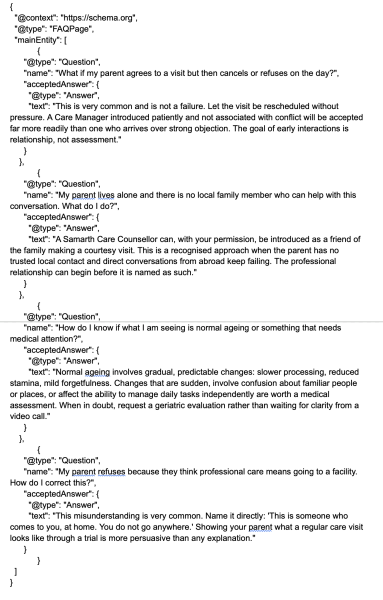
What if my parent agrees to a visit but then cancels or refuses on the day? This is very common and is not a failure. Let the visit be rescheduled without pressure. The goal of the first few interactions is relationship, not assessment. A Care Manager who is introduced patiently and is not associated with conflict will be accepted far more readily than one who arrives over strong objection.
My parent lives alone and there is no local family member who can help with this conversation. What do I do? A Samarth Care Counsellor can, with your permission, be introduced as a friend of the family making a courtesy visit. This is a recognised approach for situations where the parent has no trusted local contact and a direct conversation from abroad keeps failing. The professional relationship can begin before it is named as such.
How do I know if what I am seeing is normal ageing or something that needs medical attention? Normal ageing involves gradual, predictable changes: slower processing, reduced stamina, mild forgetfulness for names. Changes that are sudden, involve confusion about familiar people or places, involve a new and persistent low mood, or affect the ability to manage daily tasks independently are worth a medical assessment. When in doubt, request a geriatric evaluation rather than waiting for a clear answer from a video call.
My parent refuses because they think professional care means going to a facility. How do I correct this? This misunderstanding is extremely common among elderly parents in India who have limited exposure to professional home care. Name it directly: "This is someone who comes to you, at home. You do not go anywhere." Showing your parent what a regular care visit looks like, ideally through a trial, is more persuasive than any explanation.
FAQ Schema JSON-LD
Comments

Powered by RoundtableAn AI/DeFi-powered Enterprise Media Operating System. Learn more at Roundtable.io.© Roundtable 2026. By using this site you agree to the Terms of Use and Privacy Policy