


Jun 14, 2026 12:54 PM
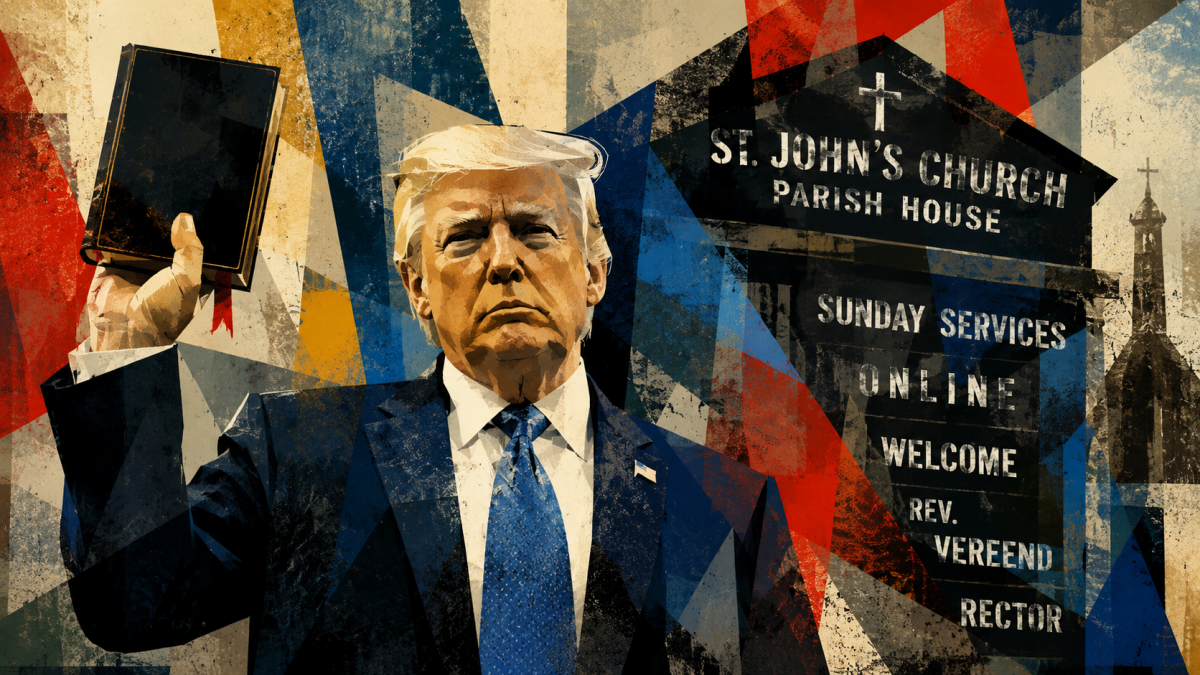
Why millions of white evangelicals embrace Donald Trump while other Christians see his politics as a betrayal of the faith’s deepest teachings on love, justice, and human dignity.
In 2018 my "Does Trump’s Religion Matter?" appeared on the History News Network webiste. In it, I cited another article on that site that noted that it’s ironic that evangelical Christian leaders, who have often warned of liberal anti-Christs, “seem to lack the self-awareness to identify something so anti-Christian in Trump himself. Or worse yet, they certainly recognize it, but don’t care.”
My article also noted that in the 2016 presidential election, according to exit polling, 81 percent of the white, born-again/evangelical voters and 60 percent of white, Catholic voters opted for Trump. In a later 2026 piece (posted on LA Progressive) I indicated that in the November 2024 election, “about 72 % of ALL White Christians—which included non-evangelical Protestants and Catholics—voted for Trump.”
I was reminded of these earlier writings by a June 2026 piece in The Atlantic by conservative Christian commentator (but anti-Trumpster) Peter Wehner. In it, he contrasted the white-born-again/evangelical voter-pro-Trump approach with his own more anti-Trump stance.
In my own 2026 essay on LA Progressive, I did something similar, quoting historian Jill Lepore who wrote that “much that was vital in Progressivism [which flourished in the years 1890-1914] grew out of Protestantism, and especially out of a movement known as the Social Gospel, adopted by almost all theological liberals and by a large number of theological conservatives, too.” They argued that “fighting inequality produced by industrialism was an obligation of Christians...Social Gospelers brought the zeal of abolitionism to the problem of industrialism.” I also referred to LAP contributor Rev. Peter Laarman, a retired minister who formerly led Progressive Christians Uniting in Los Angeles.
Related stories
But Wehner’s recent Atlantic essay is more comprehensive and deserves a thorough examination because it reveals and analyzes two very different kinds of Christian approaches—or from Wehner’s angle, a Christian one and a pseudo-Christian Trumpian one.
He begins his Atlantic article by citing Robert Jeffress, pastor of the First Baptist Church in Dallas, who thinks “that Trump embodies an ethic—cruel, vengeful, and mendacious—that Jeffress and many millions of evangelicals and fundamentalists not only tolerate but welcome.” Wehner goes on to write that “the justifications offered by Jeffress, by the evangelical leader Franklin Graham, and by countless white evangelicals and fundamentalists who voted for Trump...amount to something like this: America is engaged in an existential, even cosmic struggle; the enemy is composed of secular, progressive forces who are agents of evil; and Trump’s combativeness and ruthlessness are not vices but necessary virtues. He has been called by God for this moment.”
Wehner goes on to indicate that during Trump’s 2024 presidential campaign, he reposted the video “God Made Trump” and screened it at his rallies. It stated that “On June 14, 1946 [date of Trump’s birth] God looked down on his planned paradise and said: ‘I need a caretaker.’ So God gave us Trump...God had to have somebody willing to go into the den of vipers...Call out the fake news for their tongues as sharp as a serpent’s. The poison of vipers is on their lips...So God made Trump.” God continued, “I need somebody who will be strong and courageous. Who will not be afraid or terrified of the wolves when they attack. A man who cares for the flock. A shepherd to mankind who won’t ever leave nor forsake them. I need the most diligent worker to follow the path and remain strong in faith and know the belief of God and country.” Wehner quotes a source that believes that many evangelicals thought of Trump as their “ultimate fighting champion.”
Yet, despite the above reflection of Trump’s mentality, we should not make the mistake of equating the approach of allTrump voters with that of Trump himself. Many of them have simply been misled.
Wehner explains Trump’s appeal to evangelicals by several steps he took. One was realigning “his previously held views on a range of issues, including abortion and judges, to put himself in lockstep with the Christian right.” Another was the “advantage that Trump enjoyed...from the importance placed within significant parts of the evangelical and fundamentalist worlds on male authority... and the corresponding disdain for ‘feminized’ Christianity.” Wehner believes that “many figures within evangelicalism have promoted an aggressive, domineering, even abusive view of manhood,” and that the “more merciless, lawless and foulmouthed Trump became, the more his support among conservative evangelicals grew.”
This evangelical-supported Trump approach contrasts with a more progressive Christianity that Wehner champions and that I identified with (see paragraph four above) and developed during my years at Xavier U. (Ohio) and Georgetown U. in the late 1950s and 1960s.
Wehner refers to it as Christian humanism, and he writes that “at the very core of Christian humanism is a belief in the inherent dignity and worth of all human beings, who are made in the image of God, and in the pursuit of a society that respects and values the intrinsic and equal worth of the individual, regardless of social status.” In contrast to the fear-based Trumpian approach (“for much of the past half century, evangelical engagement with the world has...been shaped largely by fear—a fear of losing cultural and political influence, and with it a whole way of life”), Christian humanism exhibits “a confidence and calm assurance in Christ that allows them to engage with the world with less fear and defensiveness...It is the opposite of a culture-war mentality.”
Wehner recognizes the many past “moral failures of Christianity,” but in the 20th century, Christian thinkers such as the gay W. H. Auden, whom I have written of before, “were drawing on the Christian-humanist tradition to critique their own culture and to outline a plan for moral and spiritual regeneration.”
Like Wehner I applaud a Christianity driven by love (St. Paul’s words come to mind: “Love is patient, love is kind. It does not envy, it does not boast, it is not proud. It does not dishonor others, it is not self-seeking, it is not easily angered, it keeps no record of wrongs. Love does not delight in evil but rejoices with the truth. It always protects, always trusts, always hopes, always perseveres.” And “If I speak in the tongues of men or of angels, but do not have love, I am only a resounding gong or a clanging cymbal. If I have the gift of prophecy and can fathom all mysteries and all knowledge, and if I have a faith that can move mountains, but do not have love, I am nothing. If I give all I possess to the poor and give over my body to hardship that I may boast, but do not have love, I gain nothing.”)
Like Wehner, the type of Christianity I applaud is such a Christianity, not one of hate exemplified by President Trump, who in September 2025 stated, “I hate my opponent and I don’t want the best for them [sic].”
Comments

Powered by RoundtableAn AI/DeFi-powered Enterprise Media Operating System. Learn more at Roundtable.io.© Roundtable 2026. By using this site you agree to the Terms of Use and Privacy Policy