
Tom Driggers • Attribution (CC BY 2.0) • Flickr


Nov 13, 2024 10:31 PM
Updated Nov 14, 2024 7:16 PM
The rotted husk of a corrupted religion may need to fall to the ground in order for the revolutionary spirit of Jesus of Nazareth to find new life.
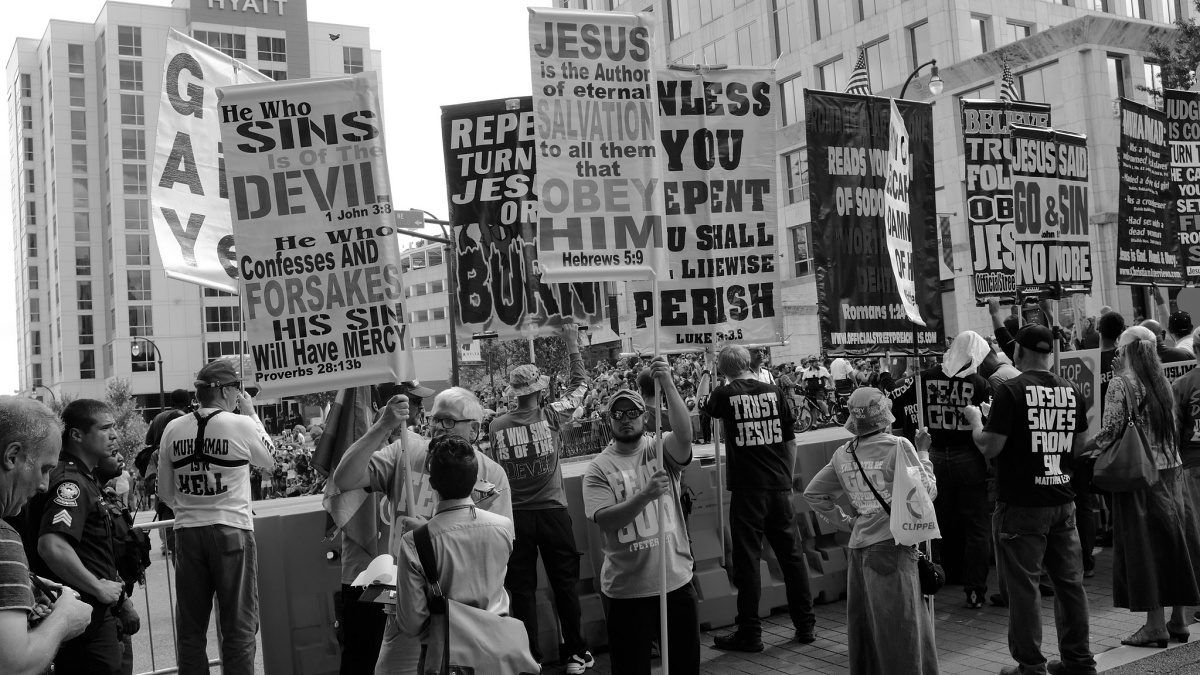
In what must be the least surprising 2024 election outcome, white evangelical Christians delivered again, and delivered bigly, for adulterer, thief, and quondam Bible pitchman Donald John Trump. Exit polls indicate that Trump gained in favor among the self-described born-again, winning 82 percent of their votes, compared to the 76 percent he picked up in 2020 when he was running against Joe Biden. Moreover, the white evangelical share of the total national electorate barely budged from 2020; the born-again share was 27% this year, as against 28% in 2020. Trump also gained among U.S. Catholics, winning 54% of the Catholic vote this time, as against 50% in 2020.
While white votes were the main factor, it's also clear that Trump also racked up noteworthy gains among Hispanic evangelicals and Hispanic Catholics. Exit polls indicate that Trump's improved performance within this diverse demographic had mostly to do with concerns about inflation and food prices in particular. But religion undoubtedly played a role. For the past 40 years and more, a number of white-led evangelical bodies—Pentecostal groups but also Southern Baptists and others—have made enormous inroads within several Spanish-speaking cohorts, even as the numbers of active voters from these cohorts have been rising. Polls and focus groups have shown that strict border controls, rejection of trans and abortion rights, and an overall "America First" politics play especially well with Hispanic Christians who have gained citizenship, who have established themselves economically, and who adhere to the strongly patriarchal moral code they believe is central to Christian faith.
So what is it about U.S. Christianity that so aligns with reactionary politics? I have been wrestling with this question for decades as a progressive Christian thinker and activist. The most obvious thing to be said about it is that pulling Christians in a rightward direction has long been a well-funded and well-organized project of hard-right conservatives with no particular interest in religion per se. The reactionary right's 20th century efforts to bring ordinary Christians into its orbit go back to the plutocrat-backed and virulently anti-New Deal America Liberty League and to James Fifield's Spiritual Mobilization of the 1940s and 1950s. The fervent anti-unionism and the ardent affection for a "self-sufficiency" gospel exhibited by celebrity preachers as unlike each other as Billy Graham and Norman Vincent Peale also did their part to keep most white Christians locked into a flag-waving capitalist and militarist orientation during the height of the Cold War.
But long before these 20th-century excrescences came along, U.S. evangelical Christianity was already firmly aligned with a petit bourgeois outlook. I have written elsewhere about the deep rooting of the money cult within the bosoms of nearly all 19th-century Christian believers. Reaching back even farther, to the 17th and 18th centuries, the notion of a special divine anointing—of "a city set upon a hill"—gripped the imaginations of the European settler colonialists, sanctioning (in their eyes) the theft of Indian lands and the near-extermination of the continent's original inhabitants. Racism has always tainted white American Christianity, from Jamestown and Plymouth Rock to the birth during the early 20th century of an emphasis on so-called Christian "fundamentals" that just happened to coincide with the second rise of the Ku Klux Klan.
Related stories
And then, of course, there was the well-documented culture warfare developed and perfected from the 1970s onward by the likes of Jerry Falwell, Pat Robertson, James Dobson, et al. No surprise that these men and others like them were all hardcore racists who learned not to use open race hatred but rather to use sex panic in order to herd Christians into their reactionary corner and keep them there. Paul Weyrich's central role in orchestrating these late 20th-century religious right machinations has likewise been well documented. What has hardly been documented or discussed at all is the systematic under-the-radar work of a neoconservative-backed outfit called the Institute for Religion and Democracy to effectively decapitate and degrade a progressive Christian voice in public life.
To this day, IRD operatives would like people to think that what are often called the "mainline" Protestant denominations—Presbyterians, Episcopalians, United Methodists, Evangelical Lutherans, Congregationalists, etc.—basically destroyed themselves by embracing causes like same-sex marriage and gay ordination that were unpopular with their own members. It is certainly true that national leaders and also many clergy leaders within these bodies have often been "ahead" of the people in the pews on various political issues. But it is also true that these leaders were actively sabotaged and sandbagged by IRD-supported plants within their denominational ranks.
The IRD was born in 1981 out of Cold Warrior alarm over the extent to which certain liberal U.S. Christian leaders were identifying with liberation theology and supporting liberation movements in Central America. These progressive leaders were smeared as Marxists and communist agents. But the IRD didn't stop there; it trained and funded splinter groups to foment bitter denominational fights over highly charged issues like the ordination of gay clergy. And the IRD's stealth campaigns have been hugely successful. The Episcopal Church and the United Methodist Church have both been broken apart and badly weakened. The National Council of Churches, a mostly mainline Protestant body with a once-robust voice in national affairs, is now a pale shadow of its former self.
One even sees the death-dealing fingerprints of militant white evangelical Christianity in the anti-gay terrorism taking place today in Uganda, Nigeria, Ghana, and elsewhere in Africa, Latin America, and Asia. Nineteenth-century missionary enterprises carried on by British, European, and American colonialists planted the original poisoned seeds. But those seeds have been watered more recently by the deep and active involvement of U.S.-based evangelicals in spreading a contorted homophobic gospel (we should always recall that Jesus had nothing at all to say about what we today call homosexuality, whereas he had a hell of a lot to say about greed and violence and exploitation of the poor).
It breaks my heart to say it, but an authoritarian-friendly Americanized Christianity has done more than its share to usher in a nightmare world, and I do not expect the nightmare to end anytime soon. I will go further and say that I now view nearly all of institutional Christianity worldwide—including nearly every expression of Roman Catholic and Eastern Orthodox power and practice—as a kind of incurable affliction: as a blight on the future of humanity.
And one last malignancy, also not reported or discussed as much as it should be: the outsized influence of U.S. based Christian Zionists in supporting Israel's ethnic cleansing project--"reclaiming" areas they imagine would have once constituted the biblical Judea and Samaria.
I do not expect that progressive Christianity will ever quite flame out completely, because I believe that at least some of the young people raised in conservative church environments will discover it and claim it for themselves as an attractive alternative. But I do expect that most of the young who have been directly damaged or just put off by the homophobia and transphobia and misogyny and other forms of craziness will abandon Christianity altogether. This is already happening across the globe, and to my mind, it's okay. The rotted husk of a corrupted religion may need to fall to the ground in order for the revolutionary spirit of Jesus of Nazareth to find new life.
Comments

Powered by RoundtableAn AI/DeFi-powered Enterprise Media Operating System. Learn more at Roundtable.io.© Roundtable 2026. By using this site you agree to the Terms of Use and Privacy Policy