
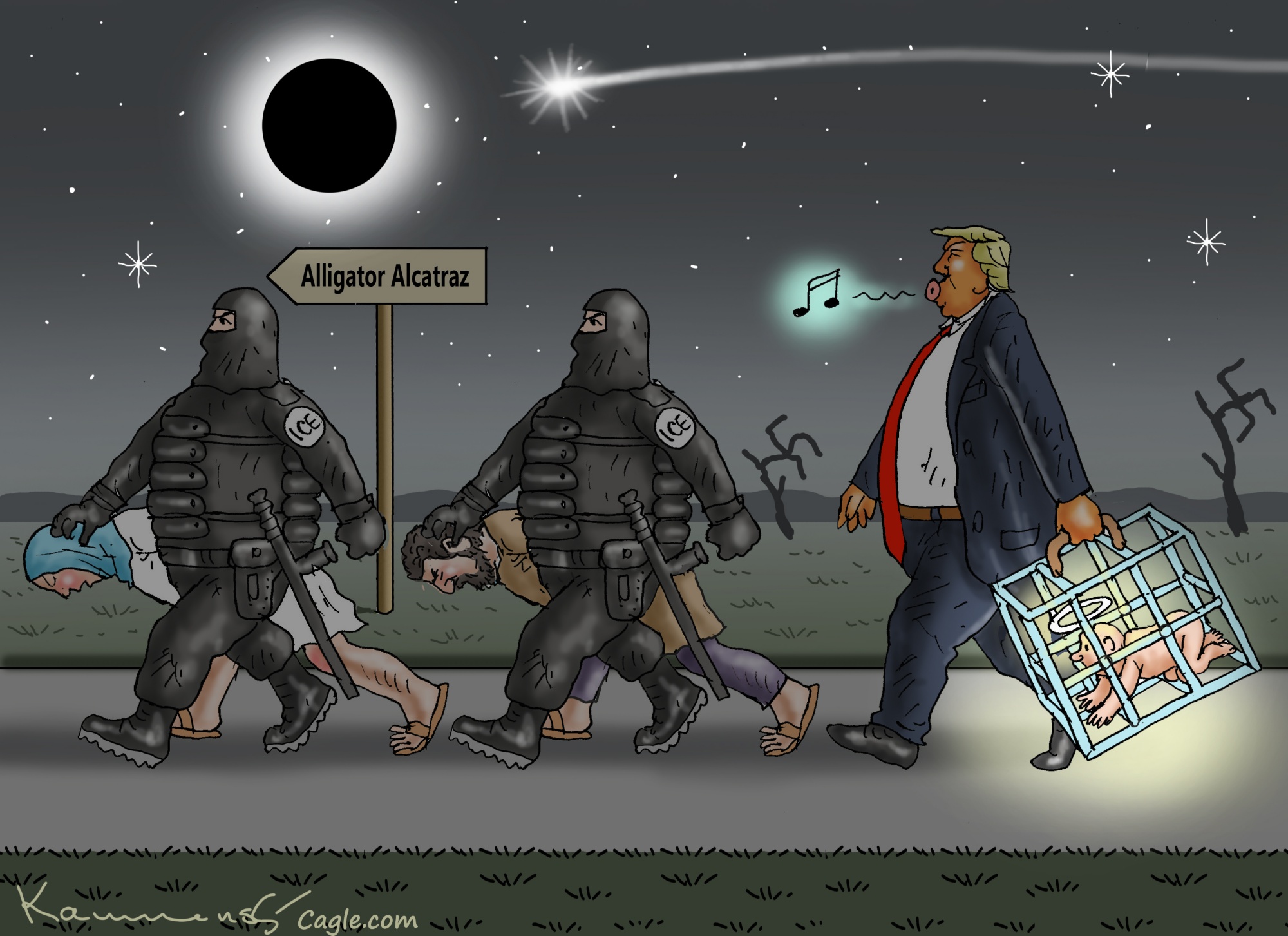
Illustration by Marian Kamensky on CagleCartoons.com


In the chapel of the Divina Providencia Hospital a prelate, now a saint, warned that the church would betray its love for God if it stopped defending the poor.
Mar 29, 2026 7:51 PM
In the chapel of the Divina Providencia Hospital a prelate, now a saint, warned that the church would betray its love for God if it stopped defending the poor.
In certain moments of history a country begins to move like a freight train in the night—heavy with memory, argument, and unfinished promises. No single passenger controls the locomotive, yet everyone aboard must live with the direction it takes. What follows is a reflection on America in such a moment, where conscience, faith, and power travel together across a darkened landscape still searching for dawn.
Some memories return because they refuse to let a country forget what it has done.
The memory comes back the way an old train whistle drifts through a winter valley—thin, distant, but sharp enough to pierce the heart.
Follow that whistle far enough and it leads to a boxcar. I am already sitting inside it.
Related stories
The wood is rough beneath my hands. The air smells of iron, dust, and the tired breath of history. The train is already moving, though no one seems to know where it began or where it intends to stop.
It is the sort of train that appears when a nation begins forgetting itself.
Mile after mile the tracks stretch forward like a sentence being written across the continent—two thin lines of steel disappearing into distance, laid down by people long dead and followed by passengers who rarely stop to ask where they lead.
There are journeys a person takes not to arrive somewhere new, but to understand where he has been.
A freight train is a good place for that kind of reckoning.
The long iron rhythm of the wheels loosens the knots of memory. Sitting in the open door of a boxcar, a traveler begins to think about the strange arithmetic of a life—its loyalties, its errors, its small acts of courage, its larger failures.
Catholics have always understood something about that reckoning.
Confession is not humiliation but truth spoken in the presence of grace. One kneels, says what must be said, and discovers—sometimes to one’s surprise—that the future has not closed its doors completely.
Perhaps that is why the old train feels like a chapel of sorts.
The wind moving through the open car carries the dry scent of wheat fields and distant rivers. The land slides past slowly enough to remind a traveler that time, like mercy, often moves at a pace human beings find difficult to accept.
Passengers climb aboard one by one.
They arrive with suitcases packed full of certainties—some religious, some political, some wrapped in the tattered flags of memory. No conductor checks their tickets. No one seems to know who is driving the locomotive.
Outside the narrow slats of the boxcar, the American landscape slides past in restless bands: deserts, suburbs, shopping malls, abandoned factories, churches with steeples sharp as bayonets.
Inside the boxcar the conversation begins.
Someone speaks of freedom.
Someone else speaks of order.
A third whispers that the republic is in danger and must be rescued from its own people.
The argument swells like wind rattling the loose boards of the car.
The train keeps moving.
And somewhere ahead of us—beyond the arguments in this freight car, beyond the sermons and strategies and prophecies of storms—there is a voice in the locomotive.
It carries the swagger of casinos and television spectacle, the voice that once descended a golden escalator beneath bright television lights and promised to make the country great again.
He does not appear among the passengers.
He does not need to.
His presence moves through the train the way weather moves through a valley—unseen, unavoidable.
Night settles differently on a freight train.
It arrives slowly, as if the darkness itself were another passenger climbing aboard at some forgotten siding on the prairie. The wheels keep their patient rhythm—steel repeating the same quiet sentence mile after mile.
Songs come first.
Not loudly. Not the way they once did on radios crackling through kitchen windows. They return more like distant signals drifting through memory.
Somewhere in the bloodstream of the continent Glen Campbell is still singing Gentle on My Mind.
And sometimes another voice drifts through the darkness—a voice rising beside the riverbanks of neighboring Montreal.
Leonard Cohen sang there of Suzanne, of oranges and tea and the quiet mysteries of tenderness.
Cohen understood something most prophets forget: love is not the opposite of suffering but its companion.
And then, in the long hours of darkness, another song sometimes returns, drifting through memory like smoke rising from an extinguished fire.
It is the melancholy patience of By the Time I Get to Phoenix, the traveler moving forward while the person he loves will not yet know he is gone.
Morning arrives first.
Understanding comes later.
Something in that delay feels devastatingly human.
Love rarely ends with explosions.
More often it fades like a town disappearing in the rear window of a bus until distance erases it completely.
Outside the boxcar the country slides past in long unfinished sentences—grain elevators rising like cathedrals of wheat, abandoned factories standing beside rivers that once carried the machinery of an earlier century.
And every so often the train slows just enough for someone new to climb aboard.
A preacher appears first.
He carries a thick Bible and the stern certainty of someone convinced the country began to fall apart the moment married women were allowed to vote. His sermons smell faintly of mothballs and empire. He speaks of restoring order, of returning the nation to an earlier obedience. One of his most devoted parishioners is the United States Secretary of War.
Farther down the train sits another traveler polishing the armor of an old mythology. He whispers about civilizational decline and sacred hierarchies.
And somewhere moving between the cars is a tireless merchant of grievance who has discovered that resentment travels faster than truth.
They speak with enormous confidence.
But the train does not change direction.
It continues its long passage through the night.
Outside the slats of the boxcar another landscape appears—fields far away across the Atlantic where a smaller train once tried to hold the line against an empire moving west. The passengers remember how the country once promised to stand beside those who refused to surrender their freedom. But promises, like timetables, can be quietly revised in the night. In distant capitals men study maps again, wondering whether the great locomotive that once pulled the democratic world forward has begun to uncouple its cars one by one. European governments now whisper about building their own engines of defense, uncertain whether the conductor in Washington still intends to keep the train on the same tracks.
Farther north another country listens to the sound of that engine with growing unease. For more than a century its frontier with the United States was the quietest border in the world. Now even there the maps are being studied again, contingency plans drawn in careful pencil as if history itself were clearing its throat. It is a strange moment when neighbors begin to imagine what was once unimaginable—that the long peace of the continent may depend not on trust, but on preparation.
Then a woman near the door raises her voice.
“What about the girls?”
The preacher looks puzzled.
“What girls?”
“The girls in the school.”
The words move through the boxcar like a sudden wind.
“I saw the pictures,” she says quietly.
“The backpacks in the dust.
The desks turned over.
The math books still open.”
The train hits a switch in the rails. The sound cracks through the car like a broken bell.
“There were more than a hundred of them,” she continues.
“Little girls.”
Silence spreads through the boxcar.
From somewhere ahead the door of the locomotive opens and the voice drifts back again—the same voice that once descended a golden escalator and promised to make the country great again.
“It wasn’t us,” the voice says.
“It was Iraq. They did it.”
The passengers glance at one another.
The woman does not move.
“The missile had a number on it,” she says quietly.
“A number that leads back here.”
“It happened during our excursion, but it wasn’t us,” says the voice from the locomotive.
The preacher lowers his eyes.
“You mean an incursion, not an excursion.”
“And it was bloody,” the woman replies, “and it lasted forever.”
Outside the darkness slides past—factories like skeletons, highways glowing with headlights, churches where candles burn beside statues of saints who once believed every human life carried the image of God.
The door of the locomotive slams shut.
The voice disappears into the roar of the engine.
The woman sits down.
The boxcar grows very quiet.
The train keeps moving.
It is then that someone notices the child.
She has been there all along, sitting on a wooden crate near the wall.
She is no more than eight.
In her lap lies a small notebook—the kind children carry to school.
Every few minutes she writes something down, pauses, and looks out through the slats of the boxcar.
“What are you writing?” the woman asks.
“Where the train is going,” the girl replies.
The preacher frowns.
“No one knows that.”
The girl shrugs and writes again.
Across the car two men whisper about a financier whose airplanes once carried senators and celebrities to an island where girls became currency—another secret the country pretended not to see.
“Everyone knew,” one of them murmurs.
Outside the country slides past—courtrooms, highways, television studios.
Somewhere far away a schoolyard in another country remains quiet beneath the dust of a missile strike.
Inside the boxcar the passengers shift uneasily.
It begins to dawn on a few of them that the problem may not be the passengers.
It may be the train itself.
The train keeps moving.
Toward morning the train begins to slow.
Not suddenly. Freight trains do nothing suddenly.
Dawn spreads across the land like a pale confession.
From the open door of the boxcar the country appears almost peaceful at this hour—fields silvered with dew, towns waiting for the voices of children.
Among the passengers sits a quiet man who has listened to everything. He is a diocesan bishop, the chief pastor of a large district in California.
He is remembering that years ago, in the chapel of the Divina Providencia Hospital in San Salvador, during troubled times, a prelate of the Catholic Church in El Salvador, now a saint, warned that the church would betray its love for God if it stopped defending the poor.
The powerful silenced him. He was shot dead while saying Mass.
He is remembering that Salvadoran soldiers killed six Jesuit priests, along with their housekeeper and her daughter, at the University of Central America.
But their words survived. They survived in classrooms where teachers insisted that the poor must learn to read the world as well as the word. They survive wherever someone discovers that love itself can become a form of resistance.
Such love moves quietly through history.
It sits in classrooms, as Paulo Freire once reminded us during his years of exile.
It kneels beside hospital beds.
It rides freight trains across long distances carrying nothing more spectacular than the belief that another world might still be possible.
The sun lifts above the fields.
Dew gathers on the rails like beads of silver.
For a moment they shine—two thin lines of light stretching toward a horizon no one can yet see.
Whether those rails still carry the old promise of the republic—or lead toward a darker country—no passenger in the boxcar can yet say.
Somewhere far behind the train, a schoolyard is still waiting for morning.
The train keeps moving.
And somewhere ahead, beyond the next bend in the tracks, grace may still be waiting.
Comments

Powered by RoundtableAn AI/DeFi-powered Enterprise Media Operating System. Learn more at Roundtable.io.© Roundtable 2026. By using this site you agree to the Terms of Use and Privacy Policy