


Teach the Ten Commandment
Jul 27, 2024 12:00 AM
Updated Jul 28, 2024 6:55 PM
There is not a religiously driven politician in the U.S. who actually wants any school to be “teaching” the Bible.
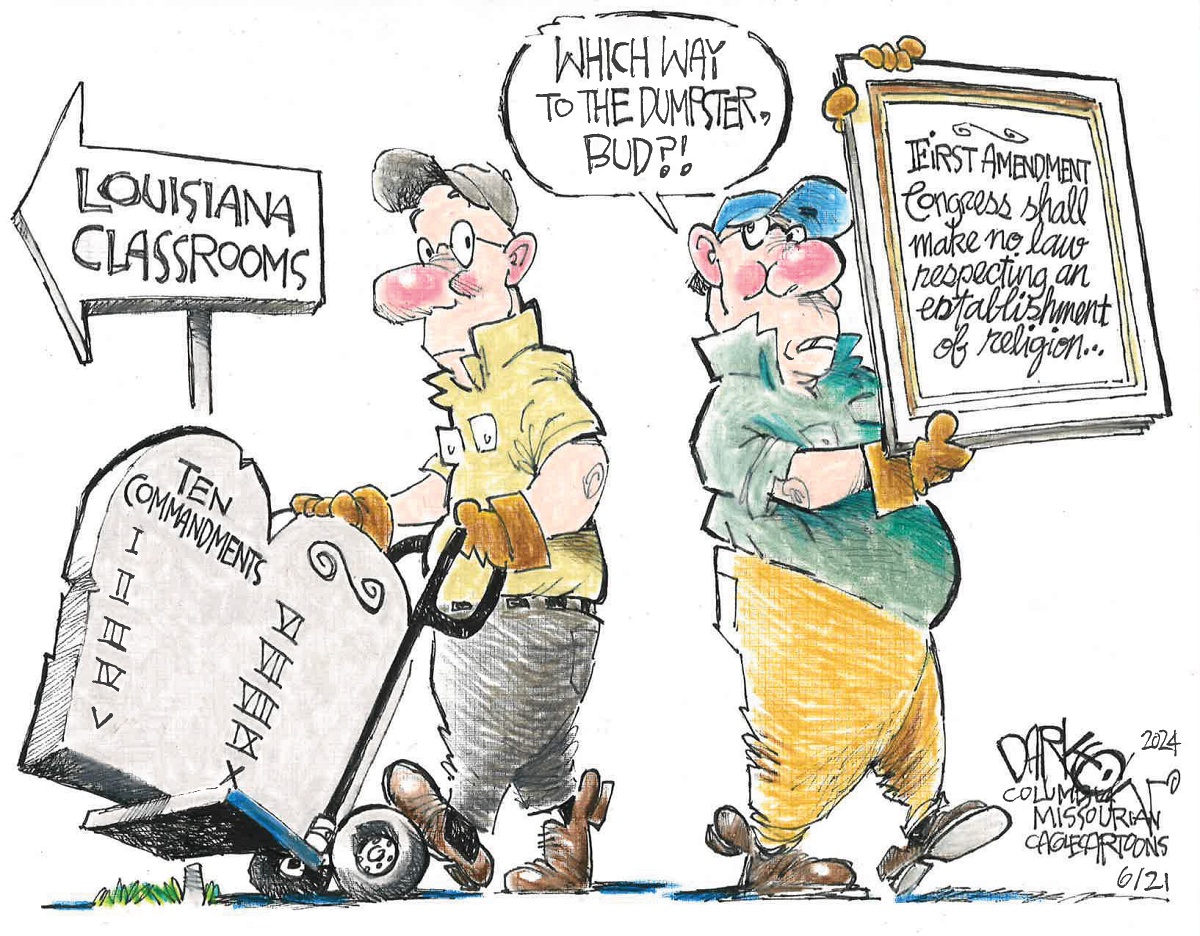
Louisiana and Oklahoma have legislated that every school classroom display the Ten Commandments. But which Ten Commandments? Catholics and Protestants have different versions of what they say are the true Ten Commandments. For example, Commandment #6 is “Thou shalt not kill.” For Catholics, this is Commandment #5. Which is mandated for Louisiana schools, which for Oklahoma? Do parents have a say in the matter?
Evangelicals and Mormons believe that the biblical Ten Commandments don’t apply to them.
When we speak of the Ten Commandments, or anything else in the Bible, we have also to ask which Bible we are talking about. There are numerous translations of “the Bible,” some of which involve the Ten Commandments.
The King James version of the Bible, known to most of those who settled the English colonies in America, print the text, “Thou shalt not kill.” But history shows us that as soon as the Catholic Church was absorbed into the Roman Empire, in the 4th century CE, christians found all sorts of reasons to kill. Modern translations like to soften the Commandment to say, “Thou shalt not murder.” But defining the word murder to justify other, “legitimate,” killing has become the norm for christians unhappy with the absolutism of the King James version. Which version should be posted in schools?
Related stories
Similar problems arise when discussing other Commandments. There is a Commandment against adultery (Protestant #7; Catholic #6) and a Commandment against coveting thy neighbor’s wife. (Protestant #10; Catholic #9) But for all modern Evangelicals and Fundagelicals these Commandments are irrelevant when approving the behavior of politicians and religious leaders who promise to end efforts to racially integrate society.
A brief look at the Ten Commandments shows us significant conflicts with modern life. Trying to understand these conflicts requires understanding their place(s) in the Bible text and the context in which they are found. So it is not surprising that states that want to post the Ten Commandments also want to “teach the Bible” in their schools. The ACLU has filed suit to stop such teaching, in what is one of history’s most ill-conceived exercises.
There is not a religiously driven politician in the U.S. who actually wants any school to be “teaching” the Bible. Rather, what politicians want is for schools to “preach” the Bible instead of teaching it. There is no desire for biblical education, but only for religious indoctrination.
The ACLU and progressives are simply wrong to oppose biblical education. Even a brief look at a few common Bible verses show clearly that the Bible is not what it is presented to be by fundagelicals. It is full of conflicts with right-wing biblical preaching. Actually teaching the Bible, rather than preaching it, would only hasten the flight of young people from the hucksterism of modern, for-profit religiosity. Let’s consider a few examples:
The Book of Job is often offered as a lesson in religious faith and steadfast devotion to god. It is widely accepted as having been written centuries BCE, and forming a foundational text in what monotheism means. The first chapter starts out with God and Satan sitting down to a meal, with “the sons of god” in attendance. Satan offers a challenge to God, claiming that Job a successful, wealthy man, will abandon his faith in God if he is deprived of all his worldly goods.
So God lets Satan take everything from Job, and Job remains devoted to God. The Second chapter starts with another meal attended by God, Satan, and God’s sons. This time Satan ups the challenge and God lets him afflict Job with personal injury, not just loss of worldly goods. Again, Job remains faithful, disproving Satan’s claims. God then restores all of Job’s goods and family—happy ending.
But let’s go back to the beginning. God and Satan are sharing a meal. Really? Aren’t we always told that God kicked Satan out of Heaven and wants nothing to do with him? And the meal was attended by “God’s sons”? Aren’t we always told that God only had one son, born centuries after the Book of Job was written? Shouldn’t students being “taught” about the Bible be encouraged to raise questions about, and write reports about such language?
(Bible publishers who cater to modern, for-profit pastors print Bibles that say God and Satan were sitting around with a bunch of angels. But they include footnotes that point out that the original Hebrew text says “God’s sons.” They don’t explain how those ancient Hebrews got their own beliefs ‘wrong.’)
Preachers also tell us that God was alone before he created the earth and the stars and the sun and the moon. But Proverbs in the Bible say something different. Proverb 8:22-31 tells us that Wisdom was with God before he created anything. And Proverb 9:1-6 establishes that Wisdom was female. So there was a woman’s touch before creation. That may explain sunsets and little puppies.
It might also sponsor students’ questions about why an “all-knowing, all-seeing” diety needed a feminine Wisdom before he could create anything. And about why their local minister doesn’t talk about Wisdom and her role in any of his phallo-centric sermons.
This overlooking of the female component of creation seems particularly strange given the fascination primitive religionists have with sex. And it seems more than a little strange that people who want to focus so much attention on other people’s sexual activities have such strong resistance to any fact-based sex education in schools.
In late elementary grades and in middle school, most students are approaching puberty and experiencing their initial feelings and confusions and fears related to sex. How many chapters of the bible tell us that male so-and-so “knew” female so-and-so and she “bore” a child?
When teaching, rather than preaching, the bible, shouldn’t students who are required to study bible stories be expected, even encouraged to ask questions seeking clarification of what that “knowing” means, and how it relates to the differences between female and male? Allowing schools to teach, rather than preach, the bible seems a natural stepping stone toward letting students learn realities about sex.
The rapid rise of a pugilistic and politicized white evangelicalism occurred in direct tandem with the virulent reaction to the advances of the midcentury civil rights movement. More Videos
I don’t understand the ACLU’s opposition to teaching the Bible in school. The ACLU has no opposition to teaching the “theory of gravity,” or the “theory of the big bang,” or the idea that the earth circles the sun, rather than the sun circling the earth, as the Bible preaches.
Letting the proponents of Biblical inerrancy control the terms of any discussion of how the Bible should be discussed is disgusting. The bible is a remarkable collection of creation myths, world explanations and images of the development of human thought on morals over millennia. Wresting control of the Bible and its interpretation from the Catholic Church was key to the Age of Enlightenment.
In the USA, the medieval Catholic Church has been replicated by for-profit televangelists, preaching that their claims about the Bible are as infallible as were the claims of the old popes.
Gutenberg made breaking the Church’s chokehold on “the truth” possible by making it possible for people to question the Church’s claims, and then question scientific “truths” and the “truth” that all rulers were appointed by god and must be obeyed. Breaking the fundamentalists’ current control of “Biblical truth” through incessant e-media blather would be a natural result of actually teaching school children about the Bible.
Actually, teaching the Bible could also undermine business attacks on schools. More than a decade ago pro-business “Christian” activists in Texas got their Republican Party to formally oppose teaching “critical thinking skills” in public schools. But teaching the Bible could undermine this effort. Encouraging students to ask “Why do these verses contradict each other” and “Why do Catholics and Protestants have different Bible versions,” and “How do other religious scriptures (the Q’uran or the teachings of Lao T’zu, or of Native American tribes) disagree (or agree) with biblical values,” almost necessarily requires students to engage in critical thinking processes.
There is little political incentive to disrupt the received wisdom of the church-state separation debate. The money is on the side of the churches. But education shouldn’t be as political as some for-profit churchmen made it in the dark ages and make it now.
Education is the most valuable thing any parent can give their child (yes, that’s also in the Bible and in the Q’uran). Parents in districts where schools are “teaching” the Bible should act to ensure that their schools are teaching and not preaching. They should be demanding non-sectarian teaching, encouraging their children/students to ask questions, and insisting that schools and teachers are allowed to, required to, give accurate, non-sectarian answers.
If schools post the Ten Commandments, parents should insist that students be allowed to post related value statements from other faith traditions. Let students compare and contrast, let them learn. Rather than simply decrying any exposure at all.
Comments

Powered by RoundtableAn AI/DeFi-powered Enterprise Media Operating System. Learn more at Roundtable.io.© Roundtable 2026. By using this site you agree to the Terms of Use and Privacy Policy