



May 4, 2023 5:42 PM
Everybody who warns us of its dangers tells us that A.I. is still in its infancy, with its powers still waiting to bloom.
I wonder about artificial intelligence. Everyday the corporate “liberal media” has a new story about the dangers posed by A.I., or an interview with some expert working in the field, who promises that the machines will become smarter than humans and will take over the world.
At first, I wondered how bad might that be. With humans running the world, we know that we continue to create pollution and climate change, even as we understand the long term destructive effects of such things. If machines think logically about preserving the planet they exist on, would they permit such destruction to continue?
It also crossed my mind to think about history. Within just my own lifetime, we’ve been told that civilization would end if we ended legal segregation. Or if we allowed women to become soldiers, or even firemen (firepersons?), or police. But the Abu Graib stories showed us that women soldiers can act as dehumanized as any man, and convictions in the last few years have shown that women police are as able as their male counterparts to gun down unarmed men of less favored races.
If we go back in history, we find that the few people who controlled what most people learned were horrified by the development of the printing press.
Related stories
If we go back in history, we find that the few people who controlled what most people learned were horrified by the development of the printing press. It was going to totally disrupt civilization. It would let people learn things on their own, without the guidance and control of the priests who provided the necessary context for what people should learn.
To some extent the doomsayers were right. Without the printing press, there might never have been the Protestant Reformation, or the Age of Enlightenment, or the development of Royal Science Societies which began to link new scholars in the pursuit of knowledge across the borders of traditionally warring nations.
Would Puritan minister Cotton Mather ever have experimented with inoculations against smallpox, in 1723, if he were not communicating with both European scientists and with African slaves whose societies had practiced inoculation long before transatlantic slave traders came on the scene? Cotton Mather’s studies and successes were both the descendants of the printing press and the great grandparents of today’s mRNA vaccines.
Millennia earlier in history humans had learned how to make weapons. Simple stones and clubs could inflict death on both enemies and food animals. And sharp-edged stones could inflict injury more quickly and safely than a round stone. A sharp stone fitted to a long tree branch could injure a woolly mammoth while keeping a hunter safely distant from the mammoth’s tusks.
Stone Age women, if we believe, Jean M. Auel’s pre-historical tales, were as intelligent as men of their times. They realized that sharp-edged stones that could kill could also be used in the kitchen and in “women’s work” around the home. Then as now, things that could be used as weapons could also be used for peaceful purposes that improved daily life.
Sharp weapons made it easier to put high protein meats “on the table” even if that table was only a flat rock in a dirt-floored cave. What came first, cooked meat or cooked vegetables? If people could pick and eat fresh fruits and vegetables, was there a need to cook them? Or did the recognition that fire transformed raw meat lead to experiments or perhaps the accidental discovery that cooked vegetables could also be, sometimes, better than their raw forms?
We lovers of fresh salads are throwbacks to our prehistoric ancestors.
Sharp weapons used against people led their targets to invent the shield. As the weapons got sharper, more metallic, and airborne, shields became forts and castles, and suits of armor. The castle builders and armorers and arrow, spear and catapult makers prospered while civilians and “grunts” died.
Basic, human powered catapults were used in warfare as recently as Word War I. But that war also introduced a new age of mechanized offensive weaponry, which was quickly followed by faster, more maneuverable airplanes and machine guns that could fire ever more bullets per-minute. We put thicker armor on ships and tanks. But as Donald Rumsfeld told us, not on Humvees which carry only nonvaluable human cargo.
All of our weapons technology is focused on developing the abilities to deliver more kenetic energy against whatever “enemy” we choose. Or put another way, focused on maximizing the profits available from weapons which are destroyed in use, and must be repeatedly reloaded and replaced.
It is a truism that “The best defense is a good offense.” But so often truisms are only true if we accept their premises. A gym mat protects a falling athlete, without being any more offensive than the net below a trapeze artist. A collapsible steering wheel doesn’t encourage dangerous driving. But it certainly reduces the consequences of the destructive kinetic energy released when a heavy vehicle is suddenly stopped from a high rate of speed.
We taxpayers pay hundreds of millions of dollars to war profiteers to build and then store our latest and greatest Abrams tanks. We store them because, until the Ukraine War, they couldn’t be used in actual battles. Why? Because they have ultra-classified armor that we can’t risk falling into enemy hands. What’s so secret about the armor? It absorbs and dissipates incoming kinetic energy—from bullets to missiles—instead of allowing that energy to damage the tank or its crew.
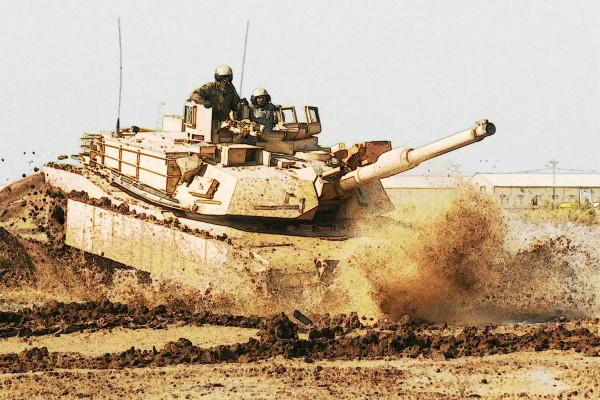
Wait, what? Yes, that’s right. It may be primitive. But we have the beginnings of technology which allows a battle tank to dissipate the energy of incoming hostile fire.
What if that technology were researched and refined and developed to a point at which incoming energy could be dissipated, or redirected at a much higher level? What if incoming energy from a big bomb could be dissipated, or absorbed?
What if A.I. let that technology be researched and developed to a point that instead of dissipating or redirecting incoming hostile energy, the energy could be harnessed and collected? Maybe even stored?
Science fantasy you say. The power in just the force of a military .223 caliber bullet (half the diameter of the Colt 45 bullets John Wayne routinely shot at bad guys) is way too powerful to stop, let alone the power of dozens of such bullets a minute from an AR-15, or from a big bomb.
I was alive when scientist were still claiming that it was a fact of physics that humans could never exceed the speed of sound and survive. I was alive when people claimed we couldn’t fly to outer space, or land people on other planets—not even on the moon. Any science that is too far advanced from common knowledge is considered to be magic. But it is actually science.
War profiteers outdid themselves with the Abrams tank. They built a killing machine so effectively self-defensive that it can’t be sent out to battle, for fear that our potential “enemies” would understand and adopt its advanced armor.
What would happen if that were the case? The battle tank, a primary, and very profitable weapon since WW-I, would lose its utility. The same technology, applied to ships, would end the effectiveness, and profitability, of missile launching aircraft.
What would happen if technology kept advancing and it became possible to dissipate the explosive force of bombs, or to at least redirect the explosive energy—back up into the sky, or toward open space where they would not cause damage? What if such technology were built into building, instead of just battle tanks? How would warfare against civilians fare then?
Among other effects, the profit might fall out of war contracting. The hedge funds and corporations which now consolidate war profiteering into a small cadre of our international business community certainly do not want any such technology being pursued, or even explored by civilian A.I. experimenters. The corporations that control our “liberal media” have their own economic interests tied up both with the war profiteers and with the extremely profitable business of both covering colorful, scary wars, and then having posturing pundits keep us riled up with their competing assessments of interests in those wars.
What if the technology were adapted to cars and home building, so that road rage and other community violence lost some of their force? What if the technology were developed not merely to dissipate hostile incoming energy, but to capture it, redirect it, and store it? The target victim would reap the energy gain. Would PG&E be happy with that?
The development of energy dissipating technology for the Abrams tank was a mistake by war profiteers. Not to be extended to other areas which could destroy their profit margins. But what do we civilians care about their profit margins?
Everybody who warns us of its dangers tells us that A.I. is still in its infancy, with its powers still waiting to bloom. But even in its primitive current state, it is terrifying to corporations who see its potential.
Spread A.I. out through an already skeptical younger generation and it is likely to find that Abrams technology and develop it much further. Instead of exotic ceramic plates covering a tank, they may deliver us the equivalent of solar panels that can absorb any hostile energy lobbed at us by Proud Boy or Atomwaffen Group warriors making last stand attempts to bring down democracy, or even North Korean nuclear missiles.
Then, instead of Congress fighting over what safety net programs to slash, they can start arguing about which Pentagon boondoggle programs to cut—what war profiteer profits to cut.
Comments

Powered by RoundtableAn AI/DeFi-powered Enterprise Media Operating System. Learn more at Roundtable.io.© Roundtable 2026. By using this site you agree to the Terms of Use and Privacy Policy