


Mar 5, 2024 8:00 AM
Updated Mar 5, 2024 9:42 PM
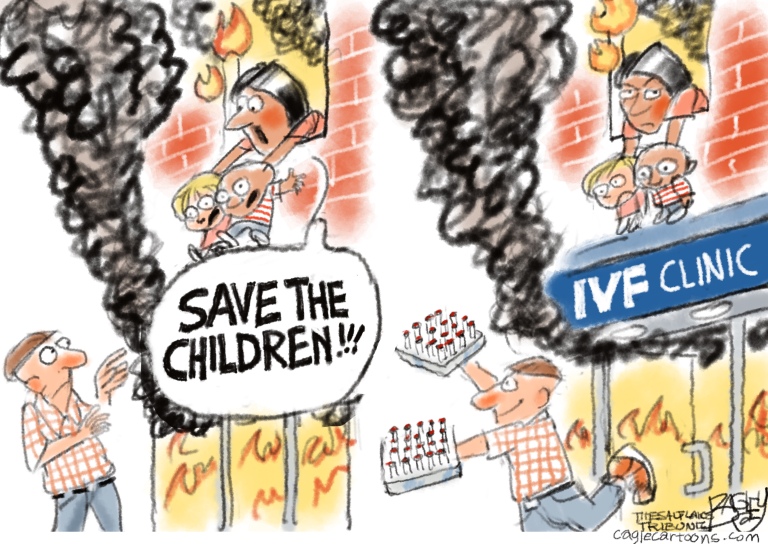
Policing abortion and the womb in the name of God is turning out to extend way beyond the womb. The Alabama IVF decision is but another example of the lunacy.
France has just enshrined abortion rights in its Constitution. What's wrong with the United States?
It is collapse of the church into the affairs of the state. For example, the recent Alabama Supreme Court theology-ridden ruling (LePage v. Mobile Infirmary Clinic, Inc.) conferred personhood status to frozen in vitro fertilization (IVF) embryos as doing God's will. Alabama Supreme Court Chief Justice Thomas Parker wrote in the ruling that "human life cannot be wrongfully destroyed without incurring the wrath of a holy God." With this ruling, reproductive justice is thrown out of the window. Women, girls, and people with the capacity for pregnancy in the state of Alabama have been relegated to human chattel and birthing incubators. And if you thought Margaret Atwood's "The Handmaid's Tale" was a fictive dystopian novel, read it now as a survival guide because this ruling will have broader implications in the ongoing anti-abortion war.
Pro-Life vs The Life of The Child
Women, girls, and people with the capacity to give birth caught up in the pro-life battle need to know their lives don't matter. Neither does that of the child. While Parker's theocratic ruling takes his concepts of "pro-life" to a newer mean-spirited and punitive level, the label "pro-life" has always used religion to cloak the misogyny and transphobia of anti-abortion legislation since Roe v Wade was ratified in 1973. The care for the fetus doesn't extend beyond birth. Former Massachusetts Democratic gay congressman Barney Frank said for pro-lifers, "Life begins at conception and ends at birth." Studies have shown that unwanted children born in states or areas where there are abortion restrictions have much more challenging lives and often live in poverty.
The Trump Effect
The precursor for the recent Alabama decision was the landmark Supreme Court decision passing Dobbs v. Jackson Women's Health Organization (2022), overturning Roe v Wade, and Planned Parenthood v. Casey (1992). Before Roe was overturned, abortion was a fundamental right under the Constitution. This right afforded women, girls, and people with the capacity for pregnancy under the 14th Amendment full citizenship, the right to privacy, bodily autonomy, and respect for a person's choice without judgment. However, religion drove the Dobbs' decision and was influenced by conservative Catholic thinkers, theologians, and Supreme Court justices.
Related stories
With the overturning of Roe v Wade, we saw that justice wasn't blind but rather biased. This is the effect of Trump's presidency. Trump nominated 274 conservative Republicans to federal benches and three to the Supreme Court—Neil Gorsuch, Brett Kavanaugh, and Amy Coney Barrett-who all sided in overturning Roe v. Wade. Today, as with the Dobb decision to overturn Roe, the Supreme Court comprises six Catholics, accounting for two-thirds of its total number of justices, of which five are pro-lifers.
Abortion Rights are Queer Rights
Before the Dobbs decision and now in Alabama's, BIPOC and LGBTQ+ communities, due to health disparities, access to a safe abortion was primarily out of their reach. Women and girls, however, are not the only ones who need abortion care. Nonbinary people, intersex individuals, gender non-conforming folks, and trans men need abortion care, too!
"I am a transgender man, which means that although I am a man, I was assigned female at birth, which means that I have a uterus, which means that I could get pregnant. Which means that I could need an abortion," Schuyler Bailar, a transgender athlete and activist, told CBSNews.com in 2021. "I am here to remind you to make it absolutely clear that people of all genders can have abortions, and people of all genders should have safe and legal access to abortions."
According to the 2023 Guttmacher Institute's Abortion Patient Survey, 16 percent of U.S. abortion patients do not identify as heterosexual women. And according to the 2020 survey, 149,000 respondents who do not identify as either straight or cisgendered obtained abortions, compared to the total number of abortions that year.
Using religion to codify discrimination against LGBTQ+ Americans began with the Religious Freedom Restoration Act (RFRA) in 1993 under the guise of religious freedom. In 2018, SCOTUS ruled in "Masterpiece Cakeshop v. Colorado Civil Rights Commission" in favor of the baker who refused to make a wedding cake for a same-sex couple on the grounds of religious freedom. Moreover, anti-abortion and anti-LGBTQ legislation go hand in hand because they both are done in the name of God.
Reproductive justice, however, is essential to a person's right to choose when and whether to have an abortion. SCOTUS shouldn't decide, and neither should the church. Perhaps U. S. needs to take a page from France's Constitution.
Comments

Powered by RoundtableAn AI/DeFi-powered Enterprise Media Operating System. Learn more at Roundtable.io.© Roundtable 2026. By using this site you agree to the Terms of Use and Privacy Policy