


Feb 1, 2025 5:23 PM
Updated Feb 5, 2025 4:57 PM
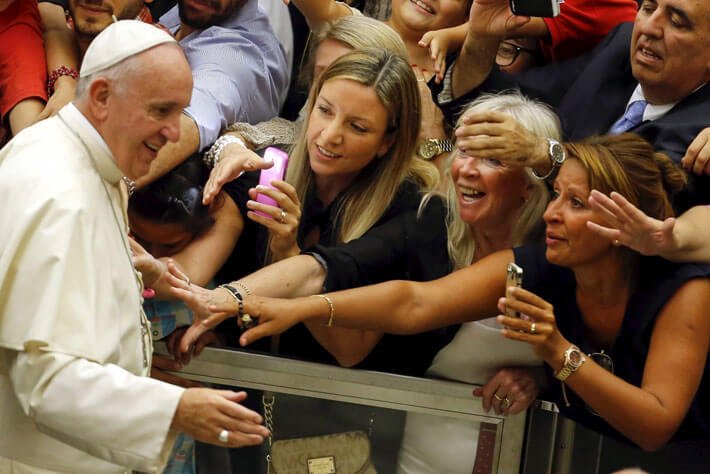
As his words make clear, instead of following our “perverse” ways, Francis points to love (symbolized by the heart) as the only “reality that can unify all the others.”
Although I do not agree with all the positions of the Catholic Church--and its Pope Francis--he nevertheless seems to me one of the great moral voices of our time. In 2013, I wrote of his insightful criticism of capitalism; in 2015 of the correctness of his environmental encyclical; and just recently of his comment that President Donald Trump’s immigration plans were a “disgrace.” Having just finished reading his October 2024 Encyclical Letter on Love, I’ll now add it to my list of his morally perceptive comments. A dozen years ago I wrote about love being the greatest of the virtues, the pope’s recent encyclical just strengthens that conviction.
Here’s why. First, in writing about love there are his criticisms of our cultures and priorities. For example, “We find ourselves immersed in societies of serial consumers who live from day to day, dominated by the hectic pace and bombarded by technology, lacking in the patience needed to engage in the processes that an interior life by its very nature requires. In contemporary society, people ‘risk losing their centre, the centre of their very selves. Indeed, the men and women of our time often find themselves confused and torn apart, almost bereft of an inner principle that can create unity and harmony in their lives and actions. Models of behaviour that, sadly, are now widespread exaggerate our rational-technological dimension or, on the contrary, that of our instincts.’”
Regarding our “rational-technological dimension,” Francis writes that “in this age of artificial intelligence [AI], we cannot forget that poetry and love are necessary to save our humanity.” (See here for more on the dangers of AI.)
Near the very end of his encyclical on love he sums up his message, “In a world where everything is bought and sold, people’s sense of their worth appears increasingly to depend on what they can accumulate with the power of money. We are constantly being pushed to keep buying, consuming and distracting ourselves, held captive to a demeaning system that prevents us from looking beyond our immediate and petty needs. The love of Christ has no place in this perverse mechanism, yet only that love can set us free from a mad pursuit that no longer has room for a gratuitous love. Christ’s love can give a heart to our world and revive love wherever we think that the ability to love has been definitively lost.”
Related stories
As his words make clear, instead of following our “perverse” ways, Francis points to love (symbolized by the heart) as the only “reality that can unify all the others.” Furthermore, “In loving, we sense that we come to know the purpose and goal of our existence in this world. Everything comes together in a state of coherence and harmony.”
Of course, much of what Francis says about love includes God’s love for us, especially Christ’s love directed at us, and vice versa. And there is much in the pope’s words about the Trinity and the love contained within it. Also, he often comments on the ideas and sayings of Catholic saints. Nevertheless, there remains a great deal of his encyclical which can be applied to human love and can still be pertinent for non-believers. And there is his warning--“The Gospel, in all its richness, was written not only for our prayerful meditation, but also to enable us to experience its reality in our works of love and in our interior life.”
One ardent Catholic, one still being considered for sainthood, Dorothy Day (1897-1980), also often wrote about love, and sometimes stressed only its human dimension. For example, “Hell is not to love anymore,” and “Love is the measure by which we will be judged.” In a 1958 letter she wrote: “If we could only learn that the only important thing is love, and that we will be judged on love—to keep on loving, and showing that love, and expressing that love, over and over, whether we feel it or not, seventy times seven, to mothers-in-law, to husbands, to children—and to be oblivious of insult, or hurt, or injury—not to see them, not to hear them. . . . not judge, not do anything, but love, love, love.” Moreover, she also paraphrased a character in non-believer Albert Camus’s The Plague, “who says that he is tired of hearing about men dying for an idea. He would like to hear about a man dying for love for a change.”
In his recent encyclical Francis writes, “Everything finds its unity in the heart, which can be the dwelling-place of love in all its spiritual, psychic and even physical dimensions. In a word, if love reigns in our heart, we become, in a complete and luminous way, the persons we are meant to be, for every human being is created above all else for love. In the deepest fibre of our being, we were made to love and to be loved. . . . Our fulfilment as human beings is found in love.”
Furthermore, he writes that “if we fail to appreciate . . . [love,] we miss out on the richness of our encounters with others; we miss out on poetry. We also lose track of history and our own past, since our real personal history is built with the heart. At the end of our lives, that alone will matter.” In short, if we are “heartless” we will become “a society dominated by narcissism and self-centredness.”
In the last part of his encyclical Francis often writes of the love we should have for those less fortunate than ourselves--and I often thought of his earlier words about immigrants, refugees, about victims of wars, famines, capitalist profiteering, and climate change. Here is just a brief sample of the pope’s words:
We need to remember that in the Roman Empire many of the poor, foreigners and others who lived on the fringes of society met with respect, affection and care from Christians. . . . One reason why Christians were respected and imitated was the assistance they gave the poor and strangers, who were ordinarily ignored and treated with contempt. . . . By associating with the lowest ranks of society . . . Jesus brought the great novelty of recognizing the dignity of every person, especially those who were considered ‘unworthy’. This new principle in human history--which emphasizes that individuals are even more ‘worthy’ of our respect and love when they are weak, scorned, or suffering . . . has changed the face of the world. It has given life to institutions that take care of those who find themselves in disadvantaged conditions, such as abandoned infants, orphans, the elderly who are left without assistance, the mentally ill, people with incurable diseases or severe deformities, and those living on the streets.
How different such words are than the statements and actions of some other world leaders--e.g., Donald Trump and Vladimir Putin--who should be advocating love, but are not.
Comments

Powered by RoundtableAn AI/DeFi-powered Enterprise Media Operating System. Learn more at Roundtable.io.© Roundtable 2026. By using this site you agree to the Terms of Use and Privacy Policy