
Tom Driggers • Attribution (CC BY 2.0) • Flickr


Jun 27, 2024 6:39 PM
Updated Jun 29, 2024 9:03 PM
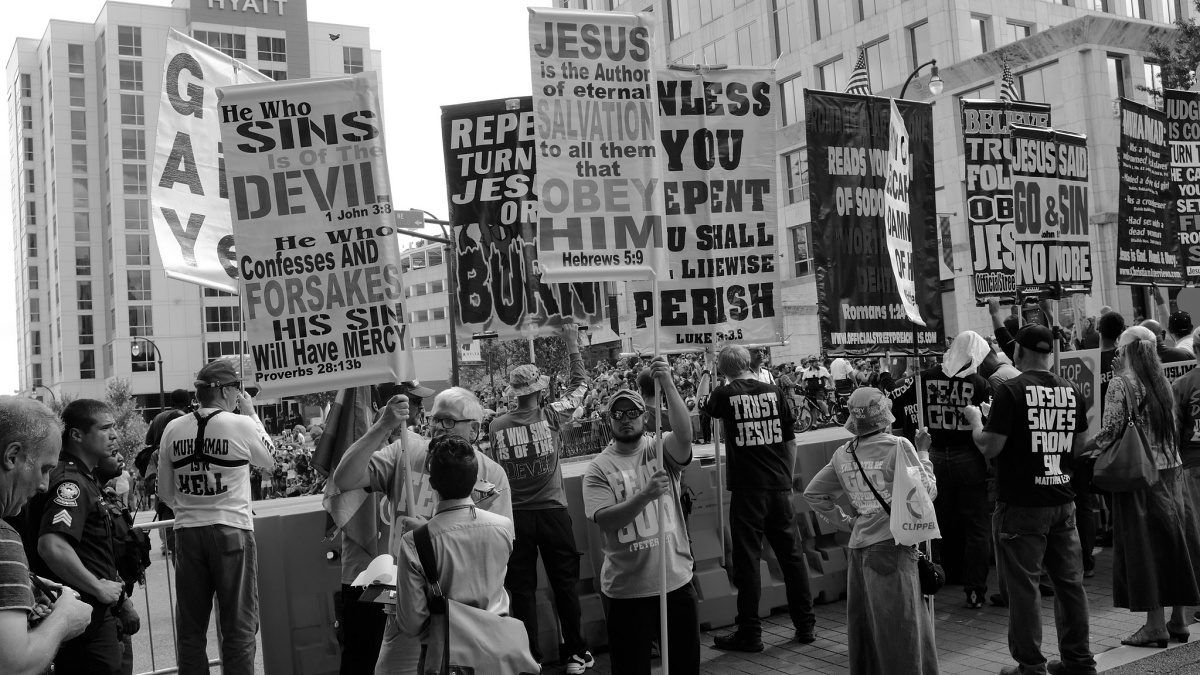
The rapid rise of a pugilistic and politicized white evangelicalism occurred in direct tandem with the virulent reaction to the advances of the midcentury civil rights movement.
The rapid rise of a pugilistic and politicized white evangelicalism occurred in direct tandem with the virulent reaction to the advances of the midcentury civil rights movement. More Videos
For many years I have felt it almost necessary to say, among my liberal friends, "I'm a minister—but not that kind." Fifty or sixty years ago, no such qualification would be needed, as many Christian leaders then were also recognized as leaders within progressive ranks, working side by side with progressive rabbis. Figures like Martin Luther King, Jr., and William Sloane Coffin, Jr., were joined by Abraham Joshua Heschel in opposing the catastrophic Vietnam War and demanding action to end segregation and extreme poverty. They made headlines, but they were far from being outliers. As well, back then, it was the hardline Catholic position on abortion that was the outlier position among American Christians as a whole. The vast majority of Protestants, including many evangelicals in that era, took a much more moderate view.
So how did this all change so drastically, so that now the word "Christian" is associated almost universally with a racist, misogynist, anti-democratic mindset? How is it that white Christians now form the most reliable base of support for a would-be dictator?
Berkeley historian David Hollinger knows more about this than any other scholar I know of, and he tells the story well in a recent piece for Religion Dispatches. He notes, first, that a strong reactionary current was always present in 20th century evangelical Christianity. Think of the Scopes "monkey" trial of 1925 or of the highly effective midcentury effort by LA's Rev. James Fifield to give a Christian veneer to efforts by big capital to roll back the New Deal and crush unions. Think of Billy Graham's response to Dr. King's dream of Black and white children walking hand-in-hand in Alabama: "Only when Christ comes again." Liberal, highly educated Protestants may have ruled the cultural roost throughout the middle decades of the 20th century, but their ascendancy was deeply resented by their conservative country cousins.
Liberal, highly educated Protestants may have ruled the cultural roost throughout the middle decades of the 20th century, but their ascendancy was deeply resented by their conservative country cousins.
Related stories
The big and troubling change, Hollinger writes, came about for two reasons. The factor that is most widely recognized is that one of the national political parties recognized how useful it would be to adopt reactionary white Christians as a primary constituency. Nixon helped to forge this alliance through his Southern Strategy. Republicans took this tack, courting mostly Southern and Western conservative Christians, at precisely the time when evangelicals were beginning to build up their institutions and create far-reaching media networks, using radio and television much more effectively than their liberal counterparts.
Money played no small part in arming the evangelicals for battle. Just as with the corporate support given to James Fifield's "Spiritual Mobilization" campaign of the 1950s, big corporate-friendly players (e.g., the Olin, Scaife, and Bradley foundations) bankrolled a new conservative Christian infrastructure, starting in the late 1970s and cresting during the 1980s and 1990s. With the help of some of these same donors, clever people working on the inside of the religious tent also helped to advance what is now univocal evangelical alignment with the Catholic bishops' stance on fetal "personhood." The clever inside operators also got money to craft strategies for muting what was left of the progressive Christian voice, using vehicles like the Institute for Religion and Democracy.
The second dimension of the big change is much less widely understood. What it amounts to is that a once-vibrant liberal Christian counterpoint to the anti-intellectualism and even the basic biblical illiteracy of the evangelicals faded out fairly quickly over the last decades of the last century. This was not mainly due to attacks from the mobilized Christian Right. It happened, says Hollinger, primarily because of demographics. So-called "mainline" Protestants—Lutherans, Methodists, Presbyterians, Episcopalians, etc.—were having fewer kids, and the kids they did have stopped going to church. There was also no longer any social premium involved, as there once had been, for evangelicals to "trade up" and migrate from, say, a Nazarene congregation in the outskirts of town to the swanky Episcopal or Presbyterian church downtown. Rapid demographic decline also meant that the liberal Christian institutions—the mainline denominations, the National Council of Churches, the seminaries, etc.—took a huge financial hit . Their leaders started functioning in survival mode rather than engaging in robust contestation with the shrill evangelical voice in public spaces. A crucial consequence of this hollowing out, writes Hollinger: there was increasingly no one left to say to the conservatives, "You've got the Bible all wrong. You ignore the most basic gospel message of equality and inclusion."
For years during my active professional life, and even now in my so-called retirement, I have been part of efforts to push back against the now-dominant reactionary Christian voice. What I learned, however—and what others like me learned—is that by the late 1990s, the Christian "brand" as a whole was so thoroughly contaminated that it became really hard to get funded for this kind of pushback activity. Yes, there have been a few passing attempts (Faith in Public Life, etc.). But at the institutional level, the liberal Christian project is now basically on the rocks.
In my view, Hollinger gets the story basically right but underplays the racism factor. The rapid rise of a pugilistic and politicized white evangelicalism occurred in direct tandem with the virulent reaction to the advances of the midcentury civil rights movement. It wasn't just resentment of left-leaning, intellectually formidable, and highly visible Christian leadership that raised evangelical hackles and sent them into overdrive; it was a wholesale white anxiety attack triggered by the prospect to having to live in a multiracial democracy. For reactionary evangelicals, there was the further catalyzing effect of seeing a Black family occupying the White House in giving white Christian nationalism an extra shot of venom, starting in 2008. As to race and racism, it also needs to be said that the overwhelmingly white memberships of the mainline church bodies were hardly exempt from racism before and during the midcentury period when many of their leaders were making common cause with Dr. King. In fact, local mainline churches often fired ministers who, in their judgment, crossed a line and leaned too far in a progressive direction. The laypeople were, at best, moderates; it was their leaders—some of them at least—who tried to stay true to the gospel and place themselves on the right side of history.
Hollinger also underplays the role of an anxious corporate class during the 1960s and 1970s. The capitalists were seriously worried by union militancy and by increasing environmental and antitrust regulation during these years; they and their intellectual allies crafted a comprehensive fightback strategy, encapsulated in the famous Powell Memorandum of 1971. The capitalists' message that fundamental American freedom was under fire from the Left meshed perfectly with the white evangelicals' message that their "fundamental" Christianity was in danger of being swept aside by godless secular forces. Before long, Wall Streeters unaccustomed to being in church on Sunday morning were only too happy to be in bed politically with the Jerry Falwells, Pat Robertsons, and James Dobsons. Today's Trump-Christofascist alliance is only the most recent and most dangerous incarnation of this convergence.
So here we are. And the question people like me keep asking is an old one from the Good Book: "Can these bones live?" That is, is there any hope for a resonant and effective progressive Christian voice at this grim moment?
I've got a threefold answer. The first piece is theological, which is to say that I am counting on God to keep a righteous remnant alive, no matter what. The second is observational, which is to say that I am able to see how effective organizers in many contexts use what I would call a gospel-based praxis to fuel movement making. They may not explicitly invoke the authentic gospel of Jesus of Nazareth—i.e., good news for the poor and defeat for their oppressors—but that's what they are doing. The bones are alive, in other words.
My third answer is conjectural and perhaps naively hopeful. I am hoping that progressive leaders and political operatives who have, to this point, mainly treated religion as irrelevant will finally come to understand the extent to which the work of changing religious ideation is foundational to the work of creating a new and better politics in this country. Whether people go to church or not, their core ideas about work and worth, about collective thriving as against individual ambition, about crime and punishment, about war and peace, about gender roles and sexuality—and so much more—are profoundly shaped by deep-level religious ideation.
It's completely unrealistic to expect that some kind of Third Great Awakening will suddenly arise in time to turn the tide against the forces of repression and reaction. But maybe—just maybe—progressive funders and others concerned about our shared future will begin to grasp that religion's power and reach need not be just on the side of the cruel and violent. If so, it's possible that some sophisticated training, organizing, and messaging could follow, giving the righteous remnant something to work with even in the shadow of a fascist takeover.
And that would be (dare I say it?) good news.
Comments

Powered by RoundtableAn AI/DeFi-powered Enterprise Media Operating System. Learn more at Roundtable.io.© Roundtable 2026. By using this site you agree to the Terms of Use and Privacy Policy