


Christian Nationalism
Feb 5, 2024 6:06 PM
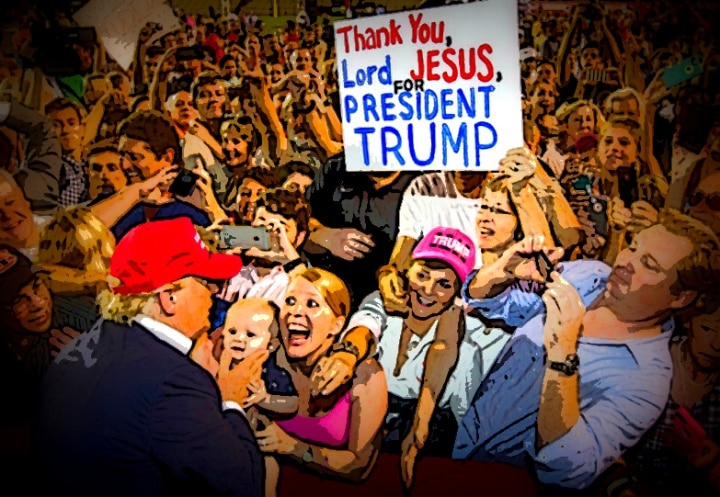
With the threat of another Trump presidency and his catering to evangelicals, the dangers of Christian nationalism have taken on a new urgency.
Christian Nationalism is an oxymoron. “White Christian Nationalism” (WCN) even more so. I am no Biblical scholar, not even a Christian. But I was raised Catholic, had more than two decades of Catholic education, have taught a university course on Comparative Religions, and have the utmost respect for good religious people who try to live up to the principles of Jesus Christ, or Buddha, or any other great religious teacher.
Among modern individuals who I consider in that category are Pope Francis, Dorothy Day, the monk Thomas Merton, the Lutheran priest Dietrich Bonhoeffer, South Africa’s Anglican Bishop Desmond Tutu and the Dalai Lama. (The links below their names will take you to some of my writings about them.)
Especially pertinent are Pope Francis’s words in a 2013 sermon, where he warned Christians against making their religion into an ideology: “When a Christian becomes a disciple of the ideology, he has lost the faith..But it is a serious illness, this of ideological Christians. . . . His attitude is: be rigid, moralistic, ethical, but without kindness.” He urged Christians “to remain humble, and so not to become closed.” Also relevant to remaining “humble” are the words of Tutu and the Dalai Lama in their co-authored The Book of Joy: “We have to have a sense of humility to laugh at ourselves and that to laugh at ourselves reminds us of our shared humility.”
But back to why Christian and nationalism contradict each other. In the Bible, Jesus tells his disciples to “make disciples of all nations, baptizing them” (Matt 28:19), and the apostle Peter says, “God does not show favoritism but accepts from every nation the one who fears him and does what is right.” (Acts 10:34-35) Nationalism, however, too often divides nations and sometimes leads them to war. It often encouraged imperialism by providing the basis for the belief in a nation’s greatness and mission abroad. It should not be confused with patriotism because the “best patriotism involves not just love of country, but also valuing compassion, justice, equality, freedom, toleration, and inclusiveness. And it yearns for peace, even if war is sometimes necessary.” Too often nationalism contradicts the greeting of Jesus—“Peace be with you!” (John 20:21)
Related stories
My present essay is not the first LA Progressive one to criticize Christian Nationalism. A little less than a year ago in this journal, John Peeler listed some of its major flaws: It is contrary to the First Amendment to the Constitution: “Congress shall make no law respecting an establishment of religion, or prohibiting the free exercise thereof”; its claim that “this country has always been a Christian nation” is false; the “Christian principles” it demands are to be determined by conservative Christian Evangelicals—not by Methodists, Episcopalians, Catholics, etc. (and, of course, non-Christian believers and all non-believers would have no say); and if Trump were once again elected (to quote Peeler) “we could have the irony of this fundamentally godless, immoral person enforcing the establishment of the new religious orthodoxy.”
Criticism of Christian nationalism is, of course, not new with Peeler. It’s been around a long time. For example, almost two decades ago, Michelle Goldberg’s Kingdom Coming: The Rise of Christian Nationalism (2006) appeared.
But with the threat of another Trump presidency and his catering to evangelicals, the dangers of Christian nationalism have taken on a new urgency. And to help us better understand it a more recent book has appeared—Preparing for War: The Extremist History of White Christian Nationalism—and What Comes Next (2023), written by Bradley Onishi, a self-described “former White Christian nationalist.” (His subtitle also makes clear that this nationalist movement is “White,” not an insignificant point in our increasingly multiracial society—he also makes a compelling case for capitalizing both Black and White when dealing with racial matters.)
Onishi makes the point that “White evangelicalism and White Christian nationalism are not the same thing. White Christian nationalism far exceeds the bounds of White evangelicalism,” and not all of these nationalists are evangelicals. (Nevertheless, he claims that “recent data shows that over 80 percent of White evangelicals are Christian nationalists, to some degree,” and that “White evangelicals have been formative in the development of White Christian nationalist culture and politics since the 1960s.”) He then goes on to explain why the “White” adjective is so important to Christian nationalism and how all three words are tied to Donald Trump, particularly the January-6-2001 storming of the U. S. capitol building, which he encouraged.
The 1960s were crucial to the development of WCN because of White backlash. During that decade, “various cultural and political movements transformed the United States and led to the extension of various civil rights and forms of cultural representation to religious, racial, sex, gender, and ethnic minorities. This set off a counterrevolution that resulted in, among other things, religious support for the Trump presidency and the central role of Christian nationalism at the January 6 insurrection.”
Onishi goes on to explain the present elements of the WCN ideology. “As a Christian nation, the United States has a covenant with God that trades obedience and loyalty for protection and blessing. The nation’s perceived decline is . . . a result of the United States breaking its covenant with God...This is why nostalgia politics, hinging on the promise to ‘make America great again,’ tap into the lifeblood of Christian nationalism...Lurking beneath the patriotic rhetoric of restoring the nation to its former glory is a desire to reinstate a retrograde social and political order. The goal is to return to a state wherein straight, White, native-born Christian men take their rightful places of authority and leadership. Everyone else—including women, racial minorities, religious minorities, and certainly the LGBTQ community—must accept their place as either lower on the American register or outside of it altogether...In essence, ‘make America great again’ is code for ‘make America White and Christian again.’”
In that Onishi’s book was published in January 2023, it’s been a bit over a year since it appeared, and he recently updated his indictment of WCN in a now week-old interview on the PBS Newshour.
Among other items he updated, he observed the important role within WCN of the New Apostolic Reformation. “It's built around the idea that Christians are called to a new transformation or reformation of the United States. These are Christians who want to revolutionize the way that our country looks, and to make it great again in terms of being a Christian nation. They also are deeply invested in the notion of spiritual warfare, the idea that we are called as Christians to fight a cosmic battle between good and evil, and that it's our duty to be boots on the ground for God in that conflict. What this has led to some decades later is...the apostles and the prophets that are really at the head of this movement were some of the earliest to support Donald Trump in 2016.”
“And,” he continued, “they have remained steadfast in that support. They were at the very avant-garde of trying to get the 2020 election overturned in the wake of Joe Biden's victory and mobilizing folks...There were hundreds, if not thousands, of New Apostolic Reformation Christians at January 6, as an example.”
He also indicates that new House of Representatives Speaker “Mike Johnson has direct ties to the New Apostolic Reformation.” Furthermore, Onishi told the PBS interviewer (Laura Barrón-López) that “a key New Apostolic Reformation figure, announced he was partnering with Charlie Kirk, the influential right-wing activist who leads Turning Point USA. They're going to be visiting and focusing on swing states, Wisconsin, Arizona, Pennsylvania. They have claimed they have already signed up 2,500 churches, and they want to mobilize those churches directly for political involvement and specifically to get Trump reelected.”
In summary, although “White Christian Nationalism” makes no logical sense, it should not be taken lightly. Like the Trump phenomenon that it so ardently supports, it is a potent political force.
Comments

Powered by RoundtableAn AI/DeFi-powered Enterprise Media Operating System. Learn more at Roundtable.io.© Roundtable 2026. By using this site you agree to the Terms of Use and Privacy Policy