


May 8, 2026 6:04 PM
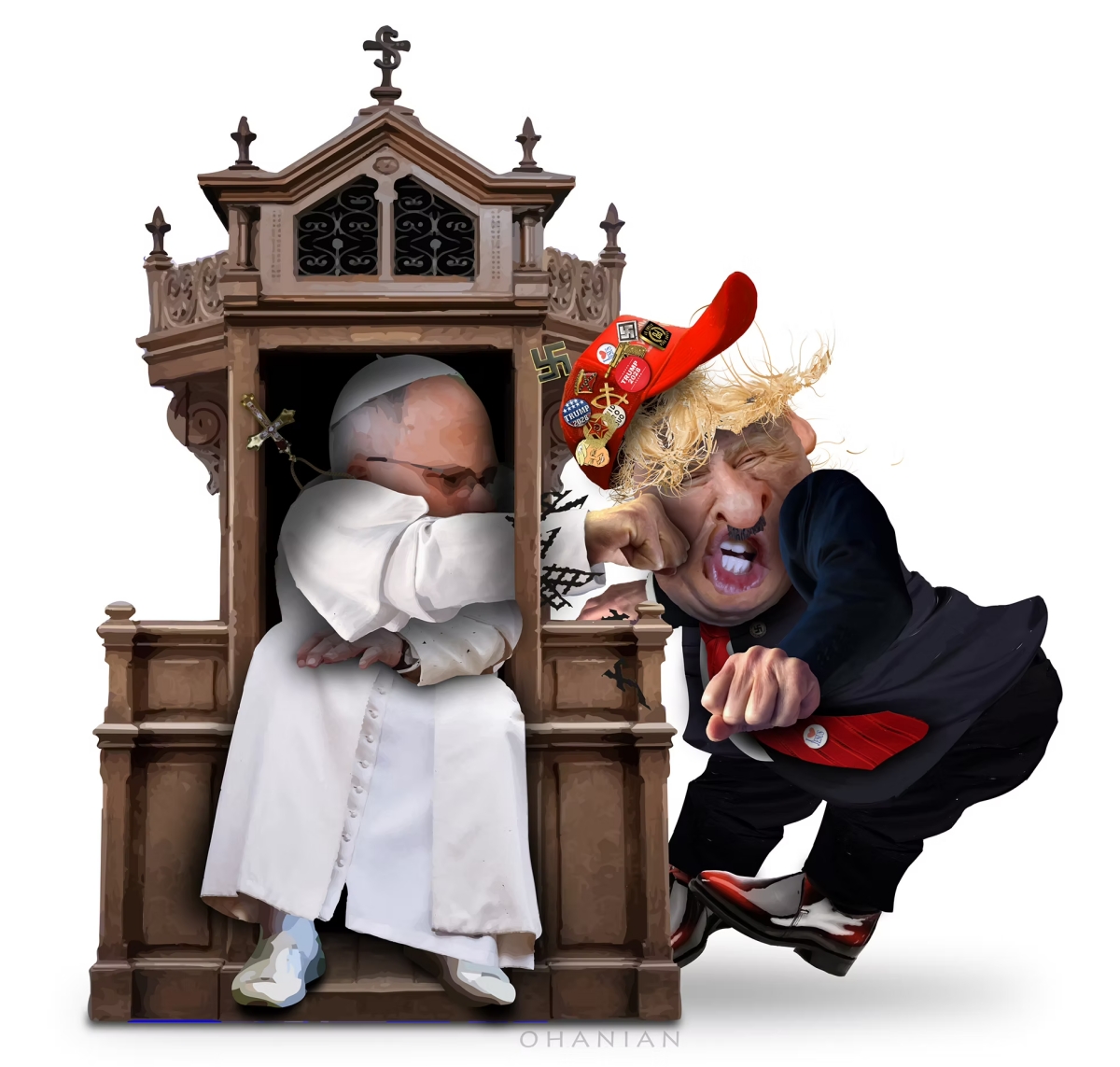
Trump’s politics feed upon escalation, domination, and emotional spectacle. Pope Leo’s authority derives from restraint, continuity, and moral witness.
There is something almost Shakespearean in the spectacle now unfolding between Donald Trump and Pope Leo XIV: not Shakespearean in the shallow sense of brute theatrical insult, but in the deeper tragic sense of a ruler whose slavish hunger for greatness expands until it begins consuming reality itself. Trump does not merely quarrel with the Pope; he collides with him the way a man intoxicated by applause collides with a man formed by ritual silence. Trump experiences the world as an arena of velocity — ratings surging across screens, crowds roaring like engines, headlines detonating every hour, history reduced to a permanent championship match in which the self must remain undefeated. Pope Leo moves within another rhythm altogether: slower, older, liturgical, shaped by centuries of confession, burial rites, famine prayers, whispered absolutions, and long meditations upon suffering. One imagination feeds upon immediacy. The other has learned patience from history itself.
This is why Trump’s attacks feel so feverish. According to reports, he privately described himself as “the most powerful man to ever live.” The statement sounds less like confidence than metaphysical hunger. He approaches existence the way a wildfire approaches a forest: not as something to inhabit alongside others, but as something to consume until only his own heat remains visible. Trump experiences reality as material awaiting submission to his will. Facts, institutions, alliances, even memory itself must bend or be broken. Limits are interpreted not as conditions of human existence but as personal insults. Every obstacle becomes evidence of conspiracy; every criticism, an act of treason against the mythology of inevitability he has built around himself. He does not merely seek power — he seeks exemption from gravity, from consequence, from the ordinary laws governing human fragility.
And then arrives Pope Leo, another American man suddenly occupying the symbolic horizon of the world. Not through spectacle, aggression, or wealth, but through moral witness. Trump senses the comparison instinctively, and it wounds him because it introduces a rival form of permanence. Not the permanence of domination, but of conscience.
This helps explain the almost desperate triviality of Trump boasting that the Pope’s brother is MAGA, as though the sanctity of the papacy could somehow be diluted by family politics. It is an attempt to drag spiritual authority downward into the swamp of tribal entertainment where everything becomes reducible to factions, teams, and personality cults. Yet Catholicism does not understand the Pope as a celebrity whose legitimacy derives from personal branding. The Pope occupies the Chair of Peter, believed by Catholics to continue the apostolic ministry entrusted to Saint Peter himself. The office carries moral continuity rather than ideological purity. It asks not whether the Pope flatters national passions, but whether he guards the ethical memory of the Gospel amid the noise of empires.
Related stories
Pope Leo himself has warned that “humanity cannot survive when nations choose domination over dialogue and vengeance over mercy.” The sentence stands in direct opposition to the emotional atmosphere of modern nationalism. It speaks from an older moral horizon — one shaped not by spectacle but by centuries spent confronting war, plague, exile, empire, and grief. Trump, however, responded not with argument but with fabrication. In remarks reported by The Wall Street Journal, he declared: “The Pope would rather talk about the fact that it’s OK for Iran to have a nuclear weapon. I don’t think that’s very good. I think he’s endangering a lot of Catholics and a lot of people.” Yet the accusation was entirely invented. Pope Leo never endorsed Iran possessing nuclear weapons. Trump transformed moral caution into betrayal because his political imagination increasingly depends upon permanent enemies.
As David French observed in The New York Times: “In this contest between a pope and a president, the president looks weak and erratic. He looks small.” French captured the essential contrast. Trump’s politics feed upon escalation, domination, and emotional spectacle. Pope Leo’s authority derives from restraint, continuity, and moral witness. One demands loyalty. The other asks for conscience.
The rhetoric surrounding figures like Pete Hegseth reveals the broader spiritual atmosphere in which this conflict unfolds. Hegseth often speaks of war in tones hovering between nationalism and myth, invoking “just war” not with the tragic caution of Augustine but with the emotional cadence of civilizational crusade. Conflict becomes romanticized as purification. Violence acquires dramatic grandeur. Entire nations are narrated as protagonists and villains within a cosmic struggle for destiny. The battlefield becomes morally theatrical, a proving ground for masculine redemption and national rebirth.
The grotesque absurdity of this atmosphere emerged when Hegseth quoted a fabricated biblical verse from Pulp Fiction during a Pentagon sermon: “The path of the righteous man is beset on all sides by the inequities of the selfish and the tyranny of evil men.” The moment felt symbolically perfect for the age itself — cinema mistaken for scripture, violence aestheticized into theology, mythology replacing moral seriousness. Catholic just war theory historically emerged from fear of violence, not fascination with it. It sought to restrain war beneath moral limits. But within Trump’s nationalist orbit, war increasingly acquires emotional glamour, becoming a theater through which masculinity, destiny, and national redemption are performed.
Hegseth, however, is only one expression of a much larger religious ecosystem surrounding Trump — a circle of nationalist evangelical figures, prosperity theologians, prophetic movement personalities, and Christian media empires that increasingly fuse apocalyptic religion with authoritarian politics. Among the most visible is Paula White, whose prosperity-gospel theology transforms Christianity into a spiritualized cult of victory, wealth, and divine entitlement. In this theological universe, material success becomes evidence of God’s favor, power becomes sacramental, and political triumph becomes indistinguishable from divine election.
Journalist George Chidi, writing in The Guardian, captures the deeper danger of the religious nationalism surrounding Trump: the transformation of politics into apocalyptic theater. In this atmosphere, political identities become so emotionally totalizing that followers begin experiencing the leader’s victories as personal salvation and the leader’s enemies as existential threats. Democracy deteriorates into eschatology. Politics ceases to concern policy or justice and instead becomes a cosmic drama dividing humanity into the righteous and the damned. The danger is not merely fanaticism. It is the gradual erosion of the moral imagination itself — the loss of the ability to see opponents as fellow human beings rather than obstacles within a sacred war narrative.
This fusion of nationalism, prophetic certainty, and authoritarian longing threatens humanity precisely because it dissolves moral limits. Once political power is interpreted as divinely sanctioned, opposition becomes heresy rather than disagreement. The leader becomes untouchable because criticism appears equivalent to rebellion against providence itself. In such an atmosphere, cruelty becomes easier to justify. Entire populations can be dehumanized beneath the language of spiritual warfare. History has repeatedly shown how quickly nations descend into catastrophe when political movements begin imagining themselves chosen instruments of God standing above ordinary moral law.
Recent polling suggests Americans are growing exhausted by this atmosphere. Surveys from Pew Research, Reuters/Ipsos, Economist/YouGov, and Marquette Law School show majorities skeptical of the war with Iran and increasingly uneasy with the administration’s militarized rhetoric. The language of crusade no longer sounds triumphant to many Americans; it sounds repetitive, anxious, disconnected from ordinary life. Trump likely understands this politically, which may explain why his attacks on the Pope intensify before the midterms. The Pope becomes useful as symbolic opposition: a globally respected moral figure who can be reframed as an elitist adversary, thereby reigniting tribal loyalties at a moment of political vulnerability.
And there is likely another dimension as well: distraction. Trump has long survived scandal through escalation. Whenever scrutiny narrows — whether around corruption allegations, legal exposure, or renewed public attention surrounding Epstein-related questions and elite impunity — the instinct is to create another spectacle overwhelming enough to absorb collective attention. The controversy with Pope Leo functions almost like smoke released across a battlefield. It transforms ethical scrutiny into another tribal conflict, another emotional storm powerful enough to scatter concentration. Epstein threatens to historicize corruption itself; spectacle attempts to dissolve it into noise.
Against all this stands theologian José Porfirio Miranda like a physician diagnosing the spiritual illness beneath the politics. Miranda argued that the deepest idolatry is not primitive superstition but the sanctification of domination itself. In Marx and the Bible, he wrote that “the biblical God is, before all else, the defender of the oppressed.” In Communism in the Bible, he warned that “the accumulation of wealth beside human misery is the essence of injustice condemned by scripture.” And in Being and the Messiah, he declared that “faith without justice is the ideological mask of oppression.” Miranda understood that power often survives not through terror alone but through mythology — by persuading people that force is virtue, wealth is destiny, and victory is evidence of righteousness.
Miranda would likely recognize in Trumpism a form of political self-expansion approaching civic theology. Trump’s obsession with legacy, immortality, public adoration, and historical centrality reveals a man attempting to escape ordinary mortality through spectacle. He does not merely wish to succeed within history; he wishes to become inseparable from history’s narrative itself. At moments, the movement surrounding him approaches devotional politics, framing him less as a fallible leader than as a providential figure uniquely capable of national salvation through sheer force of personality.
But Christianity begins by overturning precisely such fantasies. The Gospel repeatedly strips grandeur from domination and relocates moral meaning among the vulnerable, the poor, the persecuted, the abandoned. Christ does not sanctify the ruler’s hunger for immortality. He exposes it.
And this is why Pope Leo’s courage matters. He speaks against war knowing he will be caricatured as weak. He defends migrants knowing he will be denounced as radical. He resists nationalist intoxication knowing powerful men may rage against him publicly. Yet he continues because the office he holds is not meant to flatter emperors but to remind them of moral limits.
The conflict therefore becomes larger than a feud between personalities. It is a struggle between two visions of human greatness. Trump measures greatness through force of will, historical dominance, and personal centrality. Pope Leo speaks from a tradition that measures greatness through conscience, grace, mercy, sacrifice, and justice. One vision is ensepulchered in grandiosity and seeks immortality through self-exaltation. The other accepts mortality and asks instead whether power remembered compassion before the darkness came.
Bibliography
Benen, Steve. “After Picking an Ugly Fight with Pope, Trump Promotes Image Panned as ‘Blasphemy.’” MSNBC MaddowBlog, 2026.
Benen, Steve. “Vance Escalates White House Offensive Against Pope Leo.” MSNBC MaddowBlog, 2026.
Chidi, George. “US Catholics Worry Trump’s Attacks on Pope Leo Could Split the Faithful.” The Guardian, April 18, 2026.
French, David. “In This Contest Between a Pope and a President, the President Looks Small.” The New York Times, 2026.
Marquette Law School Poll. “National Survey Finds Low Support for the War with Iran.” Marquette University, 2026.
Miranda, José Porfirio. Being and the Messiah: The Message of St. John. Maryknoll, NY: Orbis Books, 1977.
Miranda, José Porfirio. Communism in the Bible. Maryknoll, NY: Orbis Books, 1982.
Miranda, José Porfirio. Marx and the Bible: A Critique of the Philosophy of Oppression. Maryknoll, NY: Orbis Books, 1974.
Pew Research Center. “Americans Broadly Disapprove of U.S. Military Action in Iran.” March 25, 2026.
Prevost, Robert Francis (Pope Leo XIV). Palm Sunday address condemning war and violence, Vatican City, 2026.
Reuters/Ipsos. “Trump Approval Sinks as War with Iran Drives Cost-of-Living Concerns.” Reuters, April 28, 2026.
The Guardian. “Trump Told Friends He Considered Himself ‘the Most Powerful Man to Ever Live.’” The Guardian, 2026.
The Wall Street Journal. “Trump Accuses Pope Leo of Endangering Catholics by Opposing Iran War.” The Wall Street Journal, 2026.
Vox. “The Department of Holy War: Pete Hegseth and the Militarization of Christian Nationalism.” Vox, 2026.
White, Paula. Something Greater: Finding Triumph over Trials. Nashville: FaithWords, 2019.
YouGov/Economist Poll. “Most Americans Oppose Continued War with Iran.” Economist/YouGov, 2026.
Comments

Powered by RoundtableAn AI/DeFi-powered Enterprise Media Operating System. Learn more at Roundtable.io.© Roundtable 2026. By using this site you agree to the Terms of Use and Privacy Policy