


May 22, 2026 6:28 PM
Updated May 22, 2026 6:31 PM
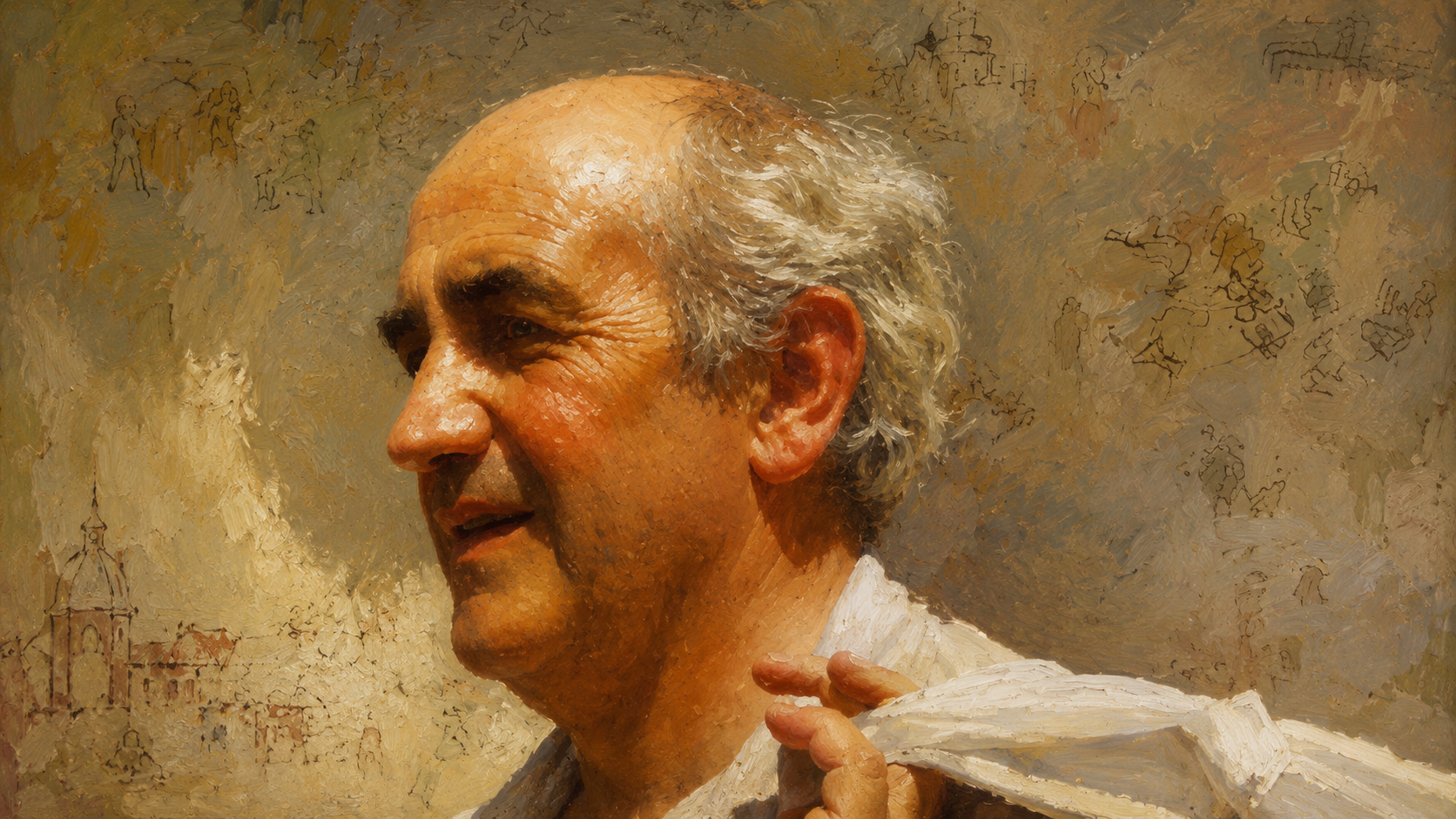
José Porfirio Miranda and the return of Revolutionary Christianity.
The work of José Porfirio Miranda enters history like a torch hurled into a cathedral of dry straw. It asks a question so incendiary that the custodians of empire recoil from it as though from a heresy whispered by ghosts beneath the altar stones: “What if Christianity itself carried the first ember of the struggle for human equality through the corridors of Western civilization?” What if the Gospel was not the enemy of revolution but its buried heartbeat?
Miranda does not ask politely to be heard. He accuses. He disturbs. He tears through centuries of domesticated Christianity with a question so dangerous that the guardians of power recoil from it as though from blasphemy itself: What if Christianity was never meant to reconcile humanity to the world as it is, but to transform it? Phrased another way: What if Christianity was never meant merely to explain suffering, but to confront the conditions that produce it?
If Christianity was never meant to reconcile us to the machinery of the world, but to reveal our freedom from it, then we are invited to reimagine the centuries not as a triumphal procession of kings, bishops, and financiers marching beneath banners embroidered with gold thread, but as a long subterranean river flowing beneath the marble floors of empire — a river composed of peasants, heretics, martyrs, barefoot prophets, women carrying bread to the hungry, workers reading scripture by candlelight while police boots thundered through the streets above them.
From the first century onward, these forbidden Christians carried the Bible not as an ornament of private salvation but as a living indictment of Caesar, of landlordism, of wealth transfigured into divine decree. Beneath the cathedrals and coronations, beneath the incense and jeweled vestments, another Christianity moved quietly through history: fugitive, communal, dangerous to every empire that mistook its own power for the will of God.
Related stories
Conservatives would recoil from such a description of Christianity. The televangelists of empire would denounce it as heresy. Yet the outrage itself would reveal the deeper wound, for this buried tradition has always threatened those who would convert the gospel into a chaplaincy for power.
The far-right apostles of capital — so-called Christian nationalists draped in flags, armed with prosperity gospels, kneeling before stock markets mistaken for altars — would call it madness. Yet Miranda compels us to stare directly into the terrifying possibility that the most radical dream in Western history may have emerged not despite Christianity, but from its deepest wounds.
As recorded in the scattered archives of Terre Nouvelle — that half-buried library of Christian rebellion where social Catholicism, liberation theology, Catholic republicanism, and democratic insurgencies flicker like candles in a crypt — Miranda emerges not merely as a theologian but as an intellectual insurgent.
Born in Monterrey, Mexico, in 1924, educated in Frankfurt and Rome, Miranda moved through the intellectual citadels of Europe carrying within him a theology that refused to separate God from the cries of the poor. His books arrived like contraband smuggled across heavily guarded borders: Marx and the Bible: A Critique of the Philosophy of Oppression (Maryknoll, NY: Orbis Books, 1974), Communism in the Bible (Maryknoll, NY: Orbis Books, 1982), and Being and the Messiah: The Message of St. John (Maryknoll, NY: Orbis Books, 1977). Their titles alone rolled through the ensepulchered chambers of ecclesiastical respectability like distant thunder. In them, Miranda shattered the fiction that Christianity could remain neutral before suffering. He accused the Church of embalming Jesus within metaphysics while the poor continued to bleed in the streets beneath cathedral shadows.
Miranda’s theology did not emerge from tranquil monasteries insulated from history. It emerged from labor struggles, political repression, anti-communist hysteria, and the terrifying asymmetries of capitalist modernity. He scandalized church authorities because he insisted that Christianity could not remain a decorative spirituality hovering safely above exploitation. The Gospel, he argued, was not a celestial abstraction but an intervention into history itself. Miranda transforms the search for human liberation into something older, deeper, and more perilous than ideology — wrenching it from the secular vocabularies of party, program, and doctrine, and lifting it into a realm of prophets, exodus, and fire, where history itself seems to blaze with the unbearable possibility that the poor were never abandoned by God.
Picture peasants reading scripture by candlelight while police boots thunder through the streets above them. Picture workers gathering in secret to discuss Exodus, the Sermon on the Mount, and the Book of Acts as if they were revolutionary manuals.
Miranda himself lived like a theological exile. As a young man he defended his faith literally with his fists. Later, after studying theology in Frankfurt and biblical sciences in Rome, he advised Catholic businessmen in Mexico only to discover that their Christianity dissolved at the factory gates. He began organizing workers. He criticized the indifference of elites toward laborers. He scandalized superiors within the Society of Jesus. Doors closed around him. Chihuahua expelled him. Rome scrutinized him. His doctoral thesis ignited controversy. Yet everywhere he went, students, workers, and the dispossessed gathered around him as though around a forbidden fire in winter.
Miranda’s theology was not born in the tranquility of monasteries but in the scream of history itself. For Miranda, God was not a celestial abstraction floating above time like a silent emperor enthroned beyond the stars. God erupted within history through the cry of the oppressed. The Bible was not a tranquil meditation upon eternity, but a battlefield document saturated with the demand for justice. The Hebrew mispat — justice, judgement, liberation — became for Miranda the pulse of divine revelation itself. God appeared wherever the widow cried out, wherever the laborer collapsed under exploitation, wherever blood seeped into the earth as Abel’s blood once seeped into the soil beneath Cain’s trembling feet.
Do not be unsettled by Miranda’s engagement with Marx, for his work bears little resemblance to the gray machinery of Stalinist orthodoxy so often invoked to silence serious reflection. Miranda turned to Marx not as an architect of tyranny, but as a diagnostician of exploitation, a reader of history’s wounds. And beneath Marx’s own moral fury there moved, however secularized, echoes of the Biblical tradition itself — the thunder of the prophets against wealth without mercy, the cry of the poor rising from Exodus, the dream that no human being should be condemned to live beneath the boots of empire.
Miranda understood that the great struggle for human liberation did not begin in the factories of the nineteenth century, but in far older fires: in the prophetic imagination of scripture, in the declaration that history belongs not to Pharaoh, Caesar, or financiers, but to the sacred dignity of the oppressed.
The God of the Bible, Miranda insisted, is encountered only through the irreducible otherness of the neighbor — the hungry stranger, the imprisoned worker, the refugee at the border, the abandoned child. Any God detached from this demand for justice degenerates into an idol. Capitalism itself becomes such an idol: a golden calf erected in stock exchanges and corporate towers while theologians mumble blessings over the machinery of inequality.
And here Miranda’s thought becomes almost unbearable in its implications. The eschaton — the kingdom of God, the final eruption of justice into history — is not waiting somewhere in the distant future like a celestial evacuation plan for the righteous. It is already breaking into the world. The Messiah is not perpetually postponed. The fields are already white for harvest.
This is what terrifies the custodians of order.
Because if the kingdom has already begun, then neutrality becomes impossible. One must either participate in the creation of justice or stand among those who crucify it anew.
José Porfirio Miranda would look upon contemporary Christian nationalism as a golden calf draped in the flag, a theology trapped within empire and deafened by its own hymns of power. For Miranda, the God of the Gospel was not the tribal deity of borders, markets, armies, or racial nostalgia, but the God who erupts historically through the cry of the oppressed. Christian nationalism, by contrast, transforms Christianity into a metaphysical police force for hierarchy and exclusion, converting the Sermon on the Mount into a civil religion of racialized resentment. In Miranda’s reading of Scripture, the biblical God stands in judgment against every Pharaoh, every Caesar, every sanctified nationalism that mistakes domination for covenant. The tragedy of the present moment is that many churches no longer crucify empire; they administer incense to it. They have become ensepulchered within spectacles of authority, mistaking proximity to power for fidelity to truth, while the crucified Christ remains outside the gates among migrants, workers, the poor, and the abandoned of history.
What brought this version of Christian nationalism upon us? From what poisoned spring did this pageant of delirium first begin to flow? Perhaps its roots disappear deep into the ancient desert soil of covenant theology itself, where nations first learned to gaze upon their own reflections as though they were carved into the very pupil of God—as chosen tribes marching beneath a private heaven while the rest of humanity wandered outside the campfires of grace. Or perhaps the sickness drifted out of the shattered cathedrals of the Reformation, when Europe split itself along doctrinal fault lines like a continent cracking beneath tectonic fury, each faction clutching its confessions as though salvation could be weaponized into a national flag.
Maybe the fever is older still: the residue of suffocating monastic shadows, centuries of spiritual airlessness sealed behind stone walls where faith slowly curdled into obsession until multitudes fled toward the cities like prisoners escaping a monastery built inside the mind itself. Yet even there the old ecstasies survived, smoldering beneath the asphalt of modernity until they erupted again beneath the circus tents of revivalism—those vast electric tabernacles where preachers sweated under floodlights like carnival prophets selling apocalypse by the gallon. Out strode the great televangelical dynasties of American spectacle: hallelujah merchants with lacquered smiles and camera-ready tears, converting salvation into performance art and turning the gospel into a roaring marketplace of flags, fear, and fundraising. Their sanctuaries became mirrors of empire itself—cathedrals of neon and nationalism where God was remade in the image of the strongman, draped not in sackcloth but in cosmetics, stage lighting, and the velvet thunder of television applause.
Or perhaps the explanation lies closer to our own moment, buried beneath the polished corridors of ideological academies where metaphysics is manufactured like disposable plastic—thin, mass-produced systems of certainty stamped out for consumption by the anxious and the angry. Perhaps it is the triumph of suggestion itself, the hypnotic machinery of repetition, grievance, and spectacle operating with all the subtlety of a megachurch smoke machine. Neuroscientists might search for clues in the architecture of the brain: in the quiet chambers of empathy and moral imagination, or in the older caverns of fear and tribal reflex where resentment coils like a serpent around the nervous system. But history may finally locate the deeper mutation not in biology but in the rise of a new electronic priesthood—radio demagogues and culture-war ventriloquists whose voices poured daily through the nation like toxic incense, baptizing rage as patriotism and cruelty as common sense. In that sense, the age did not merely produce its prophets of outrage; it crowned them with medals, amplified them through satellites, and enthroned them inside the bloodstream of the republic itself.
Miranda’s conflict was never fundamentally with individuals. It was with structures. He recognized that institutional Christianity had too often become chaplain to empire rather than companion to the poor. Long before “wokeness” became a weaponized term in contemporary culture wars, Miranda understood that Christianity had been reshaped into an ideological shield protecting hierarchy, nationalism, militarism, and capital.
The central battlefield in Miranda’s thought is the eschaton.
The word itself emerges from the ancient Greek eschatos — “the last,” “the furthermost,” “the final horizon.” Yet within theology the eschaton signifies far more than the mere end of chronological time. It names the climactic rupture of history by divine justice: the Last Judgement, the fulfillment of God’s reign, the moment when oppression, exploitation, and death itself are brought to account.
In the biblical imagination, the eschaton does not simply refer to catastrophe but transformation. Jesus announces this not as a distant possibility but as an immediate reality pressing against the present: “The time is fulfilled, and the kingdom of God has come near” (Mark 1:15). In Luke’s Gospel, Christ intensifies the claim further: “The kingdom of God is among you” (Luke 17:21). The Gospel of John speaks of eternal life not merely after death but erupting within the living present itself: “Whoever hears my word and believes him who sent me has eternal life … has passed from death to life” (John 5:24).
The eschaton is not the lurid apocalypse imagined by prophecy merchants intoxicated with fantasies of fire raining from the heavens. It is not merely the destruction of the world at the end of time, nor a celestial escape route for the saved while history collapses beneath them. In the biblical imagination, the eschaton signifies the arrival of God’s reign into history — the breaking open of ordinary time by divine justice, the moment when the world is summoned into radical transformation.
And yet countless religious conservatives have spent centuries postponing the eschaton, exiling it into an unreachable future where it can no longer threaten the structures of power governing the present world. But if the kingdom of God is already breaking into history, then neutrality becomes impossible.
One must not squander precious time gazing in awe at ballrooms, reflecting pools, and golden statues erected to manufacture demigods, while the world burns beneath them. Our task is not to kneel before the carnival lights of spectacle while the earth burns beneath the stage. It is to descend into the furnace of history itself—to stand where the wounds of the world still bleed: beneath the shadow of racism, inside the machinery of exploitation, amid the marching drums of militarism, the open graves of poverty, the poisoned rivers and dying forests sacrificed to profit, and the golden altars erected to wealth, caste, and class dominion.
We are not called to wait for justice like pilgrims staring at the horizon of some distant eternity. We are called to wrestle with the angel of history here, in the smoke and dust of the present tense, where human beings suffer, resist, hunger, dream, and rise. The kingdom worth fighting for is not buried beyond the stars or postponed until the end of time—it must be carved out of the living flesh of this world, in the trembling now, amid the unfinished struggle of humanity itself.
To acknowledge the nearness of the Kingdom would impose unbearable obligations upon those who profit from hierarchy, conquest, and human suffering. And so Christianity is transfigured into a theology of delay — a spiritual anesthesia that numbs the conscience while empire marches forward unopposed. It becomes a religion of postponement, forever deferring justice to another world so that injustice may reign undisturbed in this one. In its shadow, wars are blessed, genocides remain funded, the poor are abandoned to their crucifixion, and the machinery of exploitation continues its cold and sacramental work beneath banners bearing the name of God.
Many Christian nationalists do not merely postpone the eschaton; they bury it alive beneath patriotic spectacle, consumer desire, and liturgies of obedience. They seek to drag history backwards into the machinery of eternal recurrence, into the ancient carousel of empire where the poor remain forever poor and power endlessly sanctifies itself. They retreat into what Miranda would describe as a prison of immanence — a suffocating chamber of self-enclosed desire where salvation is measured in military strength, loyalty to the Republican Party, private accumulation, and proximity to whiteness and privilege.
Such a theology suits the masters of war and the oligarchs perfectly. It poses no threat to empire because it has amputated the Gospel from history.
For the arrival of the eschaton is not an abstraction floating somewhere beyond time like a decorative cloud painted upon the ceiling of a cathedral. It erupts within history as interruption, as judgement, as dangerous memory.
Jesus entered history not as an emperor sealed in iron-clad certainty, enthroned above the suffering of the world, but as a vulnerable body moving among the poor, the conquered, the forgotten. In that fragile human presence—the touch of wounded hands, the dust of occupied roads, the cry of the abandoned—the ancient illusion was shattered: the lie that power belongs only to the mighty, that history is written solely by empires and their swords.
This historical appearance of Jesus Christ tears through the seamless fabric of domination like lightning splitting open the night sky, exposing for one terrible and radiant instant the hidden architecture of cruelty beneath the kingdoms of the earth. The cross stands not as the ornament of empire, but as its judgment—a sign that the suffering of the least is greater in truth than the monuments of the powerful.
Without this irruption into history there can be no knowledge of the true God. And without the eschaton, transcendence itself collapses into mythology. God becomes merely another tribal idol draped in national flags.
This is the terrible secret hidden beneath the panic of the far-right’s Epstein class: the kingdom of God threatens hierarchy itself.
We have not conquered the world for justice; we have adapted ourselves to its cruelties. We have learned to breathe poisoned air. We have mistaken accommodation for wisdom and surrender for realism. Churches that once echoed with the thunder of prophets now murmur with the language of branding strategies, political calculation, private prosperity and market logic. They no longer sound like the Sermon on the Mount. They sound like corporate memoranda issued from the boardrooms of empire.
The fear of the eschaton also animates a major strand of modern conservative thought. In The New Science of Politics, Voegelin argued that many modern ideological movements—especially revolutionary movements promising earthly salvation—were attempts to “immanentize the eschaton.” By this he meant trying to bring about a final, transcendent perfection within history itself through political means. He believed this temptation led to coercion, fanaticism, and totalitarian violence because politics was being asked to deliver what religion had traditionally placed beyond history.
William F. Buckley Jr. later popularized the phrase “Don’t immanentize the eschaton” within American conservatism, transforming Eric Voegelin’s philosophical warning into a cultural slogan against utopian transformation itself.
For Buckley and many of his intellectual heirs, the attempt to create justice on earth carried within it the latent seeds of coercion and totalitarian terror; paradise, they insisted, must remain safely transcendent, forever beyond the reach of politics and history. Yet this is precisely where Voegelin becomes so fascinating in relation to liberation theology, for thinkers such as José Porfirio Miranda and Paulo Freire would partly share his suspicion of authoritarian utopianism while fiercely rejecting the notion that struggles for justice within history are merely dangerous “eschatological” fantasies.
Liberation theologians insist that Christianity carries historical and material demands—that the gospel speaks concretely to poverty, exploitation, racism, and oppression in the lived reality of the present world. Thus the tension emerges with almost tragic clarity: Voegelin feared the politicization of salvation, while liberation theology feared the spiritualization of injustice. Between those twin anxieties lies one of the great conflicts of twentieth-century religious and political thought—the struggle over whether faith should retreat from history in fear of tyranny or descend into history in solidarity with the oppressed. Miranda reverses the conservative accusation with devastating force. The true danger, he argues, is not that humanity may bring the kingdom too near to history, but that it may endlessly postpone justice into eternity so that exploitation can continue undisturbed upon the earth. The eschaton, in this vision, is not a metaphysical escape hatch from the world’s suffering but a summons to transform the world itself. And it is here that Miranda’s theology becomes almost unbearable in its implications, for it strips away every comforting alibi by which privilege excuses its indifference to the suffering of others.
God, for Miranda, is not encountered through abstraction, ritual formalism, nationalist mythology, or metaphysical speculation. The God of the Bible cannot be known directly. God becomes visible only through the irreducible otherness of the neighbor — the hungry stranger, the refugee, the prisoner, the abandoned child, the worker discarded by the machinery of profit.
Any God detached from justice degenerates into an idol.
Capital itself becomes such an idol: a golden calf erected in stock exchanges and corporate towers while theologians murmur blessings over inequality.
Miranda’s interpretation of the Hebrew mispat — justice, judgement, liberation — lies at the center of this argument. Yahweh is revealed wherever the widow cries out, wherever the laborer collapses beneath exploitation, wherever blood seeps into the earth as Abel’s blood seeped into the soil beneath Cain’s trembling feet.
The narrative of Cain and Abel becomes, for Miranda, the true beginning of human history. Cain represents not merely an individual sinner but the birth of social domination itself. Abel’s blood cries out from the earth before covenants, before law, before monarchy. Justice precedes institution. The cry of the oppressed becomes the first revelation.
Genesis therefore becomes the preface to Exodus.
The God of creation is the God who intervenes in history with justice as His goal, challenging the habituation of the will towards evil and acedia.
This is why Miranda’s theology terrified both ecclesiastical and political authorities. He did not merely reinterpret scripture; he detonated the theological architecture protecting capitalism, nationalism, and empire.
Miranda insisted that the Gospel is radically unintelligible unless one hears the cry of the oppressed. To know God means to struggle for justice. Faith is not content with private interiority but calls for the participation in the transformation of history.
This vision converges powerfully with the work of Óscar Romero, Paulo Freire and proponents of what has come to be known as liberation theology. Evangelical conservatives such as Paula White, Jerry Boykin and Franklin Graham who support Christian nationalism take heed!
As I have written elsewhere (McLaren, 2020):
Paula, Jerry, and Franklin, are you listening? You might want to order some books on liberation theology. Or join a Paulo Freire or Thomas Merton reading group. I’m sure they will encourage you to pull up a chair. Attend a Sunday service by Dr. William J. Barber, II, co-chair of the Poor People’s Campaign. You can still accept Jesus as your Lord and Savior without at the same time blaming the filthy commies from waging a war against Christianity through their advocacy of multiculturalism, feminism, LGBTQ rights, bilingual education, democratic socialism. Well, the list goes on.
The shadow of U.S.-sponsored state terror once choked Latin America, yet from the blood-soaked soil rose a radical, unbroken faith: Liberation Theology.
As Washington-trained Salvadoran death squads executed Archbishop Óscar Romero mid-Mass in a cancer hospital and slaughtered six Jesuit priests in their campus beds, the Church of the Poor refused to flinch. They chose to stand with the peasants, defiantly fusing the systemic critique of capitalism with the fierce, subversive love of Jesus Christ—an insurgent gospel that outright condemns the rich who fatten themselves on the starvation of the poor.
Saint Oscar Romero discovered through the bloodshed of El Salvador that neutrality in the face of oppression is itself a form of violence. Initially cautious and institutionally conservative, Romero underwent a profound transformation after the assassination of his friend Rutilio Grande. The murder further shattered his faith in the neutrality of the Church.
The cathedral could no longer stand outside history.
Romero’s radio sermons became the trembling conscience of El Salvador. His voice travelled across villages haunted by military death squads, across fields soaked in peasant blood, across cities swallowed by terror. He denounced oligarchic violence, American-backed repression, and the abandonment of the poor.
One day before his assassination, Romero addressed soldiers directly:
“In the name of God, and in the name of this suffering people whose cries rise to heaven more loudly each day, I beg you, I beseech you, I order you in the name of God: stop the repression!”
The next day he was murdered while celebrating Mass.
The bullet that entered Romero’s body passed symbolically through the heart of an entire historical order.
Paulo Freire, meanwhile, understood through his own struggles with the Brazilian oligarchy, that love without praxis becomes sentimentality while praxis without love degenerates into domination. His notion of conscientization — awakening critical consciousness among the oppressed — parallels Miranda’s insistence that faith is not passive belief but transformative action.
For Miranda, Freire, and Romero alike, Christianity becomes dangerous the moment it descends from abstraction into history.
The Gospel ceases to function as consolation for the powerful and instead becomes a summons issued from the crucified peoples of the earth.
This is precisely why contemporary authoritarian movements seek to resurrect forms of Christian nationalism.
The contemporary far right thrives upon a postponed kingdom. Its leaders stride across the public stage like bronze idols animated by grievance and appetite, proclaiming themselves chosen, anointed, invincible. Revenge is baptized as righteousness. Political rallies become revival meetings of collective fury.
“I am your warrior,” declares the Orange-tinted authoritarian demagogue. “I am your justice … I am your retribution.”
Such language does not echo the Beatitudes; it echoes Caesar.
Yet millions of cultists kneel before it because vengeance is easier than repentance, nationalism easier than solidarity for the poor, domination easier than justice.
The attack on “wokeness” functions within this political theology as both camouflage and confession. Beneath the rhetoric lies a desperate refusal to confront racism, misogyny, homophobia, Christian nationalism, and the asymmetrical structures of privilege sustaining capitalist society.
The word “woke” becomes a smoke machine obscuring the deeper terror haunting the conservative imagination: the fear that the cries of the oppressed might finally interrupt the serenity of privilege.
The exploited worker.
The migrant crossing deserts beneath surveillance drones.
The homeless sleeping beneath illuminated cathedrals.
The Black body crushed beneath the violence of the state.
The queer child abandoned by sanctimonious theology.
These realities rupture the fantasy of innocence upon which empire depends.
And so conservatives seek a guiltless Christianity.
A Christianity without the poor.
A Gospel without judgement.
A kingdom without equality.
A God without the neighbor.
Miranda understood that the refusal to acknowledge the eschaton as historically present permits the continuation of injustice. To postpone the kingdom indefinitely is to convert Christianity into an ideology of social stabilization.
This is why Miranda rejected attempts to transform Jesus into a merely celestial Christ detached from historical struggle. The Christ-of-faith, for Miranda, cannot be separated from the historical Jesus whose ministry announced the arrival of the kingdom among the poor.
The eschaton is not merely future chronology.
It is historical interruption.
It is the collapse of the illusion that domination can continue forever.
It is the terrifying possibility that another world is already struggling to be born beneath the surface of this one.
Miranda’s theology also pushes beyond traditional understandings of death itself. He argues that resurrection is not escapist fantasy but inseparable from the realization of justice within history. Eternal life is not merely life after death but “life that knows no death.”
The defeat of death and the defeat of oppression belong to the same historical movement. This is why Miranda rejects both liberal spiritualization and conservative postponement.
The Gospel is not information.
It is summons.
It is command.
It is the imperative to love one another.
The good news is not merely that salvation exists somewhere beyond the stars but that humanity is called to participate in the transformation of history itself.
Here Miranda intersects profoundly with the tradition of realized eschatology developed by theologians such as C. H. Dodd. The kingdom is not perpetually deferred. It is already arriving.
The fields are already white for harvest.
And this is precisely what terrifies empire.
Because if the kingdom has already begun, then neutrality becomes impossible.
One must choose.
One must either participate in the creation of justice or stand among those who crucify it anew.
Miranda’s theology therefore represents a direct confrontation with contemporary forms of authoritarian Christianity. It exposes how easily religion becomes enlisted in the service of nationalism, militarism, white supremacy, and capital accumulation.
But it also offers something else.
Hope.
Not sentimental optimism.
Not naïve utopianism.
But revolutionary hope grounded in the conviction that history itself remains unfinished.
The eschaton is not waiting at the far end of time like a distant explosion beyond the horizon. It is already breaking through the cracks of the present world. The kingdom arrives wherever human beings choose solidarity over domination, justice over hierarchy, love over cruelty.
To postpone the eschaton indefinitely is to deny the living presence of Christ within history itself.
Miranda understood that the great struggle for human liberation did not begin in the factories of the nineteenth century, but in far older fires: in the prophetic imagination of scripture, in the declaration that history belongs not to Pharaoh, Caesar, or financiers, but to the sacred dignity of the oppressed — that ancient and unextinguished fire over which every empire eventually casts its shadow before disappearing into dust.
References
Buckley, William F., Jr. Miles Gone By: A Literary Autobiography. Washington, DC: Regnery Publishing, 2004.
Dodd, C. H. The Apostolic Preaching and Its Developments. London: Hodder and Stoughton, 1936.
Freire, Paulo. Pedagogy of the Oppressed. New York: Continuum, 1970.
Miranda, José Porfirio. Being and the Messiah: The Message of St. John. Maryknoll, NY: Orbis Books, 1977.
McLaren, P. (2020). Religious Nationalism and the Coronavirus Pandemic: Soul-Sucking Evangelicals and Branch Covidians Make America Sick Again. Postdigital Science and Education (2020). https://doi.org/10.1007/s42438-020-00122-7
Miranda, José Porfirio. Communism in the Bible. Maryknoll, NY: Orbis Books, 1982.
Miranda, José Porfirio. Marx and the Bible: A Critique of the Philosophy of Oppression. Maryknoll, NY: Orbis Books, 1974.
Romero, Óscar. The Violence of Love. Edited and translated by James R. Brockman. Maryknoll, NY: Orbis Books, 1988.
Voegelin, Eric. The New Science of Politics: An Introduction. Chicago: University of Chicago Press, 1952.
Comments

Powered by RoundtableAn AI/DeFi-powered Enterprise Media Operating System. Learn more at Roundtable.io.© Roundtable 2026. By using this site you agree to the Terms of Use and Privacy Policy