
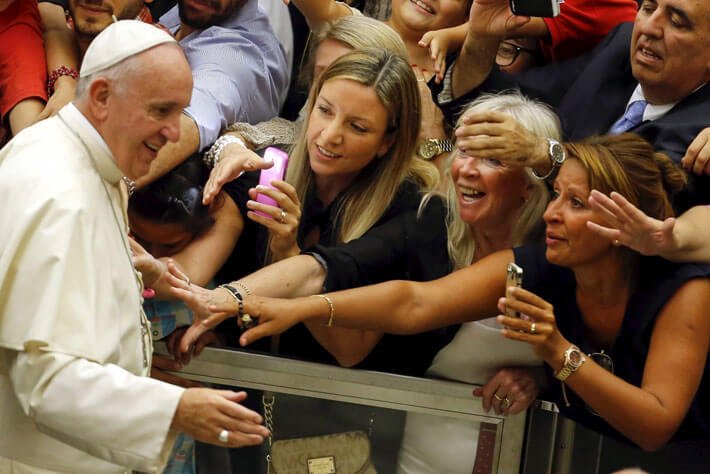


Pope Francis, A Beacon of Hope
May 29, 2024 5:33 PM
His values and general hopefulness seem to be the best approach to take in today’s troubled times.
CBS anchor Norah O'Donnell recently interviewed Pope Francis, and the interview was broadcast on an hour-long program (including ads) on her network, as well as on a segment of “60 Minutes.” About major issues—the environment, peace, capitalism, ideology and politics, and migration and refugees—the pope’s past remarks, about which I have often written, have hit the bull’s-eye. In addition, his values and general hopefulness seem to be the best approach to take in today’s troubled times.
In her interview, O'Donnell reflects sympathy for Francis and his values. That reality, plus her two degrees from Georgetown U. (BA in philosophy and MA in Liberal Studies), from which I also received a degree (my Ph.D.), perhaps biases me toward her. She has written that one of the reasons, she “chose Georgetown was for its academics and its values.” Like her, I believe values to be an extremely important—but undervalued—aspect of our existence.
But back to Pope Francis and what his recent interview reveals about him. First, his hopefulness. When O'Donnell asked him “what gives you hope?” he responded, “Everything. You see tragedies, but you also see so many beautiful things. You see heroic mothers, heroic men, men who have hopes and dreams, women who look to the future. That gives me a lot of hope. People want to live. People forge ahead. And people are fundamentally good. We are all fundamentally good. Yes, there are some rogues and sinners, but the heart itself is good.”
Regarding his views of timely topics, the O'Donnell interview touched on most of his important ones except capitalism, about which she never asked him. Those interested in his capitalist comments, however, can instead turn to his decade-old “apostolic exhortation,” Evangelii Gaudium (see also here.)
Related stories
Perhaps the most significant issue we face today is our climate crisis. O'Donnell asked him, a scientist by background, how worried he was about it. His response? “We have gotten to a point of no return. It’s sad, but that’s what it is. Global warming is a serious problem. Climate change at this moment is a road to death, a road to death, and it is an artificial climate change. No? Something provoked, not the normal climate change.” He admitted to placing most of the “blame on wealthy countries....because they are the ones that have more of an economy and an energy based on fossil fuels....They are the countries that can make the most difference given their industry and all.....But it is very difficult to create an awareness of this. They hold a conference, everybody’s in agreement, they all sign and then bye-bye. But we have to be very clear, global warming is alarming.”
After O'Donnell inquired what he said “to the deniers of climate change,” he answered, “There are foolish people, and even if you show them the statistics, still the fool will not believe. Why? Generally, it is either because they don’t understand the situation or out of a vested interest, but climate change is real. The warming of the earth has already increased by two degrees. That is a lot.” He also added, “How many young people today will not get to see so many things? It is a lack of conscience to use a plastic bottle and then throw it to the sea. This makes the sea unhealthy. We have to be conscientious about repurifying nature.”
About war and peace, he mentioned both Gaza and Ukraine and said, “Every evening at 7:00, I call the [Catholic] parish of Gaza. There are 600 people there, and they tell me about what happens. It is very tough, very tough.” He added, “I pray every day for peace in Palestine and Israel.” And his advice? “Please stop. Negotiate. A bad deal is always better than an ugly defeat. . . . Negotiate, negotiate. . . . Strive for peace. A negotiated peace is always better than an endless war. War always serves to destroy. Always.”
Like an Ian McEwan character in his novel Black Dogs (1993), Francis realizes the countless individual tragedies of war. McEwan wrote, “He was struck by the recently concluded war [World War II in Europe] not as a historical, geopolitical fact but as a multiplicity, a near-infinity of private sorrows, as a boundless grief minutely subdivided without diminishment among individuals who covered the continent like dust.” To O'Donnell the pope said, “Whenever I visit one of the military cemeteries, I see the age of the kids. 18, 19, 20-year-olds....I think of the mothers when they receive a letter, ‘Madam, I have the honor of informing you that your son is a hero and I’m sending you this medal.’ The mother says in her heart, ‘I don’t want this medal. I don’t want a hero. I want my son.’” Francis also talked about a possible visit to the UN in New York and said, “If I go, it is to talk about peace.”
Regarding ideology and politics, as he has done before, he criticized ideology. He told O'Donnell, “All ideology is bad, whether it is from the right, the center, or the left. An ideology is not an idea. No, it is something worse.” As an example, he mentioned anti-Semitism and said, “anti is always bad. So these postures of persecution, of condemning outright are no good at all. You can criticize one government or another....the government of Israel, the Palestinian government. You can criticize all you want, but not anti a people.”
In general, Pope Francis is a pragmatist, a great believer in being open-minded and dialoguing. In the interview he insisted, “You have to be open to everything. . . . Everyone, everyone, everyone....And once inside, we’ll figure out how to sort it all out. But everyone. Do not forget that the Gospel is for everyone.”
He mentioned to O'Donnell that a “conservative is one who clings to something and does not want to see beyond that. It is a suicidal attitude. Because one thing is to take tradition into account, to consider situations from the past, but quite another is to be closed up inside a dogmatic box....A closed heart becomes hardened. It hardens and gets sick....The heart must be open. It is true that in many people, their selfishness leads them to close up their hearts. But that can be helped by talking, discussing, helping, right? Someone who dies with a closed up heart is a pity. They miss out on a great happiness that of going forward with an open heart.”
It would be going too far to describe Francis as a believer in “Situation Ethics” (the title of a 1966 book written by Anglican theologian Joseph Fletcher which argued that an ethics based on unbending moral laws with no exceptions was too rigid. In place of a system of absolute “dos” and “don’ts,” Fletcher advocated acting in the most loving way possible in any particular situation). But in answering a query from O'Donnell about surrogate motherhood, Francis said the following:. “I would say that in each case the situation should be carefully and clearly considered, consulting medically and then morally as well. I think there is a general rule in these cases, but you have to go into each case in particular to assess the situation, as long as the moral principle is not skirted.”
The pope believes a major political problem is indifference. People read or hear about wars, injustice, crimes, etc. and they “wash their hands....That is what happens when the heart hardens....and becomes indifferent. Please, we have to get our hearts to feel again. We cannot remain indifferent in the face of such human dramas. The globalization of indifference is a very ugly disease.”
One of the major political problems that Francis and O'Donnell discussed at some length was migration and refugees—he is the son of migrants from Italy to Brazil, and three of four of her grandparents came to the USA from Ireland, with the other grandparent also being an Irish American. She mentioned that immigration was sometimes linked to climate change, and five years ago he indicated that “weapons of war are produced and sold in other regions which are then unwilling to take in the refugees produced by these conflicts.” (In February 2024, for example, the UN announced that 1.6 million Sudanese fled their war-torn country to become refugees in nearby nations.)
Three and a half years ago, I contrasted Pope Francis’s attitude to immigrants—he “has sought to awaken the consciences of people worldwide to the plight of migrants and refugees"—with that of President Trump. About the latter I wrote that “ever since he announced that he was running for president in 2015, he has railed against illegal immigrants or even legal ones from countries he doesn’t like.”
O'Donnell mentioned that Francis’s “first trip as Pope was [to] the Island of Lampedusa,” where he “talked about suffering.” (That was in 2013, when the Italian island was already a haven for migrants from north Africa. Ten years later 7,000 migrants, more than the normal population of the island, arrived in two days, highlighting how Europe, as well as the USA, continues to face a serious migration crisis.)
She pointed out that many times migrants attempting to enter the USA are “mothers with children who are fleeing violence and they walk thousands of miles with their families for a better life, and yet there is a discussion about closing the border.” She added that she grew up in Texas, and that now the state “is attempting to shut down a Catholic charity on the border with Mexico that offers undocumented migrants humanitarian assistance. What . . . [did he] think of that?” His response? “That is madness. Sheer madness. To close the border and leave them there, that is madness. The migrant has to be received. Thereafter you see how you are going to deal with him. Maybe you have to send him back, I don't know, but each case ought to be considered humanely.”
He repeated an idea he had earlier promoted: “For an immigration policy to be good, it must have four things, for the migrant to be received, assisted, promoted, and integrated. This is what is most important to integrate them into the new life.”
Besides the major topics mentioned Pope Francis had some insightful comments on other topics, for example on the effects of social media on young minds and that “all too often it is customary to put the elderly in geriatric homes.” And O'Donnell recognized that “Pope Francis’ devotion to traditional doctrine like his unwillingness to ordain women has frustrated those who want him to loosen restrictions against things like contraception and surrogacy.”
From a progressive viewpoint his views are sometimes flawed, but as he says about himself, “I am a sinner.” He has the humility to recognize that he, like all of us, is sometimes wrong. And he demonstrates the observation that the theologian Reinhold Niebuhr once made—“The saintliest men frequently have a humorous glint in their eyes. They retain the capacity to laugh at both themselves and at others.” At the end of Francis’s interview with O'Donnell he said, “Thank you. And pray for me, don’t forget, huh? In favor, not against.”
Comments

Powered by RoundtableAn AI/DeFi-powered Enterprise Media Operating System. Learn more at Roundtable.io.© Roundtable 2026. By using this site you agree to the Terms of Use and Privacy Policy