


Apr 25, 2023 12:00 PM
Christian Nationalists believe that the country ought to be governed by rigorous Christian principles.
Congress shall make no law respecting an establishment of religion, or prohibiting the free exercise thereof
Above is the well-known text of the first clause of the First Amendment to the Constitution of the United States of America. It seems to state clearly that the USA may not have an established church or religion, and that Congress may not outlaw the exercise of any religion.
It was this reading that led the Supreme Court in the 1960s to outlaw prayers in public schools, because they amounted to an unconstitutional establishment of a particular religion (Christianity), or even of religion in general, thus violating the rights of minority religions such as Judaism, or those of the nonreligious.
Conservatives have been trying since the 1960s to roll this ruling back. While they have not been completely successful, subsequent Supreme Court decisions have watered down the prohibition.
Related stories
The current Supreme Court, with its 6-3 conservative supermajority, seems particularly inclined to protect the exercise of religion by conservative Christians.
The current Supreme Court, with its 6-3 conservative supermajority, seems particularly inclined to protect the exercise of religion by conservative Christians when they come into conflict with anti-discrimination laws. Whether the Court will be similarly solicitous of the rights of Jews or Muslims or atheists, has yet to be tested.
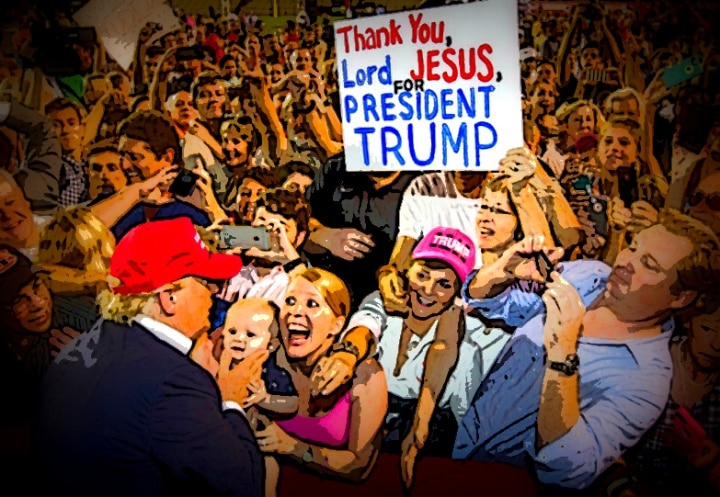
The Far Right, led by Donald Trump and Ron DeSantis, has lately taken this movement to its logical conclusion. Their erroneous (see below) premise is that this country has always been a Christian nation, and should finally define itself as such. This is known as “Christian Nationalism.”
Christian Nationalists believe that the country ought to be governed by rigorous Christian principles, as interpreted by conservative Christian Evangelicals. Not by Methodists or Episcopalians or Catholics (or, God forbid, by Mormons!). Non-Christians and the wrong kind of Christians would only be permitted to practice their religions to the extent that they did not conflict with the established version of Christianity. Atheists would just have to shut up.Christian Nationalists believe that the country ought to be governed by rigorous Christian principles, as interpreted by conservative Christian Evangelicals.
Not by Methodists or Episcopalians or Catholics (or, God forbid, by Mormons!). Non-Christians and the wrong kind of Christians would only be permitted to practice their religions to the extent that they did not conflict with the established version of Christianity. Atheists would just have to shut up.
If Christian Nationalism actually comes to power, its principles would abrogate the first clause of the First Amendment, because it would specify one version of Christianity as the established religion of the country. Indeed, because this version of Christianity, strongly based in the Old Testament, is highly authoritarian, it would undermine our whole constitutional system, with its elaborate checks and balances and the rights guaranteed by the Bill of Rights.
It is paradoxical that Christian Nationalists would establish the Christianity of conservative Evangelicals, when you consider that contemporary Evangelicalism is notoriously sectarian. Fine points of doctrine lead churches to split. Every Evangelical pastor is an entrepreneur competing with other pastors to build his (very rarely, her) church’s numbers and wealth. Why should we suppose that these Evangelical leaders would suddenly agree on doctrine and cooperate?
The Christian Nation premise is erroneous for several reasons. First, several of the original colonies (Rhode Island, Pennsylvania and North Carolina) had no established church at all. The other New England colonies established Puritanism (now Congregationalism). New York, New Jersey and the rest of the Southern colonies established the Anglican (now Episcopalian) Church.
None of the colonies restricted the exercise of religions not established. Indeed the federal First Amendment was probably intended to prevent a struggle between the Anglicans and the Congregationalists to be the established national church.
The Religious Right (Conservative Evangelicals) is a small (but growing) part of the national electorate (maybe 15 percent), but it provides the energy for the larger Far Right movement around Donald Trump. Were he elected again, we could have the irony of this fundamentally godless, immoral person enforcing the establishment of the new religious orthodoxy.
The logic of Christian Nationalism parallels that of Russian Orthodoxy (and the Orthodox tradition more generally. The Russian Orthodox Church has always been closely allied with the ruling secular authorities, whether Tsars, or the Communist Party of the Soviet Union, or President Vladimir Putin. The Christian Nationalists would establish a similar alliance.
Comments

Powered by RoundtableAn AI/DeFi-powered Enterprise Media Operating System. Learn more at Roundtable.io.© Roundtable 2026. By using this site you agree to the Terms of Use and Privacy Policy