


Sep 16, 2023 1:00 PM
White Christian Nationalism is the greatest threat to a multi-racial inclusive democracy
Most people will insist on the removal of a cancerous tumor. No rational person would agree to the partial removal of a cancerous tumor because what remains of that tumor will continue to grow, infecting healthy cells, causing the patient to suffer until, eventually, the patient dies. What remains, in other words, will still act like cancer. It will eventually, kill the host. A partial removal isn’t the same as “all clear.” Likewise, ridding ourselves of a little bit or even half of something toxic to democracy won't solve our current political and cultural crisis.
There are those who oppose disclosing the complete history of the United States. We all know that light is the best disinfectant. But some Americans prefer to keep large portions of American history in the dark as if sharing it is life threatening.
Why would some Americans view this knowledge as life-threatening? For that answer we have to ask, what is, for these Americans, worth protecting—at all cost—if not white supremacy. The history of using caves to hold kidnapped human beings along the western coast of Africa, of auction blocks, of selling and buying men, women, and children, of the systemic rape of Black children and adults, male and female, of the systemic exploitation of forced labor, resulting in the foundational establishment of institutions and industries is to be erased, if not forcefully forgotten. Too uncomfortable for Americans filled to the brim with innocence, God, and patriotism!
To eradicate the history of the Black lived experience so as to effect a “disappearance” of the unwanted results in the coercion of all Americans, offering everyone, that is, a shared role in the violence of fascism.
Related stories
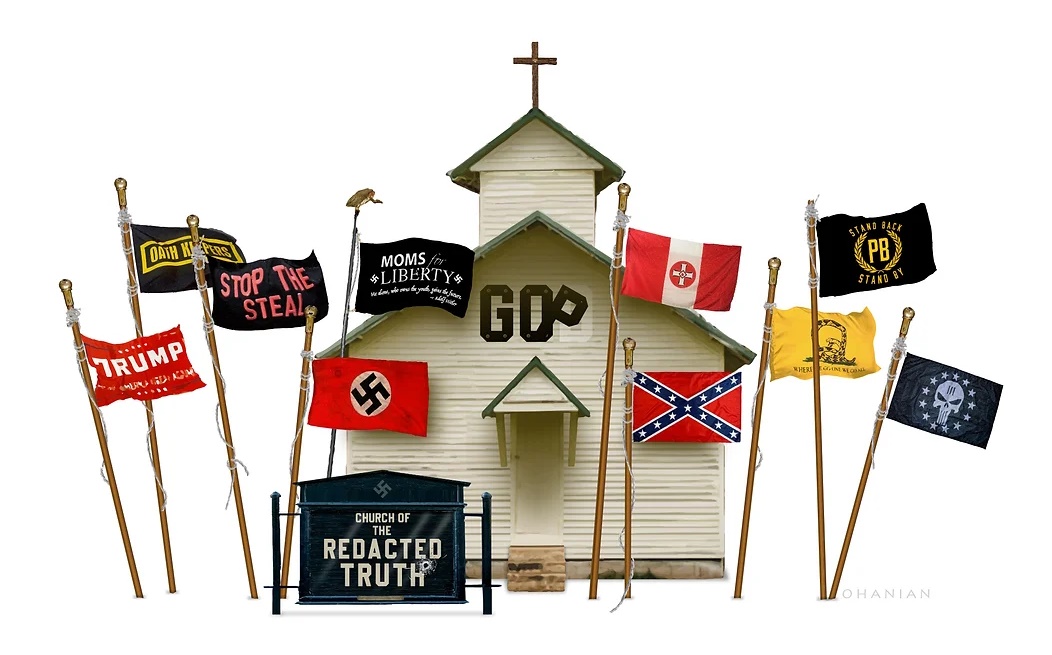
Bring out the Confederate flag. Display the crosses. And the noose. No one need wonder where Christianity enters the picture. God is on the side of the insurrections at the US Capitol on January 6, 2021. Insurrectionists shouting, “take back our country,” coincides with the pogroms, such as the banning of books and the removal of AP courses in African American studies and the outright censorship against anything having to do with slavery. Slavery. It’s the dream of American fascist to “disappear” Black people, beginning with pogroms that shift the victim of enslavement, conquest, imperialism, and exploitation into the embodiment of the “un-Godly.” Evil itself.
It’s a pattern of outcomes history has recorded again and again. And it is nothing short of a declaration of war.
And so war it is! *
The war began long before Trumpism. In the “Forward” to The Flag and the Cross: White Christian Nationalism and the Threat to American Democracy (2022), the public historian, writer, and former Evangelical Christian Jemar Tisby describes how the results of the Trump victory in 2016 affected him. It was as if he had engaged in battle, and lost. The physical signs of the conflict manifested themselves in a muscle twitch under his left eye. He suffered from this “physiological response in which,” he writes, “I essentially winced every time I opened my laptop.” Tisby later learns that he experienced “a form of racial trauma.”
He had to ask himself, How would it be possible to worship alongside whites at church? “How could I sing, pray, and exchange pleasantries with folks who seemed not to care what their favored politician’s plans would mean for me, my family, our community, and our country?”
Yet, for Americans, at odds with the idea of a democracy, it’s perfectly fine if folks like Tisby worship elsewhere. In fact, Black Americans would be encouraged to do so. The US has experienced an uptick of white supremacist violence in the passing of laws to protect white culture from Black matters. The “slow-moving changes” that authors Philip S. Gorski and Samuel L. Perry refer to in The Flag and the Cross, has some Americans willing to outlaw democracy and tear asunder the Constitution. “The United States has slowly,” the authors write, “become less white; less Christian and less powerful; more diverse, secular, and cosmopolitan.” And while this is finally a welcoming society for some Americans, it’s a foreboding future for those who believe white culture is in danger of being obliterated by an invasion of the Other.
For Gorski and Perry white Christian nationalism is their term for “the ethno-traditionalism among many white Americans that conflates racial, religious, and national identity (the deep story) and pines for cultural and political power that demographic and cultural shifts have increasingly threatened (the vision).” While white nationalism, the authors write, isn’t synonymous with evangelicalism, “there is considerable overlap.” White evangelicalism is becoming “more and more synonymous with Republican voting and reactionary politics.”
And so, if America is a “white Christian nation favored by God and ruled by white Christian men ready to defend freedom and order with violence,” then so be it. For believers, the rejection of “pluralism” and thus, a turn against democracy. Whatever stands to threaten white power is a target of justifiable violence.
And so war it is! White culture is in need of protection and so the merging of religious nationalism and white nationalism is necessary for the amassing of troops for battle. The call to patriotism is a shout out to those who love their country, a non-pluralistic country, a white country. As Gorski and Perry make clear, “patriotism is animated by love; nationalism by hatred.” It’s not patriotism that stirs these adherents with anti-democratic fervor but, instead, hatred of those perceived as being invaders.
There was an invasion and there is one continuing with new populations of “others.” It’s a pay-noattention-to-the-actual-history moment! With all the drama of an Edgar Allan Poe horror tale, white evangelical nationalists perceive themselves as victims of a darkening American landscape.
Grievance politics follows grievance narratives when there’s an overwhelming feeling of loss.
Especially if the loss is perceived as a theft! And how ironic when, in fact, the oral and written history of Black and Native Americans, victims of conquest and enslavement, speaks of a historical theft of culture. For American Christians, the feeling of loss is new. As Gorski and Perry explain, in the past, American Christians thought themselves “racially, politically, and religiously superior to their opponents du jour.” Exhibiting “a triumphalist tone,” they were able to feel self-righteous rather than overwhelmed. In today’s racially pluralist society, however, American Christians “imagine themselves playing defense.”
A key reason propelling this notion of theft, something lost because it was stolen, writes Gorski and Perry, is not that Christian nationalist have “a different understanding of American history,” but rather that they “often have an incorrect understanding.” And the others add, this is the case, “only if they are white.” A “cottage industry” spreading “historical misinformation” forms the bases of white Christian nationalists’ believes, writes Gorski and Perry.
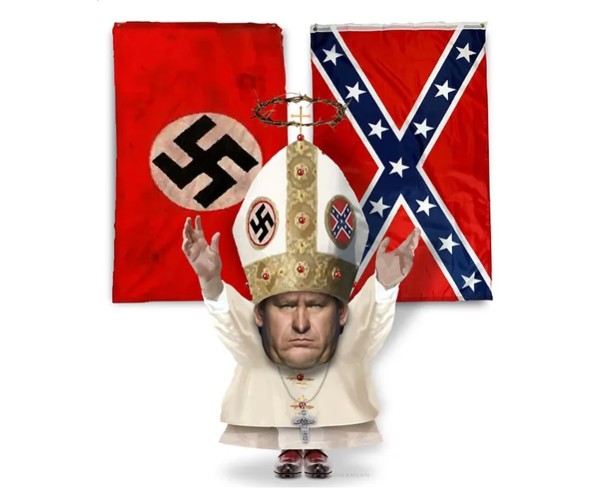
So it follows that “grievance politics” reflects back to white Christian nationalist an array of ways they are wronged by Blacks, women, liberals, liberal education, leftists, gay and trans Americans, in particular. “Grievance politics” reflects “the way in which loss of status has contributed to feelings of persecution among conservative white Christians.”
As victims, and with the anti-Black animus remaining as a “core element” of white Christian nationalism, American Christians are free to add anti-immigrant nativism to their enemies list. In a country in need of “redeeming” from hoards of “un-Christians” and “outsiders,” if the enemy is enlarging its troops, why not merge forces? The unwanted cancer is metastasizing!
With God sanctioning the necessary violence required to rid the blackened landscape of polluters, this same God is expected to reward white nationalist and to punish the “evil.” And so goes the narrative of “the end times,” an ideology that not only promotes a “sharp division between a good ‘us’ and ‘evil’ them,” but also promotes “gory tales of ‘spiritual warfare.’”
Democracy, then, is no where on the horizon. Martyrdom for the supremacy of whiteness is doing the Lord’s work! *
In my modest library, I have a little more than 500 books. When you move as much as I’ve had to move to escape racist authoritarians and pursue a teaching position elsewhere, expect to engage in the purging of books, even those histories and novels read during my college years. I can’t imagine, then, the Academy’s philosopher, who, writes journalist and classist Catherine Nixey, in The Darkening Age: the Christian destruction of the Classical World (2018), “proudly traced their history back in an unbroken line-- ‘a golden chain’ as they called it—to Plato himself,” a 1000 years before, on the run from zealots. Their leader, Damascius, setting out on a trip to unknown lands, understood that this era was no longer one for “a philosopher to be philosophical.” Instead of reason, the “tyrant,” said one philosopher, was in charge.
Beginning in Palmyra, C. AD 385, with the arrival of Christians to that city, Nixey describes the carnage as nothing short of an invasion by determined “destroyers.” Originating from the desert, these invaders were expected by the citizens of Palmyra for some years, ever since hearing from terrorized refugees about “marauding bands of bearded, black-robed zealots, armed with little more than stones, iron bars and an iron sense of righteousness,” dismantling the Roman Empire to the east.
Bands of marauders infiltrated “pagan” cities, increasing their numbers while destroying any and everything not Christian. Any classical texts written by pagan philosophers and poets was destroyed, and whole libraries, stripped of their holdings, were set ablaze. As Nixey explains, “classical literature not only questioned the reality of divine beings, it frequently laughed at them too.” Consequently, whatever texts escaped the flames were deemed banned, as forbidden as idolatry.
Writing about the destruction of the Great Library of Alexandria, the modern scholar Luciano Canfora described a library that held some 700,000 volumes by the 1st Century B.C and 500,000 scrolls by the 3 rd Century. After the arrival of the Christians, writes Nixey, the world had lost much of the thought of human beings contemplating the reality of their existence, Earth, and the universe. “Ten of thousands of books, the remnants of the greatest library in the world, were lost, never to reappear,” and where there had been “competing philosophical schools, all equally valid, all equally arguable,” there was now a “right” and a “wrong” way of thinking. In fact, there was “the Bible said—and there was everything else.” Or rather, nothing else! For to hold a belief that was “wrong” could, in the right circumstances, put you in grave danger.”
Given their arrival in a whirlwind of violence, it’s no wonder the Christians increased their ranks. Fear of being flayed and dismembered, what happened to the greatest classist mathematician, Hypatia, compelled many to convert. In the meantime, other Christians goaded Roman governors into sentencing to death in order to die a martyr.
As Nixey explains, it was God’s work to be a “victim” within the Roman Empire and ultimately die a saint. Since most Christians were economically poor, without standing in their society, martyrdom became an end goal. Nixey adds that those witnessing these “gory” deaths wanted nothing more than to become part of the Christian sainthood.
Displaying little respect for Roman laws, Christians, Nixey writes, “spat, metaphorically and literally, in the face of Roman legal process.” However, for the bulk of the 250 years after the birth of Jesus, “the imperial policy towards [Christians] was first to ignore them and then to declare that they must not be hounded.” To understand what really happened, writes Nixey, it’s necessary to read the accounts written by the non-Christians rather than the “replacement” narrative, filled with stories about the lives and deaths of saints. There’s Pliny the Younger annoyed at the number of Christians committing suicide in Bithynia, and Lucian who recognized Christians as those “deluded” into believing they were “going to be immortal and live for all time.”
It didn’t take long before the Roman government understood the reason for the appearance in their courts of contrarian Christians. But the slaughter and destruction persisted for decades until the arrival of Constantine, the first Christian emperor to implement laws restricting “‘the pollution of idolatry,’” furthering the institutionalization of Christianity. And now, no one was permitted to establish “cultobjects,” that is, “pagan” objects to sacrifice.
Less than 50 years after Constantine’s death, the death penalty was established for those sacrificing to “false” gods. A century later, in AD 423, the Christian government announces that “any pagans who still [survive] were to be suppressed.” As Nixey points out, the Christian government, not content with a partial removal of all “pagan” worshipers, continued its pogrom of cleansing until it could be heard: “‘We now believe that there are none.’”
The triumph of Christianity meant the annihilation of any and everything not Christian. It wasn’t merely about victory, writes Nixey. “It was about the total and utter subjugation of the loser.” *
In The Flag and the Cross, Gorski and Perry suggest that the spirit of white Christian nationalism’s can be traced to 1690 when there was a need to justify the enslavement of African people. The association, then, of “whiteness” with “freedom” and “order,” write Gorsky and Perry justifies the freedom to use violence against Blacks in bondage, that is, against the unfree Black, and the freedom to enforce order on the native “savages”
This rise of this narrative of “whiteness” is in response to 1619 when the first 20 kidnapped Africans “arrived off the coast of Port Comfort, in the English colony of Virginia,”--an historical event that is the premise of journalist Nikole Hannah-Jones’ 1619 Project. An “inflection point” falls between 1619 and July 4, 1776, write Gorski and Perry. Within this narrative of whiteness is the “deep story,” write Gorski and Perry, surrounding the fusing of Christianity and racism around 1690.
America, the authors of The Flag and the Cross agree, lost something: America lost “an alternative vision of life in the New World.” It lost the potential to envision a New World in which “the natives and the colonists would live in concord or even in community.” America lost a vision of a New World in which the line between white and Black did not yet fully and irrevocably correspond to that between freedom and bondage.” When America lost a vision of itself as a place with room, “not only for nonProtestants but also for non-Christians,” it lost it’s soul.
Comments

Powered by RoundtableAn AI/DeFi-powered Enterprise Media Operating System. Learn more at Roundtable.io.© Roundtable 2026. By using this site you agree to the Terms of Use and Privacy Policy