


Aug 12, 2026 8:19 AM
Progressives often ask why more Black people aren't in the room. After a lifetime in progressive movements, I have begun to think we may be asking the wrong question.
I have been an activist—boots on the ground, organizer, progressive advocate, troublemaker when necessary—for virtually my entire adult life.
And as a Black woman who has spent much of that life in progressive spaces, I have frequently found myself confronting a question that troubles progressive organizations across the country:
Where are the Black people?
Why aren't more Black people attending our conferences? Why aren't they joining our organizations? Why aren't they showing up for our meetings, forums, campaigns and coalitions?
Related stories
There are many answers to that question.
But I have increasingly come to believe that we are asking the wrong one.
Maybe the more important question is this:
What happens to Black people when we do show up?
My husband, Dick Price, and I publish the LA Progressive every day. We've been doing it for 19 years. We also organize the Left Coast Forum, an in-person gathering of progressive activists, writers, organizers and organizations, and we produce the weekly Hollywood Progressive.
I say this not to polish our progressive credentials. At this point I think they're fairly well established.
I mention it because I have spent a great deal of my life watching progressive politics from the inside.
And there is one scene I cannot forget.
Where Were the White People?
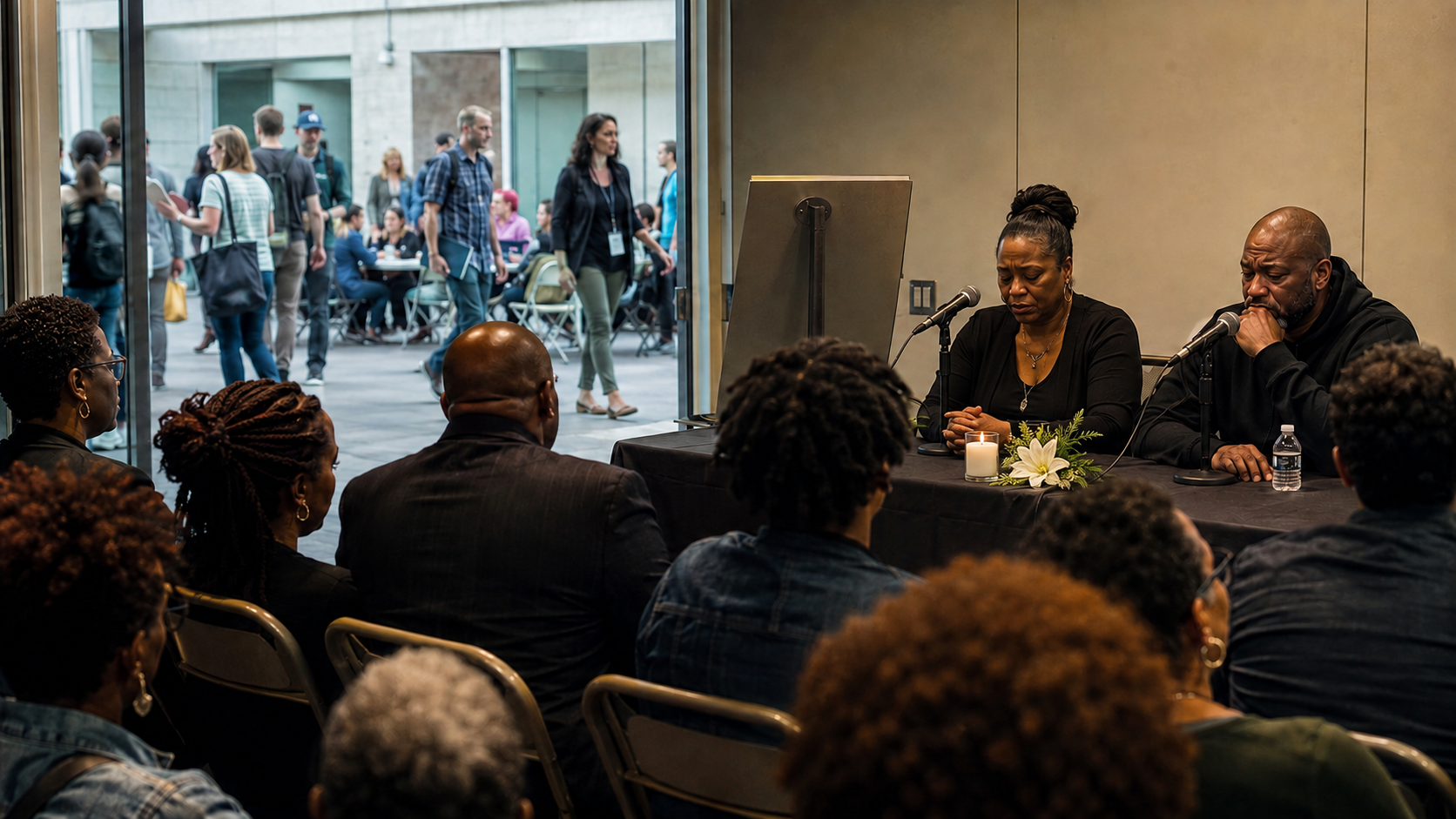
A few years ago, Dick and I organized a Left Coast Forum at Los Angeles Trade-Technical College. We had hundreds of attendees, dozens of presenters and multiple sessions occurring simultaneously throughout the campus.
The gathering was overwhelmingly white.
One of our presentations was organized by Cephus "Uncle Bobby" Johnson, uncle of Oscar Grant III, the 22-year-old Black man killed by a BART police officer at Oakland's Fruitvale Station on New Year's Day 2009. Johnson subsequently became a national organizer against police violence and helped build networks connecting families whose loved ones had been killed by law enforcement.
The session centered those families.
Not academics talking about police violence.
Not policy experts discussing it.
Not politicians explaining what should be done about it.
The families themselves.
Mothers. Fathers. Uncles. People who had buried children and relatives after encounters with law enforcement.
Among the presenters were Andrew Joseph Jr. and Deanna Joseph.
Their 14-year-old son, Andrew Joseph III—"Pee Wee"—had been taken into custody at the Florida State Fair in Tampa in 2014, removed from the fairgrounds and left on the other side of Interstate 4. Trying to make his way home, the child was struck and killed by a vehicle. His parents spent the years that followed fighting for accountability and eventually became activists on behalf of other families affected by police violence.
I met Andrew and Deanna that day for the first time.
They were a beautiful couple.
And their story broke my heart.
Perhaps it affected me so deeply because I recognized them. I had once been a young Black mother raising two children. I could imagine loving my children with the same fierceness I saw in them.
But my children came home.
Theirs did not.
I sat transfixed as they talked.
And then I looked around the room.
Almost everybody there was Black.
That struck me because the conference itself was overwhelmingly white.
So where were the white progressives?
They were there.
They were simply in other rooms.
Listening to other panels.
Discussing other issues.
Doing other progressive things.
And once I noticed it, I couldn't stop noticing it.
The same pattern repeated itself throughout the gathering.
Andrew Joseph Is Gone Now, Too
That memory returned to me recently for another reason.
Andrew Joseph Jr. died unexpectedly on May 16, 2026, at just 54 years old. Less than three months ago, Deanna Joseph lost not only the child with whom she had built a life, but the husband with whom she had spent more than a decade turning their grief into activism.
After their son's death, Andrew could have retreated into private grief.
Instead, he stepped into public struggle.
Representative Ayanna Pressley, honoring him after his death, described a man who transformed personal tragedy into organizing against police violence and qualified immunity.
That is the Andrew I remember sitting before us at the Left Coast Forum.
And thinking about his death brought me back to that room.
Back to those parents.
Back to those empty chairs.
Back to the question I have been struggling with ever since.
Whose pain do progressives consider their pain?
There Are Two Injuries
There are really two injuries involved when Black people confront racialized violence.
The first is the violence itself.
A child dies.
A man is shot.
A woman is killed.
A family is destroyed.
That wound is obvious.
But there is another wound that can be more difficult to explain to people who have never experienced it.
It is the experience of looking around afterward and discovering that what has shattered your world barely seems to have disturbed somebody else's.
A Black child dies and you cannot stop thinking about that child.
You imagine his mother.
You imagine his father.
You imagine your child.
You imagine yourself getting the phone call.
And then you step into another room and people are discussing electoral strategy, climate policy, campaign finance or whatever else is on the agenda that afternoon.
All of those issues may matter.
But the contrast can be devastating.
Because what you are experiencing is not simply sorrow.
You are discovering that grief itself appears to have a racial hierarchy.
Black Pain Is Not Imaginary
There is research behind at least part of what many Black people have long experienced intuitively.
Psychological studies have repeatedly documented racial bias in perceptions of pain. One body of research found that participants tended to assume Black people experienced less pain than white people; other studies found racial differences in empathic responses to another person's suffering.
None of this means every white person lacks empathy or every Black person responds identically.
That isn't the point.
The point is that racial hierarchy does not operate only through laws, wealth, housing, education, policing and employment.
It can operate through something much more intimate:
attention.
Who gets noticed.
Who gets believed.
Who is mourned.
Whose death becomes a national story.
Whose mother gets interviewed.
Whose photograph stays on television for three weeks.
Whose name everybody knows.
And whose death disappears almost before the body has been buried.
Research into media coverage has documented racial disparities in whose victimization receives attention, while scholars studying coverage of police violence have shown how racial stereotypes can shape whether victims themselves are blamed or humanized.
Attention is not trivial.
Attention determines what becomes a crisis.
And what becomes a crisis determines what movements mobilize around, what politicians are pressured to address, what journalists investigate and what the public eventually demands be changed.
We Don't Get to Leave the Room
This may help explain something about progressive spaces that I believe many white progressives do not fully understand.
For a white progressive, police violence against Black people can be an issue.
For Black people, it may be an issue—but it may also be family.
It may be memory.
It may be fear.
It may be that conversation you had with your son about what to do when the police stop him.
It may be the phone call you dread.
It may be remembering what happened to your father, your brother, your nephew, your neighbor.
It may simply be the knowledge that somebody who looks like your child was killed, and that you are expected to finish your breakfast, answer your email and carry on with your day.
White progressives can leave the breakout session.
We don't always get to leave the subject.
That distinction matters.
Maybe Black People Are Not the Problem
Progressive organizations often treat Black participation as an outreach problem.
We need better recruitment.
We need more diversity.
We need Black speakers.
We need Black organizations as partners.
We need somebody Black on the steering committee.
Maybe.
But perhaps Black people are making judgments about progressive spaces that progressives themselves have been unwilling to make.
Maybe Black people walk into these spaces and notice what is centered.
Maybe we notice what gets the largest room.
Maybe we notice which panel everybody wants to attend.
Maybe we notice whose suffering is treated as universal and whose suffering is treated as specialized programming.
Maybe we notice that everybody wants Black votes, Black organizing, Black cultural energy and Black moral authority—but sitting quietly in a room listening to Black mothers and fathers describe the deaths of their children somehow remains optional.
And maybe, after enough experiences like that, some Black people decide there are other places they would rather be.
That is not apathy.
That may be information.
Solidarity Is About What You Cannot Ignore
I am not arguing that white progressives do not care about Black people.
I have spent too many decades working beside white people who have risked careers, friendships, comfort and sometimes their bodies fighting racism to make such a ridiculous claim.
I am saying something more difficult.
Caring is not the same thing as identifying.
You can care about someone's suffering while still experiencing it as fundamentally theirs.
Solidarity asks something more of us.
Solidarity says:
Your child was killed, and therefore something happened to me.
Your community is under attack, and therefore my community has a problem.
Your freedom has been violated, and therefore I am not yet free enough to go into the other room.
That is a much higher standard.
And progressive movements cannot build the multiracial coalitions they constantly talk about without confronting it.
We cannot keep asking Black people to bring our entire selves into progressive movements while allowing everyone else to engage Black suffering as an elective.
The Empty Chairs
I keep coming back to Andrew and Deanna Joseph.
I remember them sitting before us telling the story no parent should ever have to tell.
I remember thinking about my own children.
I remember looking around that room.
And I remember the empty chairs.
Andrew is gone now.
Deanna has had to bury her son and her husband.
And somewhere, another Black family is beginning the same unbearable journey—trying to turn grief into organizing, trying to make strangers care, trying to convince America that the person they loved deserves to be remembered.
So perhaps the next time progressives gather and wonder why there aren't more Black people in the room, we should resist the urge to immediately devise another diversity initiative.
First, look around.
Look at the agenda.
Look at which rooms are packed.
Look at which rooms are empty.
Look at whose pain everyone considers essential knowledge and whose pain they believe they already understand well enough to skip.
Because sometimes the empty chairs tell you everything you need to know.
The question may not be why Black people aren't showing up for the progressive movement.
The question may be whether the progressive movement is fully showing up for us.
Comments

Powered by RoundtableAn AI/DeFi-powered Enterprise Media Operating System. Learn more at Roundtable.io.© Roundtable 2026. By using this site you agree to the Terms of Use and Privacy Policy