
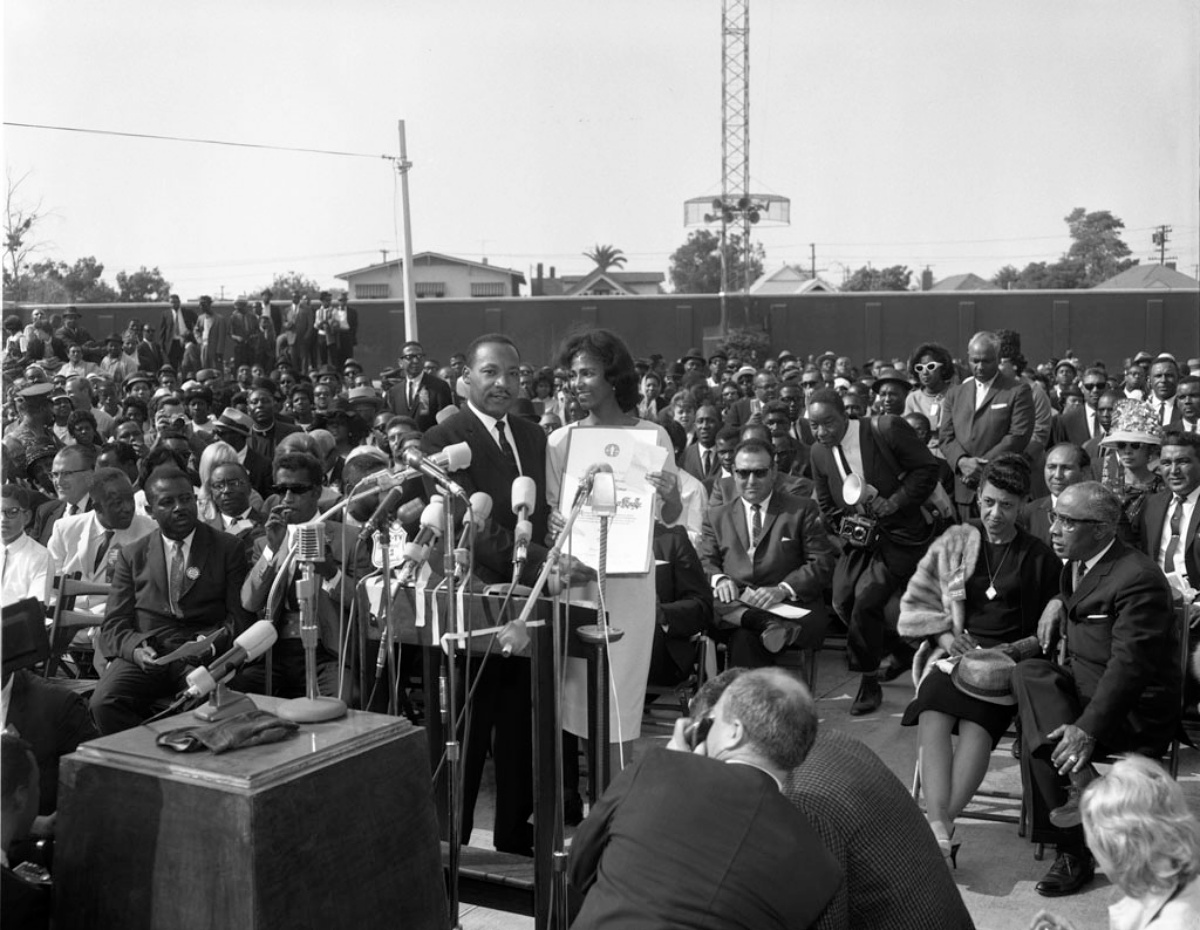
Actress Dorothy Dandridge standing next to Martin Luther King, Jr. in front of a crowd of 35,000 at Wrigley Field in Los Angeles, May 1963. (Photo: TOM & ETHEL BRADLEY CENTER)


Jun 18, 2025 3:52 PM
Updated Jul 16, 2025 2:54 PM
King’s nonviolence wasn’t just marches and lunch counter sit-ins but school boycotts, rent strikes, and the disruption of city and business life because injustice was comfortable for too many people.
As ICE continues to seize people off the streets of Los Angeles, protests have continued to mount. So have armchair critics. Many roll out Martin Luther King Jr. on the “right way” to protest—be more like King, they say, don’t be so angry and disruptive.
This is a dramatic distortion of what King actually did and believed. Our public history Southernizes King. But the civil rights leader made more than fifteen trips to Los Angeles where he joined more than fifty rallies, mobilizations, freedom meetings and marches before the Watts uprising, stressing the city’s “segregation and discrimination here, and police brutality.” Days after the Watts rebellion, King came to LA to hold city leaders accountable. So on this Juneteenth, it’s time to reckon with what King actually said and did in Los Angeles. Ten ways to be like King in LA:
Los Angeles, as racially unjust as Birmingham:
At a packed mass meeting in 1962 following the LAPD murder of Nation of Islam secretary Ronald Stokes, King condemned police brutality. “There is no compromise on this issue.” In 1963, King made clear that the “segregation here is as bad as Birmingham’s segregation” to a huge crowd at Wrigley Field. Behind the city’s liberal façade, Los Angeles’ city government and police department were as racially intractable as Birmingham’s.
Hold allies accountable: In 1960, King, Bayard Rustin and A. Phillip Randolph prepared to hold a March on the Conventions to hold both the Democratic and Republican Parties accountable to Black interests. Congressman Adam Clayton Powell and NAACP leader Roy Wilkins were furious they were targeting the Democratic Party. But they pushed forward anyway. As King observed in “Letter from a Birmingham Jail”, the greatest threat was not necessarily from the KKK but from the white moderate who “prefers order to justice.”
Related stories
Be furious at injustice: “Mass civil disobedience can use rage as a constructive and creative force.” King stressed. “It is purposeless to tell Negroes they should not be enraged when they should be.”
Support disruption: King’s nonviolence wasn’t just marches and lunch counter sit-ins but school boycotts, rent strikes, and the disruption of city and business life because injustice was comfortable for too many people. King observed that many California liberals (political leaders, residents, and journalists) came to praise bold disruption in the South while condemning it at home. “If our direct action programs alienate so-called friends” he observed, “they never were really our friends.”
King himself was arrested 29 times over his life— slammed down on a police counter, choked him, kicked in the back, picked up by his pants, and shackled and chained to a police car floor for hours.
Push for accountable policing: King stopped using the phrase “law and order,” instead calling for “law and justice.” King himself was arrested 29 times over his life— slammed down on a police counter, choked him, kicked in the back, picked up by his pants, and shackled and chained to a police car floor for hours. King condemned the push for increased law enforcement in Black communities and particularly around Black protest. “Many Americans would like to have a nation which is a democracy for white Americans but simultaneously a dictatorship over black Americans.” One of the March on Washington’s unfulfilled demands was to establish the US Attorney General’s authority to issue injunctive suits—including against police departments—when people’s constitutional rights were violated. Black communities needed a concrete way to take on the racism of police departments like the LAPD.
Call out city officials: In 1964, white Californians secured a devastating proposition on the ballot to retain their right to discriminate in the sale and rental of their property. King flew back and forth joining a multiracial movement across the state to defeat it—and was picketed repeatedly and attacked as a Communist. King called Proposition 14 “a vote for ghettos” and fingered its passage as laying the kindling for the Watts uprising nine months later. Days after the uprising, he met with Mayor Yorty and Police Chief Parker and highlighted long-standing Black grievances around schools, housing, jobs, and policing that they hadn’t addressed. He called for a civilian complaint review board, and Chief Parker’s resignation. Mayor Yorty called King’s visit “a great disservice to the people of Los Angeles and to the nation.”
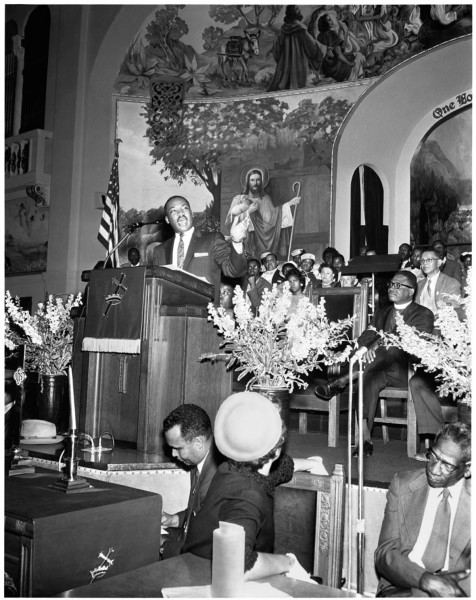
Critique the media for shielding injustice and demonizing protesters. King highlighted the tendency “of looking sympathetically at all sides that it fails to become committed to either side.” He rejected the ways the media framed white resistance to housing and school desegregation as a “backlash” to Black militancy and referred to “alleged” police brutality or “alleged” school segregation. No, many Californians “had never been committed” to civil rights. King tired of the ways the media tried to portray young urban people of color at odds with him. King had gone to Watts to meet with people. While the Los Angeles Times headlined the “heckling” the civil rights leader received, Jet Magazine made clear “the cynics were drowned out by cheers and applause” with young people both speaking and listening. King described the reception as “marvelous,” telling Coretta that what struck him the most “as he walked the streets those terrible nights, the people, young and old would gather and listen to him thoughtfully and sympathetically.” But exaggerating a divide between King and Angelenos was a convenient framing to avoid addressing the city’s pervasive inequality and cast Black youth as alienated and bent on ‘destroying their neighborhoods.’
Believe in the Leadership of a Vast Array of Young People: In 1965 and 1966, as part of the Chicago Freedom Movement, King spent hundreds of hours with gang members strategizing about challenging the city’s racial inequality. It wasn’t about telling them to pull their pants up. The respect and care were mutual, even if they didn’t agree on everything. “You couldn’t help but fall in love with him” Vice Lords leader Lawrence Johnson explained. SCLC convened an all-day summit—the Turfmasters First Annual Conference—bringing together two hundred gang members from eighteen different Chicago gangs—Black, white, Native American, Mexican, and Puerto Rican aimed to end violence between gangs and turn their energy to advocacy for their community needs. Many gang members served as marshals in the open housing marches in the summer of 1966 and went to DC in 1968 to carry on the Poor People’s Campaign King had been building when he was assassinated.
Stand with unions: King was also a die-hard unionist. When the American Federation of Television and Radio Artists went on strike in April 1967, King refused to cross the picket line to be on ABC’s Issues and Answers program. He supported the farmworkers struggle, telegramming Cesar Chavez during his fast that “the plight of your people and ours is so grave that we desperately need the inspiring example and effective leadership you have given.”
Link domestic issues to the injustices of foreign policy. Two months before his historic speech at Riverside Church, King gave a searing speech in Los Angeles lambasting US involvement in Vietnam as “perpetuat[ing]white colonialism” and rendering US global standing “pathetically frail.” He stressed how Black people were “100% of a citizen in warfare” but “50% of a citizen on American soil.”
Hold the country responsible: The future of the country, King observed in 1967, “will depend on the ability of white America to honestly face its racism and honestly respond to the demands that will not cease.”
Fifty eight years later, it is time for such honesty.
Comments

Powered by RoundtableAn AI/DeFi-powered Enterprise Media Operating System. Learn more at Roundtable.io.© Roundtable 2026. By using this site you agree to the Terms of Use and Privacy Policy