


Aug 16, 2026 7:24 PM
Updated Aug 16, 2026 8:50 PM
From Lake Lanier to Altadena, America Keeps Erasing Black Communities
There is a lake in Georgia that people say is haunted.
Lake Lanier draws boaters and fishermen every weekend, and every year a few of them drown, and every year someone repeats the story about why. Locals will tell you the lake is cursed. What they are less likely to tell you is what the lake was built on top of.
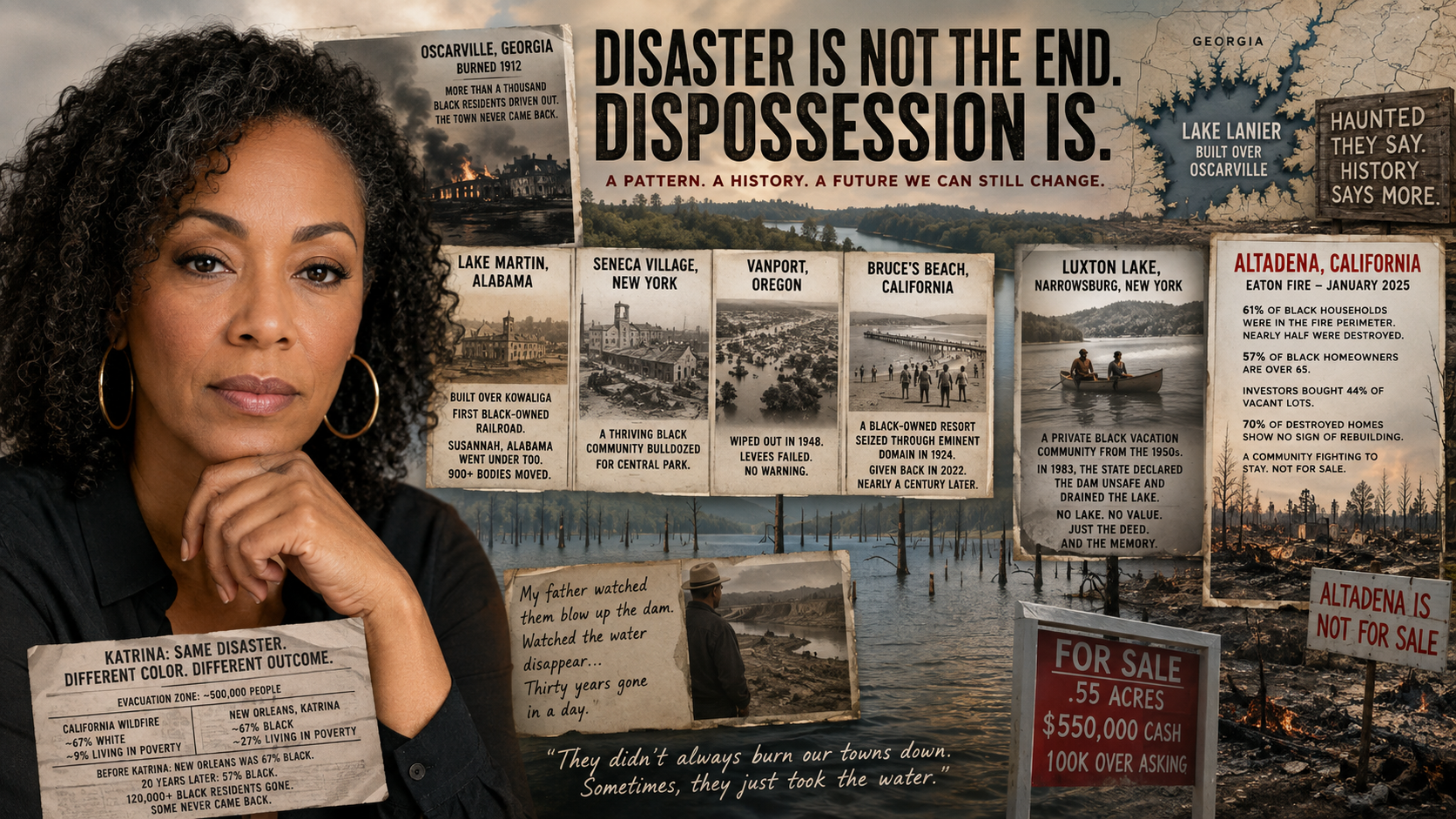
Before it was a lake, it was Oscarville. A Black town. Burned to the ground in 1912 after a white mob lynched a Black man accused of a crime, then drove more than a thousand Black residents off their land, out of their homes, away from their churches and schools. The town never came back. Decades later, the state flooded what was left of it and called it recreation.
Oscarville is not an anomaly. It is a pattern.
Related stories
The Drowned and the Dispossessed
Alabama's Lake Martin sits on top of Kowaliga, once home to the first Black-owned railroad in the country and a school built to educate Black children when almost nothing else would. Susannah, Alabama went under the same lake — more than 900 bodies had to be dug up and moved before the water came. Seneca Village, a thriving community of Black property owners in Manhattan, was condemned and bulldozed so New York could have Central Park. Vanport, Oregon, home to tens of thousands of Black shipyard workers during World War II, was wiped out in a single day in 1948 when officials knew the levees were failing and didn't bother to warn anyone in time.
And then there's Bruce's Beach, a Black-owned resort in Manhattan Beach, California, seized by the city through eminent domain in 1924 because Black people enjoying the ocean was apparently more offensive than empty land. It took until 2022 — nearly a century — for California to give it back.
I have my own drowned town, if I'm honest.
In the early 1950s, a private community called Luxton Lake, in the hamlet of Narrowsburg, New York, was subdivided and marketed as a vacation community for Black families from Harlem, Queens, and the Bronx. Bandleader Noble Sissle, of Broadway's "Shuffle Along," was one of the principals behind what became known as Lucky Lake Estates, and it drew working families for $100 down and pocket change a day. My father bought a lot there because he loved to fish and loved to camp, and he took my little brother up with him. For thirty years, roughly a hundred Black families built cabins there, swam, fished, canoed, and raised children in a place that was theirs.
In 1983, the state declared the dam that formed the lake unsafe and ordered it removed. My father was there the day they blew it up. He watched the water his family had fished and swum in for thirty years disappear in a matter of hours. Homeowners sued the town and the developer for $20 million and lost.
I inherited that property when my father died. It is worthless now. Not "worth less." Worthless. A landlocked patch of ground that was once a lakefront lot my father chose, on purpose, because he loved what it gave him. There is no lake to sell it on. There is no fishing to pass down. There is only the deed, and the memory of a man watching the thing he loved drained out from under him.
Nobody burned Luxton Lake down. Nobody needed to. They just took the water.
I want you to notice the method here, because it repeats. First comes the violence, or the "emergency," or the flood. Then comes the land grab, dressed up as progress, recreation, or public necessity. And then comes the erasure — not just of homes, but of the fact that Black people were ever there at all.
This is not ancient history. It is a business model. And it is still running.
What Color Is Your Disaster?
I've seen a comparison that has stayed with me for years. Two disasters, roughly the same size: the evacuation zone for Hurricane Katrina in New Orleans, and the evacuation zone for a major California wildfire. Both areas held about 500,000 people. In the California fire, roughly two-thirds of the evacuees were white, and about 9 percent were living in poverty. In New Orleans, roughly two-thirds of the evacuees were Black, and 27 percent were living in poverty.
Same disaster. Different color. Different odds of getting out, getting help, and getting home.
Before Katrina, New Orleans was a Black-majority city — about 67 percent Black. Twenty years later, that share has fallen to roughly 57 percent, with the city's Black population down by more than 120,000 people since the storm. Some people never had the money to return. Some came back to neighborhoods that no longer existed. Some were simply priced out once the rebuilding made New Orleans whiter, wealthier, and more gentrified than the city they'd grown up in.
Katrina didn't just take homes. It took a city's Black majority and never gave it back.
Altadena Is the Same Story, Told Faster
I don't have to reach far back into history for the next chapter. It's happening right now, in Altadena, less than an hour from where I live.
When the Eaton Fire tore through Altadena in January 2025, it did not fall evenly. Altadena's Black community had one of the highest Black homeownership rates in the country — around 80 percent, nearly double the national rate, built over generations in a neighborhood Black families turned to precisely because redlining locked them out of so many others. And when the fire came, it took aim at that legacy with brutal precision: 61 percent of Black households in Altadena sat within the fire perimeter, compared with 50 percent of non-Black households, and nearly half of Black households were destroyed or seriously damaged.
Then came the part Naomi Klein warned us about years ago in her writing on disaster capitalism — the moment when catastrophe becomes opportunity, but never for the people who lost everything.
Within a month of the fire, the first burned lot in Altadena sold for $550,000 in cash, $100,000 over asking, and investors — some of them international — began buying up scorched land while grieving families were still trying to find housing. By the fall, real estate investors were buying roughly 44 percent of the vacant Altadena lots that sold, snapping up land in a zip code that had seen essentially zero investor purchases the year before the fire. Cash offers. No mention of what stood there before. No mention of who lived there.
Meanwhile, 57 percent of Black homeowners in Altadena are over 65, elders now navigating insurance shortfalls and rebuilding costs on fixed incomes, exactly the population most vulnerable to a lowball cash offer that looks like a lifeline. UCLA researchers who studied the fire's aftermath put it plainly: rising property values and the barriers Black buyers already face mean younger Black families may never be able to buy back into the community their parents and grandparents built. Researchers now warn that these forces together threaten to erase Altadena's Black community altogether.
A year after the fire, 70 percent of the homes destroyed or damaged in Altadena showed no visible sign of rebuilding — no permit, no lot for sale, nothing. Just absence. Waiting rooms of grief with no floor plan.
Some residents have organized a land bank to buy lots and hold them for the community rather than let them go to developers. "Altadena is not for sale" signs have gone up across the neighborhood. It is, in its way, a beautiful act of resistance. It is also, if we're honest, a community trying to out-cash institutional capital with folding chairs and GoFundMe pages.
The Machinery Never Changed, Only the Weather
Oscarville burned because of a mob. Vanport drowned because officials didn't warn people in time. Seneca Village and Bruce's Beach were taken by government decree in the name of parks and progress. Luxton Lake didn't need a mob or a flood — a state agency just took the water away. New Orleans flooded because the levees failed the poorest, Blackest parts of the city first. Altadena burned because a fire doesn't check deeds — but recovery does.
Every single time, the disaster is the excuse. The land is the target. And the erasure of a Black community is treated, at best, as an unfortunate side effect, and at worst, as the plan working exactly as intended.
Naomi Klein taught a generation to recognize disaster capitalism when it showed up in Baghdad or New Orleans in the years right after Katrina — the exploitation of a crisis to push through changes people would never accept under normal conditions. I'd ask us to recognize it a little closer to home, and to notice how consistently it has a favorite target.
We keep calling these events natural disasters. Fires happen. Floods happen. Storms happen. But what happens after — who gets bought out, who gets pushed out, who gets remembered and who gets a plaque dedicated decades later for a village nobody thought to protect while it still existed — that part isn't natural at all.
That part is a choice. And until we start naming it as one, we will keep drowning towns, burning towns, and flooding towns, and calling it recovery.
The opinions expressed here are solely the author's.
Sources
Drowned towns (Oscarville, Kowaliga, Susannah, Vanport): Travel Noire, "Black American Towns Hidden Beneath the Water," https://travelnoire.com/amp/black-american-towns-hidden
Seneca Village: Central Park Conservancy, "Seneca Village," https://www.centralparknyc.org/articles/seneca-village
Luxton Lake / Lucky Lake Estates:
● New York Almanack, "Noble Sissle's Lucky Lake: An Interracial Catskills Lake Colony," https://www.newyorkalmanack.com/2025/02/noble-sissle-catskills-resort/
● Sullivan County Democrat, "Noble Sissle Comes to Sullivan County," https://www.scdemocratonline.com/stories/noble-sissle-comes-to-sullivan-county,165875
● Roosevelt Island Historical Society, "The First Inter-Racial Community in the Borscht Belt," https://rihs.us/2025/02/24/monday-february-24-2025-the-first-inter-racial-community-in-the-borscht-belt/
● The River Reporter, "Is Luxton Lake a Forgotten Community?," https://www.riverreporter.com/stories/is-luxton-lake-a-forgotten-community,48309
● Wikipedia, "Luxton Lake," https://en.wikipedia.org/wiki/Luxton_Lake
New Orleans / Katrina population data:
● Word In Black, "Katrina at 20: Race, Wealth, and Recovery," https://wordinblack.com/2025/08/katrina-at-20-race-wealth-and-recovery/
● The Data Center, "Who Lives in New Orleans and Metro Parishes Now?," https://www.datacenterresearch.org/data-resources/who-lives-in-new-orleans-now/
● City Journal, "After Katrina," https://www.city-journal.org/article/after-katrina
Altadena / Eaton Fire:
● UCLA Social Sciences, "Altadena's Black Community Disproportionately Affected by Eaton Fire, Report Shows," https://socialsciences.ucla.edu/2025/01/29/ucla_altadena_fires-study
● UCLA Luskin, "Ensuring Rebuilding Efforts Preserve Altadena's Historically Black Identity," https://luskin.ucla.edu/ensuring-rebuilding-efforts-preserve-altadenas-historically-black-identity
● NBC News, "Black Altadena Residents Fight to Keep Out Luxury Developers," https://www.nbcnews.com/news/nbcblk/eaton-fire-altadena-residents-fight-keep-luxury-developers-rcna196272
● Businesswire/Redfin, "Vacant Lots for Sale Are Piling Up After the L.A. Fires," https://www.businesswire.com/news/home/20251230482895/en/Vacant-Lots-for-Sale-Are-Piling-Up-After-the-L.A.-Fires-Investors-Are-Buying-40-of-Those-That-Sell
● Governing.com, "The Long and Uncertain Road to Recovery in Altadena," https://www.governing.com/resilience/the-long-and-uncertain-road-to-recovery-in-altadena
● LAist, "Corporations Are Buying Up Altadena Lots," https://laist.com/news/climate-environment/corporations-buying-altadena-lots
Comments

Powered by RoundtableAn AI/DeFi-powered Enterprise Media Operating System. Learn more at Roundtable.io.© Roundtable 2026. By using this site you agree to the Terms of Use and Privacy Policy