
This file is licensed under the Creative Commons Attribution-Share Alike 3.0 Unported license.


Feb 15, 2023 2:00 PM
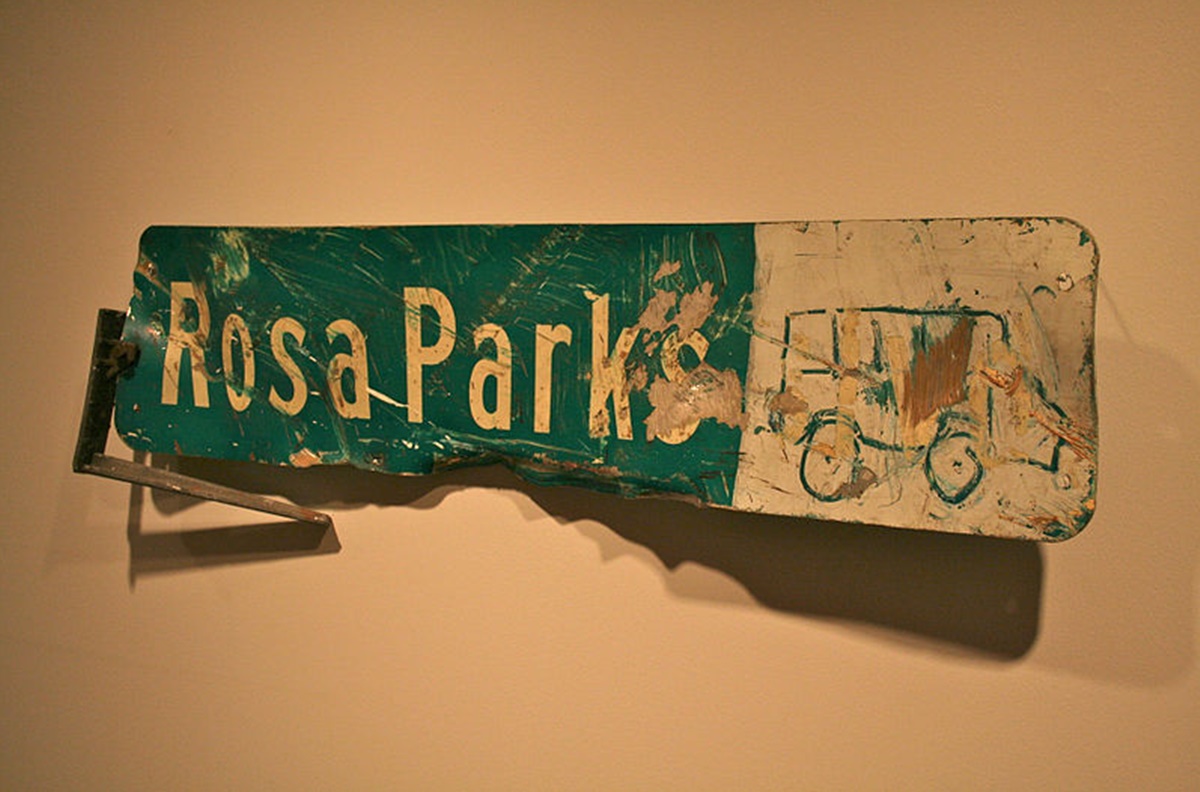
The town that greeted Kyle Rittenhouse and his AR-15 with open arms hosts Kenosha Transit Equity Day with posters of Rosa Parks on its public busses.
On Saturday, February 4, 2023, I boarded a bus for a mundane 3-block ride to the store. I paid my fare and turned to take a seat when I noticed a familiar face staring back at me from her front seat. A biography above the face, introduces the activist to those who might not recognize the face of Rosa Parks. She first took a front seat on a bus in a Montgomery, Alabama on December 1, 1955 and entered American history.
Below the poster, sitting across the seat, was a single stemmed red rose. Kenosha Transit Equity Day it read further down. I don’t recall such a day in previous years.
In a town that greeted Kyle Rittenhouse and his AR-15 with open arms, is this the beginning of systemic change? An awakening of sorts…
My grandmother warned: Don’t use that word in this house! My grandmother was referring to the word, Black. As in the Black community. Black people.
Related stories
Negroes. Black is an insult!
I referred to Black people only when I was around my age peers. In the meantime, whenever I would hear Dr. Martin Luther King Jr.’s name mentioned on the kitchen radio, I stopped to listen, careful, however, to not draw my grandmother’s attention. If she had seen me listening, she would have asked why I was bothering about what was going on “out there.” What happens out there doesn’t have anything to do with what happens in here, among family.
I lived with my grandparents until I was eleven, and wanting to continue being a good girl, no trouble to adults, no boat rocker, I stopped to listen, pretending I wasn’t listening at all. But I suspected something was happening out there that had everything to do with my grandmother’s willingness to deny acknowledging the lived experience of Black Americans not just out there but also inside our home as well.
We were one of the first in the neighborhood to have a black and white television. A monstrous piece of furniture in which I was planted in front whenever Dorothy from Kansas suffered a nightmare or when little Shirley Temple danced alongside of Bojangles.
At school, for at least two years in a row, Crispus Attucks lived to fight in the American Revolution before becoming the first to give his life for freedom. Someone’s freedom. Maybe not his. The nuns never followed up with why white Americans took up arms to free themselves from the British, but they insisted on keeping Blacks enslaved until 1865.
The nuns introduced us to Oklahoma. The Rodgers and Hammerstein musical, Oklahoma!
Oklahoma where the wind comes sweeping down the plains…
Did I mention that I lived on the South Side of Chicago and the school and church were a block away?
In August 1955, 14-year-old Emmett Till was kidnapped, tortured and murdered by white supremacist in Money, Mississippi. Dr. King’s name is on Hoover’s list of enemies. Meanwhile, white America is enraged.
In an ideal world, as the saying goes, I should have been able to rely on my formal education to teach me about my history, the history of this country. But years later, I realized I had my Southern father and his sisters. It wasn’t in the stories they told. As many Black migrants from the South, they kept company with silence. They would have preferred I learn what was happening out there rather than learn to sing songs about the plains of Oklahoma. I can still see how my father and my aunts quietly went about being Black and proud before James Brown sang about it.
To become educated is to hold in one’s hands a means of changing reality. In this sense, reading is an act of transgression.
I didn’t tell anyone on either side of the family, but someone introduced me to the bookstore, Timbuktu. Maybe someone told me about it. I don’t recall. But there is where I came across the works of historian Lerone Bennett. I read Alain Locke’s The New Negro and Arne Bontemps’ Black Thunder. In fact, my pay from summer jobs went to buying books at Timbuktu. The posters covering the walls of the bookstore displayed our inheritance of resistance. At Timbuktu, I saw what Sojourner and Frederick Douglass looked like. While I might have been sickly, barely over 100 pounds, I nonetheless felt like a giant among giants.
In my day, “politically conscious” was a way of being, informing how one became educated in order to understand his or her role in the world. “For to become educated,” James Baldwin writes, (as all tyrants have always known) is to become inaccessibly independent, it is to acquire a dangerous way of accessing danger, and it is to hold in one’s hands a means of changing reality.” In this sense, reading is an act of transgression. There shouldn’t be anything placid about reading Diop or Audre Lorde. What tyrant desires the independently free to read the independently free? A woke citizenry is unbound.
Among the young adults, our surrogate educators, it was expected of us teenagers to point to Africa on a map and recognize it was more than a continent. Africa makes America a great conqueror. Americans, a collection of Europeans until, “seeing black men for the first time,” Baldwin writes, became Americans, conquerors of a continent and the marketplace.
We wore dashikis and the Afro proudly. We knew the words to the Black National Anthem.
Lift every voice and sing…
There was such a thing as Black Feminism and the Bluest Eyes.
I joined the seniors in protest during my junior year in high school because it made perfectly good sense to have at least one course that taught African American history. I climbed up onto a lunchroom table and shouted. Demanded… And why not?
And then came the backlash like the winds sweeping over the plains. To be “politically conscious” became a foreign concept to a new generation of Black youth who were told to be upstanding “consumers.” During the early to mid-1980s, as Director of Student Activities for Harold Washington College, I thought it would be a good idea for the campus to host speakers and events for the whole month of February in honor of Black History Month. Students suggested Oprah. I mentioned Kwame Ture and Diane Nash. To which the students responded: Oprah.
On the day Oprah was to speak, students lined the streets between the campus building and the ABC television studio on State Street. Later in the month, in the lecture room where Ture and later Nash spoke on resistance, a few students took seats while others drifted in and out of the room.
Years later, in my fifties, I approached a white female professor in my first year of the doctorate program in literature. I showed a list of work I might cover with her, if she was interested. She looked up at me and declared I was “showing off.” This is a doctorate program! Compiling lists of texts to study is what it’s all about! But I suppose I had one too many James Baldwin essays. Too much June Jordan and bell hooks. For someone who declared herself to be a feminist, an author of a book on a Black woman writer of the Harlem Renaissance era, and a professor of Black women writers, she had the audacity of a patriarch. Far from woke. I never signed up for any of her classes.
In a democratic society, woke citizens are feared by fascists.
The 1990s followed the 1980s, entrenching the fight for freedom as a relic of the past. Resistance went underground again like that once famous railroad. In the meantime, Black, Latinx, and Indigenous professors, marginalized if not silenced, were assigned composition classes. We were of no use otherwise.
It’s a struggle to stay awake, to be unafraid to confront America’s past. Unfortunately, today, sleepwalkers are in demand…
In Faulkner’s Absalom, Absalom!, Rosa Coldfield, the future poet laureate from Mississippi, begins crafting the narrative of “the Old South.” The Civil War, out there, has ended, and it is at this moment when she hears that echo of a shot which sent her running to the plantation mansion. She suspects what’s happened will alter life as she knows it forever. She suspects that all the bloodshed out there has everything to do with what has just occurred at Sutpen’s mansion. A white father, ordering his white son to murder his Black son, mirrors American violence at its core.
Yet, Coldfield, sitting at her father’s desk, denies culpability. She has never seen the face of the dead man because he was dead to her when he was alive, living as he did, in her fairy tale of lush gardens rather than plantations and fields of tobacco or sugar. While she isn’t privy to the murder of the Black son and escape from justice of the white son of the slaveholder, Coldfield is nonetheless a major component of American violence: she is a writer of white supremacist propaganda. For Rosa Coldfield vows to write of “the Old South.”
Ironically, Coldfield becomes woke, briefly: “‘Ay, wake up, Rosa; wake up—not from what was, what used to be, but from what had not; could not have ever, been; wake, Rosa…’” And he eyes open to see the coffee-colored face. The slaveholder in the coffee-colored face. All the land covered with laboring Black bodies. Back shacks that no image of wisteria gardens is able to conceal. There is “the debacle” that ruined the South! Coldfield sees it. She sees it!
But she is facing Clytie, thinking, if the peculiar institution is dead, then the fairy tale too is dead. Yet, there is no going back. She will deny truth to an audience all to eager to accept lies. As poet laureate, her narratives will “invent” a past, making it glorious, so one day, Americans will pine for what never was…
Nonetheless, “the debacle” is none other than the victims of enslavement.
“It is terrible to watch people cling to their captivity and insist on their own destruction,” writes Baldwin.
But I identify with someone using her past to move forward. Clytie. Quiet, but steady, Clytie recognizes she is more than a face resembling a slaveholder. She is the sister of the dead man behind the door. She is what was denied to her and enslaved Blacks once labeled “property.” She is the sister and the descendant from ancestors made invisible in the fairy tales of plantation gardens. But no more! Deciding to be neither the property or the debacle, Clytie offers no small act of resistance. On the contrary, her decision to act results her prohibiting a propagandist committed to whitewashing America’s peculiar institution of slavery from distorting and marginalizing her lived experience and that of the lived experience of all African Americans formerly enslaved.
What’s a slap? Clytie stands, immovable!
In a democratic society, woke citizens, feared by fascists, nonetheless, identify with the struggle for democracy. They have empathy. They read. They join a protest march similar to the largest ever Black Lives Matter protest in 2020. A half a million citizens (maybe more) in some 550 locations across the US lock arms and identify with the victim of police brutality.
If not today, then tomorrow. Resistance is immovable!
Comments

Powered by RoundtableAn AI/DeFi-powered Enterprise Media Operating System. Learn more at Roundtable.io.© Roundtable 2026. By using this site you agree to the Terms of Use and Privacy Policy