


May 18, 2026 8:00 PM
How Movement Conservatism Reshaped American Democracy: If racism were truly over, why do the new maps look so much like modernized versions of Jim Crow laws of the past?
In her book How the South Won the Civil War, historian Heather Cox Richardson traces how the authoritarian ideology that fueled the Confederacy did not disappear after the Civil War. Instead, she argues, it migrated westward and reemerged through a mythology of rugged individualism, hierarchy, and cowboy culture that masked older systems of oligarchic power.
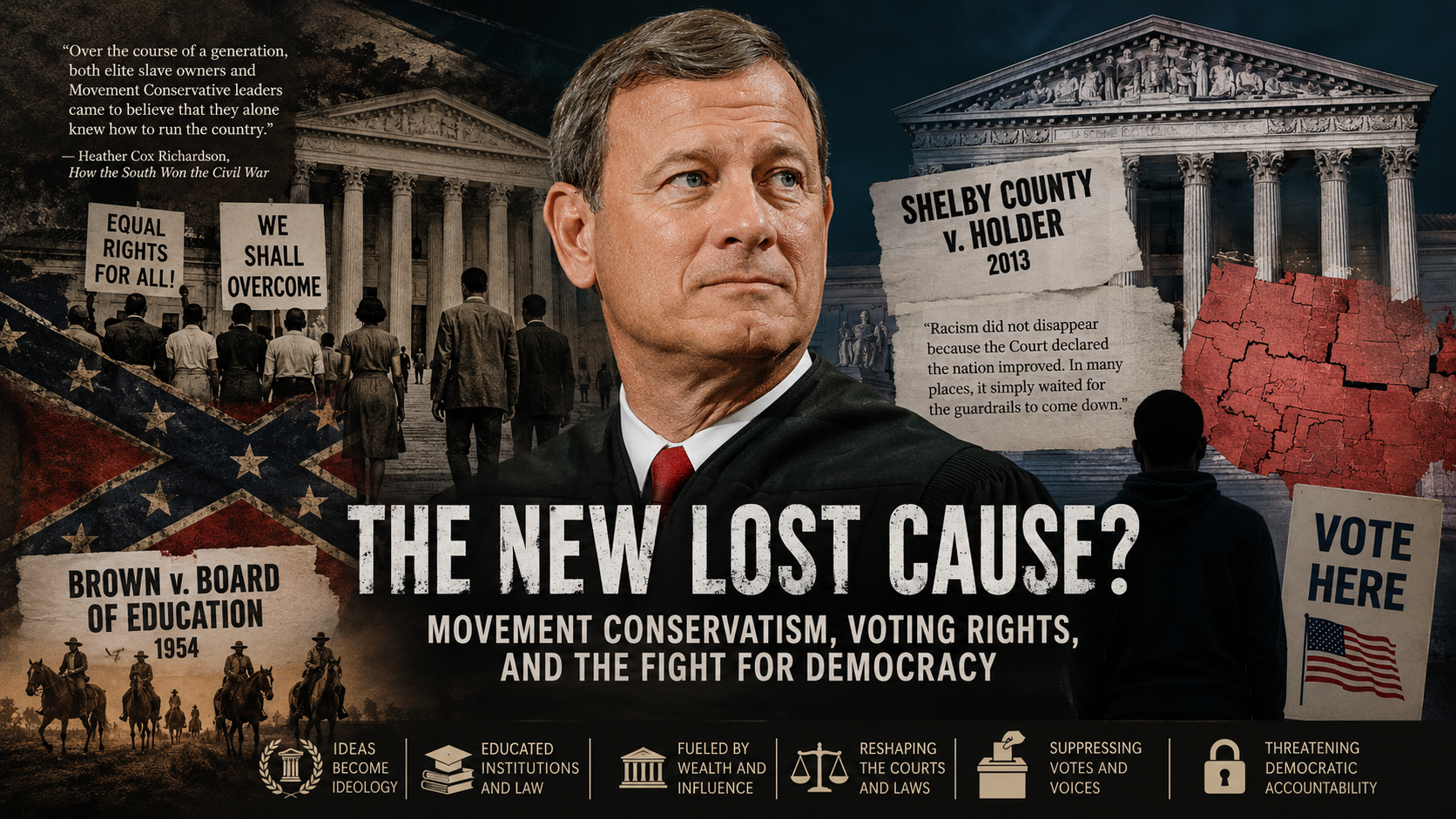
She writes, “Over the course of a generation, both elite slave owners and Movement Conservative leaders came to believe that they alone knew how to run the country.”
That observation helps explain much of modern American politics, especially the evolution of the conservative legal movement and its decades-long effort to weaken federal protections for minority voting rights.
Through years of observation, I have come to believe that Chief Justice John Roberts is deeply aligned, both philosophically and institutionally, with Movement Conservatism. Nothing in isolation immediately jumps out as radical. Roberts is cautious, disciplined, polished, and measured.
Related stories
But when you fast-forward through his career and judicial opinions, a pattern emerges: consistent skepticism toward federal voting-rights enforcement and race-conscious remedies designed to protect minority participation in democracy.
Roberts fits the movement-conservative pipeline almost perfectly. He clerked for William Rehnquist, joined the Reagan Justice Department, worked on conservative legal positions opposing expansions of civil-rights remedies, later served in the George H. W. Bush Solicitor General’s office, and was ultimately elevated by George W. Bush as the kind of refined conservative jurist the legal movement had spent decades cultivating.
The clearest organizational tie is the Federalist Society. In 2005, The Washington Post reported that Roberts appeared in the 1997–98 directory as one of nineteen steering committee members of the organization’s Washington chapter.
Leonard Leo said Roberts had been recruited as a law-firm contact for the group, though Roberts and White House aides later said he had no recollection of being a formal member. But whether he carried a membership card is beside the point. Roberts moved through the same elite legal ecosystem that transformed movement conservatism from a political philosophy into constitutional doctrine.
I did not fully grasp the magnitude of the backlash that followed Brown v. Board of Education at the time, but in hindsight I should have. Every major step toward racial equality in American history has been met with organized resistance, often fierce resistance. Over a decade after the decision nearly 100,000 Black educators were fired.
That backlash eventually evolved into something more sophisticated than the crude segregation of the past. It adopted the language of economics, states’ rights, constitutional originalism, and “government overreach.” But beneath much of it remained the same old fear: the fear of losing social dominance.
Economist James M. Buchanan seized upon this climate of resentment and transformed it into an ideological framework that posed a profound challenge to democratic government itself. Buchanan’s philosophy emerged from the South during the resistance to desegregation and carried with it echoes of the Lost Cause mentality.
Over time, however, the movement evolved into something broader and less overtly racial. Class supremacy and extreme market fundamentalism increasingly became its public face, while the racial origins became easier to obscure.
The acolytes of this worldview tend to dismiss the sacrifices and struggles that shaped modern democracy. Prosperity, however obtained, is treated as proof of virtue. The working class is often viewed as parasitic. Taxation becomes synonymous with theft. Government itself is portrayed not as a democratic instrument, but as an enemy to be restrained, crippled, or drowned.
In Democracy in Chains, historian Nancy MacLean documents how Buchanan’s anti-government ideology gradually spread through universities, judicial networks, think tanks, and state legislatures, fueled by enormous concentrations of private wealth.
The result has been decades of voter suppression efforts, attacks on labor protections, hostility toward public education, and a growing effort to insulate concentrated wealth from democratic accountability.
The pressing question now is whether this wave can still be contained or whether we are watching the slow-motion erosion of democratic self-government itself.
I do not plan to write additional books devoted specifically to racial bias, but I have never stopped researching the subject. Once you begin to understand how deeply distorted the conventional telling of American history has often been, and how many realities were softened, omitted, or sanitized to preserve national myths, it becomes difficult to stop trying to explain the deeper forces underneath our political conflicts.
One revealing example came during Roberts’s years in the Reagan administration. In a December 1981 memo, Roberts wrote that “something must be done to educate the Senators” about the “seriousness” of changing Section 2 of the Voting Rights Act to an effects test.
In January 1982 talking points, he recommended that the administration take a “positive and aggressive” position against the proposal, arguing that it would produce nationwide litigation and encourage quota-like outcomes in electoral politics.
The larger significance is not that Roberts opposed the Voting Rights Act entirely. He did not. The significance is that he opposed strengthening the law by allowing discriminatory effects, rather than explicit racist intent, to establish violations.
That distinction sounds technical, but its consequences are enormous. If plaintiffs must prove racist intent, voting-rights cases become vastly harder to win because modern discrimination rarely announces itself openly. The crude language of segregation has largely disappeared from official discourse. What remains are systems, maps, procedures, and bureaucratic mechanisms that produce unequal outcomes while maintaining plausible deniability.
That judicial philosophy later found its fullest expression in Shelby County v. Holder, where Roberts wrote the majority opinion striking down the Voting Rights Act’s preclearance coverage formula. The Court argued that the country had changed and that the extraordinary federal oversight imposed on states with histories of racial discrimination was no longer justified.
But the aftermath tells a different story. Across much of the South, new gerrymandered maps quickly emerged that diluted minority voting power through cracking, packing, and district manipulation.
In states where Black voters possessed sufficient numbers to influence elections, mapmakers often found sophisticated ways to reduce that influence without using openly racist language.
That does not resemble a post-racial democracy. It resembles the old Southern playbook updated with software, consultants, and legal insulation.
The lesson is difficult to avoid: racism did not disappear because the Court declared the nation improved. In many places, it simply waited for the guardrails to come down.
When protections are removed and suppression rapidly follows, the obvious conclusion is that protection is still necessary.
If racism were truly over, why do the new maps look so much like modernized versions of Jim Crow laws politics? The question answers itself.
The bedrock ideology of the current Republican Party is steeped in Movement Conservatism. DEI has given way to open racial vitriol and contempt. That debate is no longer theoretical. It now sits at the center of America’s political instability.
Yes, racism remains a major problem in America, especially after a decade in which Donald Trump has openly inflamed racial resentment for political gain. The language may wear a cleaner suit now, but the purpose remains hauntingly familiar: ensuring that some citizens count less than others. Increasingly, in my view, this raises the question of whether democracy itself will become the new “Lost Cause.”
Comments

Powered by RoundtableAn AI/DeFi-powered Enterprise Media Operating System. Learn more at Roundtable.io.© Roundtable 2026. By using this site you agree to the Terms of Use and Privacy Policy