


Feb 17, 2021 1:48 AM
Updated Apr 26, 2023 9:54 PM
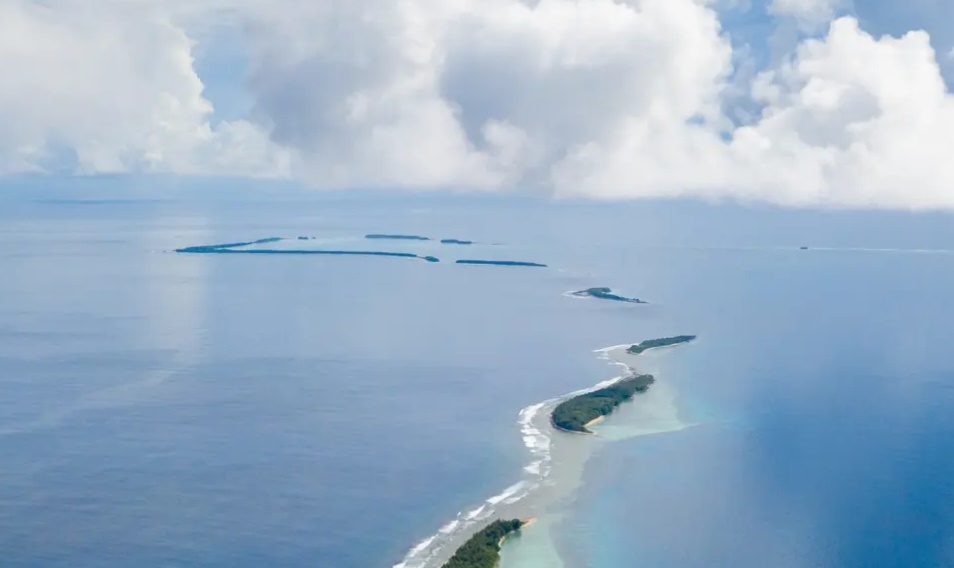
Sharon Kyle: The people of Tuvalu are losing access to significant portions of their livable land mass, due largely to the actions of people in the western world, especially the United States.
In trying to explain systemic racism, I’d like to use a metaphor. Sometimes I compare racism to having a significant carbon footprint. The population of the United States is just 5% of the world’s population, yet we contribute disproportionately to the carbon footprint that is causing global warming and the loss of the polar ice caps – resulting in rising sea levels. The rising sea levels devastate many populations across the globe – populations whose lifestyles and industries contribute almost nothing to global warming -- particularly small islands. Take Tuvalu - a tiny country in Oceania made up of nine tiny islands.
The people of Tuvalu are losing access to significant portions of their livable land mass, due largely to the actions of people in the western world, especially the United States.
The people of Tuvalu are losing access to significant portions of their livable land mass, due largely to the actions of people in the western world, especially the United States. Judging from the media attention this story gets, the U.S. perspective is that the country of Tuvalu is inconsequential. Even though our consumer lifestyle and fossil fuel use is a major contributing factor to the hardships faced by Tuvalu, most people in the Western world are oblivious to the plight of the people living in this small island nation..
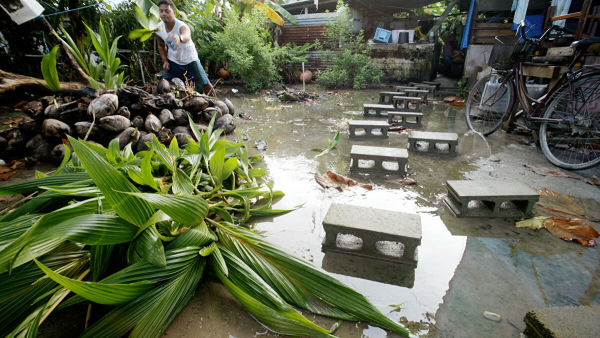
People in Tuvalu often walk through ankle-deep water to get anywhere on the islands, sometimes using cement blocks as stepping stones to get from point A to point B in order to get some relief from always having wet feet. They may soon be forced to evacuate. Their living conditions exemplify how the harms caused by one group can devastate another group while harm causing group can remain essentially oblivious.
Related stories
For people who believe that harm is only caused when there is intent to do harm, the situation in Tuvalu puts a focus on the flaw in that reasoning.
But here’s the kicker: Our leaders are fully aware of what is going on with Tuvalu. They’ve known for years that if the developed nations reduce their carbon output, the people of Tuvalu could continue to inhabit their island nation. At the United Nations Climate Change Conference, the prime minister of Tuvalu said, “Let’s do it for Tuvalu. For if we save Tuvalu we save the world.”
Tuvalu is a canary in the coal mine. It is a warning that the fate of Tuvalu will be the fate for all of us, if we don’t change.
I like this metaphor, because I think it helps us to see that systemic racism causes harm whether there is intention to cause harm or not -- whether those causing harm are aware that they are causing harm or not-- and, if left unaddressed this cancer will impact everyone, not just the Black, Indigenous and People of Color (BIPOC) populations.
Lots of people think that racist outcomes require racist intent or racial animus. Going back to my metaphor - the people of the United States hold no animus for the people of Tuvalu, heck, most Americans have never even heard of Tuvalu. But what Americans think or do not think doesn't matter -- our carbon footprint (the size of which is driven by capitalism, consumerism, culture, politics, industries, policies, and institutions) has disproportionately contributed to factors that cause global warming and make life in Tuvalu close to unbearable.
Likewise, many white people in the United States will tell you that they harbor no ill will toward people of color. All to often, we have racially neutral policies or procedures that produce racially disparate outcomes. Our white dominated power structures/institutions enact policies and procedures that consistently produce racially disparate outcomes. In every measure of human well-being, Black and Brown people in the U.S. (as a group) fare poorly compared to whites in the United States.
Of course, there are exceptions. When people point out Oprah Winfrey or Barack Obama to counter this assertion, I remind them that with rule, there is an exception. There have always been a few Black and Brown individuals whose lives are somehow exceptional. That was even true during slavery.
The bottom line is that economic inequality and limited opportunity is the by-product of interlocking systems just as the state of Tuvalu is the prouct of interlocking systems. This is just as true today as it has been for much of this country’s history. Empirical data bears it out.
Comments

Powered by RoundtableAn AI/DeFi-powered Enterprise Media Operating System. Learn more at Roundtable.io.© Roundtable 2026. By using this site you agree to the Terms of Use and Privacy Policy