
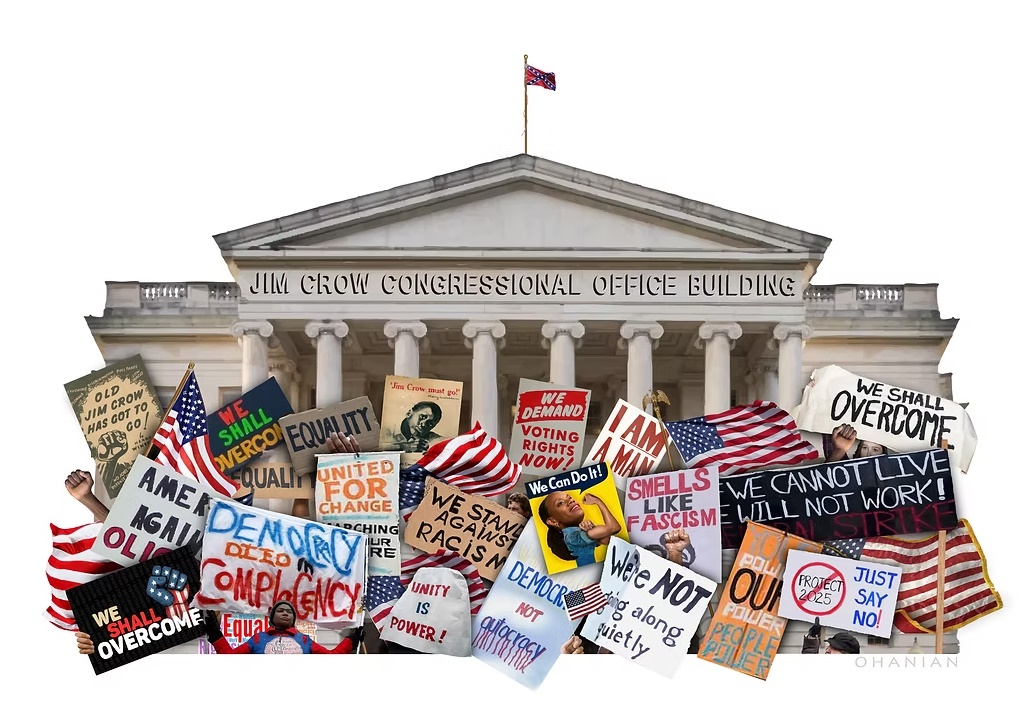


White Supremacy in Government
Aug 27, 2025 9:57 PM
Updated Sep 27, 2025 6:48 PM
Clemency for violent white insurrectionists, mass deportations of non-criminal brown immigrants, arrests of Black officials, and a purge of diversity programs show a two-tiered system of justice.
Donald Trump has made a career out of drawing lines—between insiders and outsiders, loyalists and enemies, those deserving of forgiveness and those marked for punishment. But in his second term, that line is drawn sharper than ever along racial, political, and ideological fault lines. White rioters who stormed the Capitol are welcomed back as patriots. Brown immigrants, even those with no criminal record, are treated as enemies of the state. Black and brown elected officials who dare to resist are handcuffed and smeared. And now, even the U.S. military—long touted as the nation’s most diverse merit-based institution—is being reshaped to purge diversity in the name of “anti-woke” politics.
The anecdotes are piling up, and together they tell a story too powerful to ignore.
At its core is this undeniable truth:
Donald Trump pardons white insurrectionists convicted of violent felonies, while Black and Brown people—including duly elected officials—are arrested, manhandled, and dragged away, often stripped of due process.
Related stories
---
1) January 6th: The crimes, the pardons, the relapse into violence
On January 6, 2021, Americans watched in horror as rioters stormed the U.S. Capitol. They weren’t tourists. They weren’t peaceful. They were armed with flagpoles, pepper spray, tasers, and even firearms. They smashed windows, beat police officers, and sent lawmakers fleeing.
The convictions. Over the next four years, hundreds of rioters were charged and convicted. Their crimes ranged from assault on federal officers, obstruction of an official proceeding, and civil disorder to, in the most serious cases, seditious conspiracy. Leaders of the Proud Boys and Oath Keepers were found guilty of attempting to overthrow lawful government authority. The courts treated these as felonies of the highest order—acts of violence meant to subvert democracy itself.
The pardons. On January 20, 2025—Trump’s first day back in the Oval Office—he issued a sweeping clemency order freeing nearly 1,500–1,600 Jan. 6 defendants. Fourteen high-profile figures, including leaders of far-right militias, were granted full commutations. Federal prosecutors, judges, and law enforcement leaders warned that such a mass absolution was unprecedented and reckless. Yet Trump painted it as correcting a “historic injustice.”
The fallout. Predictably, some of those released reoffended almost immediately. At least 10 individuals have been arrested again since their release, facing new charges including burglary, weapons violations, and even drunk driving that led to fatalities. One died in a violent confrontation with police. Rather than repentant citizens, many emerged from prison emboldened, wrapped in Trump’s narrative that they were “political prisoners” unfairly targeted by a “deep state.”
The message was clear: violence in Trump’s name is not only excused—it’s rewarded. This mirrors a long American tradition of excusing white political violence, from the pardons of Confederate leaders after the Civil War to the impunity granted white supremacist groups during Reconstruction.
---
2) Immigration: Punishment without crime
While Jan. 6 rioters received clemency, another group—immigrants, overwhelmingly Brown—faced a radically different fate.
The quotas. Trump’s DHS reinstated mass deportation quotas, pressuring ICE agents to hit 3,000 arrests a day. This wasn’t about removing violent criminals; it was about numbers. Non-criminal immigrants—workers, parents, long-time residents—were swept up in raids. “Collateral arrests” became the norm: if ICE agents encountered someone without papers, even if they weren’t the target, they were detained.
The militarization. Federal agents began targeting places once considered “sensitive”—schools, churches, and courthouses. Families were torn apart in broad daylight. In several major cities, Trump deployed the National Guard and federalized police forces under the guise of “public safety,” despite crime rates being flat or declining. The optics were intentional: military vehicles patrolling immigrant neighborhoods, a show of dominance meant to instill fear.
The reality. Most of those arrested had no violent history. Many had lived in the U.S. for decades, working and paying taxes. Their crime was paperwork. Their punishment was detention, deportation, and family separation.
The contrast is grotesque: those who beat police and tried to topple government walked free, while mothers and fathers without papers were shackled and deported.
This scapegoating has precedent. From the 1924 Immigration Act designed to preserve a white demographic majority, to Operation Wetback in the 1950s, to post-9/11 roundups of Arab and Muslim immigrants, America’s oligarchic order has long relied on immigrant persecution to maintain division and control.
---
3) Elected officials of color: Criminalized for oversight
Trump’s selective mercy doesn’t stop at anonymous groups. When elected officials of color push back against his policies, they, too, find themselves criminalized.
Senator Alex Padilla (D–CA)
On June 12, 2025, Padilla was forcibly removed, thrown to the floor, arm twisted, handcuffed, and detained at a DHS press conference in Los Angeles after questioning the administration’s deportation raids. Witnesses confirmed he identified himself as a U.S. Senator. Still, he was dragged away. Padilla later called it a chilling abuse of power: “If they will handcuff a U.S. Senator, what will they do to ordinary citizens?”
Mayor Ras Baraka (Newark, NJ)
On May 9, 2025, Baraka joined members of Congress outside Newark’s Delaney Hall ICE detention facility to demand transparency about conditions inside. For this, he was arrested and charged with trespassing—on public property. The charges were later dropped, and Baraka filed suit against federal officials, calling his arrest “an authoritarian stunt.”
Rep. LaMonica McIver (D–NJ)
When officers tried to arrest Baraka, McIver stepped forward to shield him. For that, she was indicted on felony counts of resisting and impeding federal officers. She dismissed the charges as “political intimidation in its purest form.”
Rep. Bonnie Watson Coleman (D–NJ)
Also present, Watson Coleman was hit with a misdemeanor trespass charge. She argued they were performing oversight, not committing crimes. In her words: “They want to make lawful dissent look like lawlessness.”
When immigrants are targeted, those who defend them are also criminalized. Oversight becomes trespass. Advocacy becomes obstruction. Resistance becomes crime. This too is structural—echoing J. Edgar Hoover's COINTELPRO, which targeted Black leaders under the guise of law and order.
---
4) Trump’s military pivot: Recruiting inducements + DEI obliteration
The Trump administration’s two-tiered system of justice is mirrored in the armed forces. At the very moment the military faces a recruitment crisis, Trump and Secretary of Defense Pete Hegseth are remaking its culture—not for readiness, but for ideology.
A. Expanding inducements
Military recruitment has struggled for years, with fewer young Americans willing or able to serve. In early 2025, Trump touted “record gains” in enlistment and announced new inducements: expanded signing bonuses, broadened eligibility criteria, and a slick national recruitment campaign. Hegseth unveiled the Military Service Recruitment Task Force, tasked with selling military service to the next generation.
B. Purging DEI
But alongside these inducements came a sweeping rollback. On his first day back, Trump signed Executive Order 14151, eliminating all federal DEI programs. The Pentagon followed suit, shutting down DEI offices, halting observance months like Black History Month, and even erasing profiles of minority pioneers—Tuskegee Airmen, Native code talkers, women combat leaders—from official sites.
Hegseth declared diversity initiatives “the dumbest phrase on planet Earth.” He targeted military leaders he branded as “DEI hires,” including Chairman of the Joint Chiefs Gen. Charles Q. Brown Jr. He banned transgender service and halted gender-affirming care for troops. He framed the moves as restoring “cohesion” but in reality they stripped the armed forces of hard-won inclusion.
C. The demographic consequences
Here’s the irony: the U.S. military is one of the most diverse institutions in the nation. Roughly 30% of service members are minorities, and by 2027, the majority of America’s recruitable population will be people of color. In other words, the future of the all-volunteer force depends on Black, Latino, Asian, Native, and immigrant youth.
DEI programs weren’t window dressing—they were pipelines. They broadened access, supported cohesion, and helped the military tap into diverse communities. Eliminating DEI, banning trans service, and scrubbing minority representation isn’t just ideological—it actively narrows the pool of who can serve.
By catering to anti-woke politics, the Trump administration is undercutting the very demographic foundation of the future military. The result? A whiter, less representative, and ultimately less capable armed force. Historically, the military has been a rare path of social mobility for marginalized communities; Trump’s rollback slams that door shut.
---
5) The ideology underneath: White supremacy as an organizing principle
The question is why. Why offer clemency to violent white rioters while criminalizing immigrants with no record? Why pardon insurrectionists while prosecuting Black and Brown lawmakers for protest? Why erase DEI at the very moment the armed forces depend on it?
The answer, many observers argue, is white supremacy.
White supremacy is the belief that whiteness—whether in culture, identity, or political alignment—confers superior value, status, and entitlement. It doesn’t always wear hoods or wave Confederate flags. In policy, it looks like clemency for white rioters while immigrants are caged. It looks like silencing Black and Brown elected officials while elevating violent loyalists. It looks like purging the military of DEI even when diversity is vital to readiness.
In viewing the clear difference in treatment, many are interpreting the administration’s actions as driven not simply by partisanship but by white supremacist ideology. That ideology sorts people into two categories: those who belong and those who don’t. Those who deserve forgiveness and those who deserve punishment. Those whose violence is patriotism and those whose mere existence is a threat.
---
6) Oligarchy, democracy denied, and the destruction of hope
This isn’t just hypocrisy. It’s another pillar of oligarchy. As I’ve argued before, the United States has never been a true democracy—it has always been an oligarchy, where power rests with the wealthy, the connected, and the entrenched. What Trump is doing doesn’t merely expose the system’s structural flaws; it cements them. By deciding who deserves forgiveness, who deserves punishment, and who even belongs in the armed forces, Trump is narrowing an already constricted political order.
For most people in this country, democracy has always been aspirational—a promise more than a practice, an idea often withheld from the majority. But what Trump and his ilk are destroying is even more dangerous: they are dismantling the possibility of achieving a working democracy in the future. The dream of democracy—never fully realized in America—is being buried under the weight of oligarchy married to white supremacy.
Final Word
History will remember Trump’s pardons of Jan. 6 rioters as a betrayal of accountability. It will remember the arrests of Padilla, Baraka, McIver, and Watson Coleman as warnings that oversight itself had become criminalized. It will remember the purging of DEI from the military as a self-inflicted wound—shrinking the force to appease ideology rather than strengthen readiness.
But perhaps most importantly, history will record that the through-line was white supremacy joined with oligarchy: a system that forgave violent white loyalists, punished Brown immigrants and Black dissenters, and sought to preserve whiteness and wealth at the expense of democracy.
Unless we name it, resist it, and refuse to normalize it, this two-tiered system will calcify. And once that calcification is complete, it won’t just define Trump’s legacy—it will define America’s future.
Comments

Powered by RoundtableAn AI/DeFi-powered Enterprise Media Operating System. Learn more at Roundtable.io.© Roundtable 2026. By using this site you agree to the Terms of Use and Privacy Policy