


Mar 9, 2024 8:00 PM
Updated Mar 9, 2024 10:02 PM
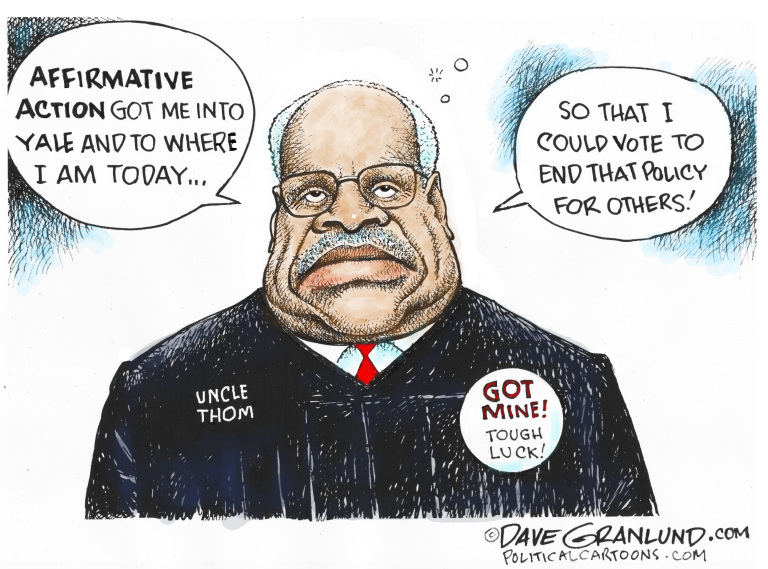
SCOTUS held that Harvard's affirmative action admissions violated the Equal Protection Clause, but that clause restricts what government can do. Harvard is a private university.
Affirmative action baffles courts. Striking down affirmative action at Harvard and the University of North Carolina exemplified this bafflement.
The Supreme Court held that Harvard's affirmative action admissions violated the Equal Protection Clause, which was awkward because that clause restricts only what government can do. Harvard is a private university.
Justice Gorsuch plausibly thought the Court should have based its decision on the Civil Rights Act, which does apply to private actors. This, at least, would have bypassed the problems with the Court's approach to equal protection.
The Court's Equal Protection jurisprudence fails to distinguish between two very different aspects of government:
Related stories
1. Government-as-Legislator enacts and enforces laws---general rules of action enforceable by sanctions. Taxes are levied by this aspect of government. .
2. Government-as-Contractor: The government's second major aspect ---uses tax money to induce individuals, organizations, and other governments to enter into voluntary associations with it. These associations are created by mutual consent of the federal government and the other parties to the exchange or transfer of inducements.
Equal Protection clearly restricts government-as-legislator. If they don't apply to everybody, its rules aren't laws at all, but pseudolaws. Relegating minority people to the back of the bus, or requiring Jews to wear a yellow star are clearly examples.
On the other hand, equal protection cannot apply at all to government-as-contractor. Like any other party, the government must be free to refuse to enter voluntary associations for any reason. Mutual consent being required, its entry into voluntary associations is inherently a selective process.
Public universities wield no sanctions (they cannot jail, fine, or execute anyone) and are operated by government-as-contractor. The Equal Protection Clause therefore does not apply even to North Carolina's admissions, let alone to private institutions like Harvard.
But the Supreme Court hasn't recognized the importance of distinguishing between the two aspects of government for equal protection purposes.
If the Court had followed Justice Gorsuch's advice and based its decision on Title VI of the Civil Rights Act, which applies to all organizations, public or private, it could still have gotten things wrong. This legislation (note that I do not call it a law) purports to make "discrimination" illegal. But a law must be a rule of action, and discrimination is a reason for action, not an action.
If a university does not admit John Jones (an action) , under antidiscrimination legislation, it is only illegal if it has bad reasons for that. The action itself is not the key.
The Constitution cannot plausibly be construed to authorize Congress to enact pseudolaws. Since Title VI is a pseudolaw, the Court should have held it unconstitutional and dismissed the cases again in Harvard and North Carolina.
Other parts of the Civil Rights Act are not unconstitutional. Its open accommodations provisions are the equivalent of a general requirement that public facilities---restaurants, hotels, theaters, etc---- serve all comers first come, first served. They are the equivalent of genuine laws.
First come, first served gets rid of discrimination without purporting to make it illegal. This part of the Civil Rights Act has been very successful. But first come, first served would not work for selective universities or for most employment. We would not want an airline to hire would-be pilots first come, first served!
A rule requiring universities—public or private—to use a race-blind method of admissions—no pictures, no information allowing discernment of the applicant's race—could be enacted. The analogy here would be symphony orchestras auditioning applicant members behind a screen.
But wouldn't it be better for the government to stop trying to fine tune the membership of all organizations? There's much to be said for decentralized decision-making. Our chief protection from bad voluntary associations is and will remain our freedom to leave them or refuse to join them in the first place.
If affirmative action is a bad idea, that is not a question for the courts.
Comments

Powered by RoundtableAn AI/DeFi-powered Enterprise Media Operating System. Learn more at Roundtable.io.© Roundtable 2026. By using this site you agree to the Terms of Use and Privacy Policy