


Aug 16, 2026 7:23 PM
Updated Aug 16, 2026 8:35 PM
Black Maternal Health Crisis: Inside Summer Lee's Clash With RFK Jr. Over Erasure
A few weeks ago I wrote about the machinery this country uses to erase Black communities — the lakes built over Black towns, the parks built over Black land, the fires and floods that always seem to find the same neighborhoods twice: once when the disaster hits, and again when the recovery money shows up and somehow never quite reaches the people who lost the most. I called it a pattern because it is one. Different decade, different disaster, same target.
I want to add a chapter to that pattern, because I just watched it happen in real time, on C-SPAN, in a hearing room in Washington, D.C.
"How Are We Going to Solve It If We Cannot Say 'Black'?"
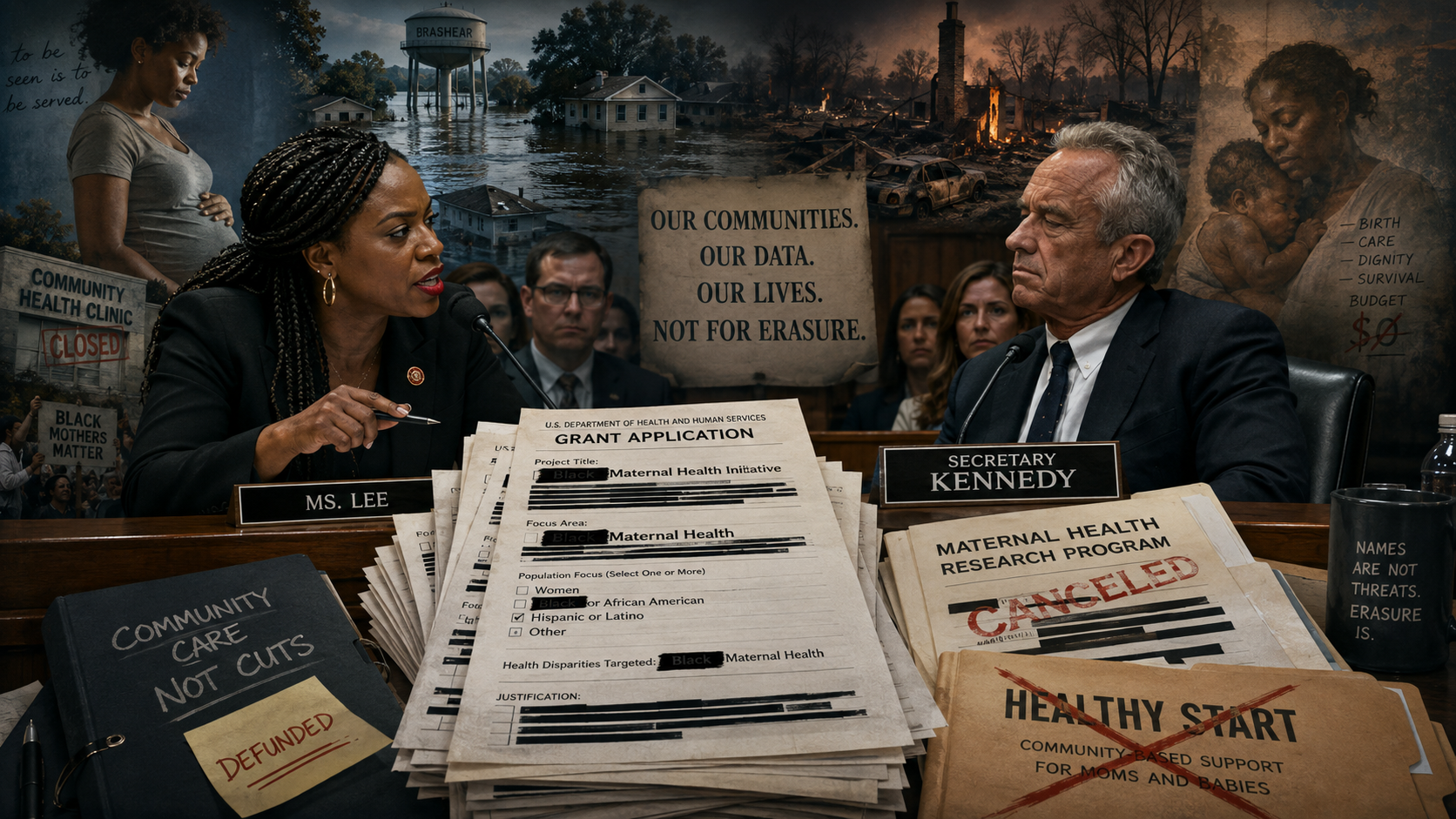
On April 17, 2026 — during Black Maternal Health Week, no less — Pennsylvania Congresswoman Summer Lee sat across from Health and Human Services Secretary Robert F. Kennedy Jr. at a House Committee on Education and Workforce hearing and asked him a question that should not be complicated.
"This is Black Maternal Health Week, so I'll start there," Lee told Kennedy. "Secretary Kennedy, I'm sure you're aware that Black women are at least three times more likely to die from pregnancy-related causes than white women. The vast majority of these deaths are preventable. Black women in my district are more likely to die during pregnancy than their peers in 97 percent of U.S. cities."
Related stories
Then she told him something his own agency had done. HHS, she said, had instructed federal programs to strip nearly 200 words and phrases from their grant and funding applications — and "Black" was on the list.
"How are we going to solve the Black maternal mortality crisis," Lee asked, "if we cannot say 'Black'?"
Kennedy didn't answer the question. He pivoted to the administration's line on DEI, telling Lee that the president wants to end division, not create it, and that diversity, equity, and inclusion programs had spent the last four years dividing people rather than uniting them. Lee reminded him they were talking about maternal mortality, not an ideology. He held the line anyway. So she pressed further: how do you target research, funding, and intervention toward a population dying at three times the rate of everyone else if your own department won't let anyone name that population in writing? Kennedy insisted HHS was meeting its obligations on maternal health.
"We are not," Lee said.
She wasn't speaking rhetorically. Her committee questioning also surfaced the specifics behind the phrase "meeting its obligations": reported cancellations of NIH grants studying Black maternal health, a proposed FY27 budget that eliminates Healthy Start — the federal program that has spent three decades funding community-based care specifically in the neighborhoods where Black mothers and infants die at the highest rates — and a secretary who, weeks earlier, had made public comments about the state "re-parenting" Black children that alarmed the very communities his agency is supposed to serve.
The Same Machine, Running on Paperwork Instead of Bulldozers
I keep coming back to something I wrote about Oscarville, the Black town in Georgia that a mob burned in 1912 and the state later drowned under Lake Lanier. Nobody had to burn Luxton Lake, the vacation community my father built his summers around — a state agency just declared the dam unsafe and took the water. Altadena didn't need a mob either; a fire did the initial damage, and then cash buyers and absentee investors did the rest, snapping up scorched lots from grieving 65-and-older homeowners before the ash had settled.
Every one of those stories has the same shape. Something is destroyed — by violence, by neglect, by fire, by a flood nobody warned people about in time. Then comes the argument that what's left isn't really worth saving, or worth naming, or worth returning. And by the time anyone official is willing to say plainly what was lost and who it belonged to, the thing itself is already gone.
The HHS word list is the same machine, just running without heavy equipment. You don't need to bulldoze a maternal health program if you can simply make it illegible. Strip "Black" from a funding application and the researchers still studying why Black women in Summer Lee's district die in childbirth at rates worse than 97 percent of American cities can no longer describe, on paper, who they're studying or why. Cancel the NIH grants that were tracking the problem and there's no data left to argue with. Eliminate Healthy Start and the community clinics closest to the crisis lose their funding stream entirely. None of it requires an arsonist or a flood. It only requires a list of words nobody's allowed to type into a federal form.
This is what I mean when I say the erasure isn't only physical anymore. Lake Lanier took land. Katrina's aftermath took a city's Black majority, 120,000 people who never made it back to New Orleans. Altadena is, right now, losing the ability of the next generation to buy back into the neighborhood their grandparents built. HHS's word list goes after something even more upstream than land or housing stock: it goes after the record. If you can't name the group in the paperwork, you can't fund research on the group, can't track outcomes for the group, can't build the evidence base that any future intervention — or any future lawsuit, or any future land bank, or any future "Altadena is not for sale" sign — would need to stand on.
Naming the Pattern Is the Whole Point
Naomi Klein's disaster capitalism thesis, the one I leaned on in the last piece, is about exploiting a crisis to push through changes people would never accept under calm conditions. What Kennedy's exchange with Lee makes clear is that you can run that same play without waiting for a hurricane or a wildfire. Bureaucratic language is disaster enough, if you're patient and nobody's watching the hearing room.
Rep. Lee watched. She named it in real time, on the record, in the room where the decision was being defended. "We are not" meeting the obligation — two words, and she wouldn't let the secretary walk past them. That's the same instinct behind the land banks forming in Altadena and the lawsuits my father's neighbors filed over Luxton Lake: someone has to say, on paper, in public, that this happened, to these people, on purpose or through the kind of neglect that stops being an accident once it's been the pattern for a hundred years running.
I don't know yet whether Kennedy's word list survives the year, or whether Healthy Start gets restored in conference, or whether the NIH grants get their funding back. I do know that every drowned town I wrote about started the same way mine did — with someone deciding, quietly, that the thing didn't need to be named, tracked, or protected anymore. Lake Lanier didn't need permission to erase Oscarville from memory; it just needed people to stop saying the word.
Don't let them stop saying the word.
Comments

Powered by RoundtableAn AI/DeFi-powered Enterprise Media Operating System. Learn more at Roundtable.io.© Roundtable 2026. By using this site you agree to the Terms of Use and Privacy Policy