


Sep 27, 2017 1:13 AM
Updated Feb 10, 2022 10:28 PM
Ron Briley: Trump’s tweets, however, suggest that his comments are very much rooted in race and are a continuation of the racial profiling and discrimination in which he has engaged for much of his life going back to the housing policies of his father.
In the midst of a nuclear confrontation with North Korea, the devastation of Puerto Rico and the U. S. Virgin Islands along with the recovery of Florida and Houston from hurricanes, the crisis of the health care system, and foreign interference in American elections, in recent days President Donald Trump has focused his attention upon the National Football League and the protest of black players began by Colin Kaepernick, now unofficially blacklisted from professional football, for greater racial justice.
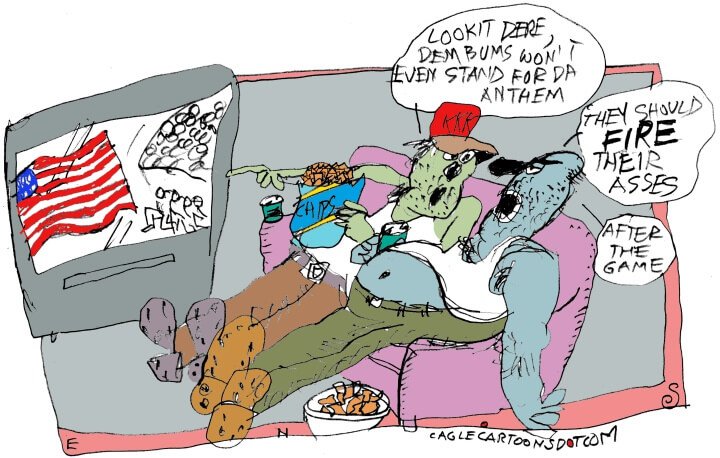
By taking a knee during the playing of the National Anthem, Kaepernick and the athletes following his example are suggesting that the way police departments often interact with young black men does not reflect the values of life, liberty, and the pursuit of happiness symbolized by the American flag. Instead of responding to these protests by engaging in a serious discourse regarding race in contemporary America, Trump chooses to denounce the players as “sons of bitches” who should be fired by NFL owners, provoking even greater protests in which ownership has sought to establish common ground with protesting athletes.
But Trump has insisted that his comments have nothing to do with race. He is simply angry that players are dishonoring the flag and American soldiers who fought under that banner, equating patriotism with military service.
Trump’s tweets, however, suggest that his comments are very much rooted in race and are a continuation of the racial profiling and discrimination in which he has engaged for much of his life going back to the housing policies of his father.
Trump’s tweets, however, suggest that his comments are very much rooted in race and are a continuation of the racial profiling and discrimination in which he has engaged for much of his life going back to the housing policies of his father. In addition to taking on the NFL, Trump announced that since Stephen Curry of the Golden State Warriors criticized him, the President is withdrawing the invitation for the Nation Basketball Association champion Warriors to visit the White House.
Related stories
Thus, Trump censured the NFL and NBA, leagues dominated by black athletes. On the other hand, he commended NASCAR, with only one black driver and a predominantly white following, for announcing that the race car organization would not tolerate any demonstrations during the playing of the National Anthem. The champion Pittsburgh Penguins of the virtually all-white National Hockey League are still on tap for a visit to the White House. Major League Baseball has also been spared the wrath of Trump. The sport which played such an important role in racial integration with Jackie Robinson is now a sport dominated by whites and Latinos with only about 60 black players on 30 teams.
Thus far, only one black player, rookie catcher Bruce Maxwell of the Oakland A’s, has taken a knee. Accordingly, Trump has concentrated his rhetoric upon the black athletes of the NBA and NFL, cursing protesting players before a largely white crowd in Alabama, a state with a troubled racial history.
While Trump found it easy to denounce black players on twitter and in his rallies, he could not bring himself to announce his opposition to Nazi and white supremacists marching in Charlottesville, Virginia. Expressing his approval of the orderly young men with torches protesting the removal of a statue of Confederate General Robert E. Lee, Trump ignored their chanting of anti-Semitic slogans amid the Nazi refrain of “blood and soil.”
While Trump eventually made a general denunciation of white supremacists, he never took to twitter in order to denounce the support of racists such as Klansman David Duke who found comfort in the President’s comments. Instead, Trump sought to foster a moral equivalency between white supremacists and the counter protesters in Charlottesville. The President places Charlottesville within the context of preserving Southern culture by memorializing the Confederacy. Trump, thus, returns to the rhetoric of patriotism and ignores the legacy of racism and slavery that the Confederacy fought to defend.
In a similar sense, Trump attempts to deflect young NFL black player protest about police brutality into an issue of patriotism. To Trump and many of his supporters, to take a knee during the anthem is an insult to Americans who fought under the flag. This approach narrowly defines patriotism as militarism, ignoring the idea that one honors the country by defending the right to dissent and working to assure that the promise of American life is made available to all of its people.
Pregame shows, in the past supported by government funds from the Pentagon, honor the flag and soldiers while jets fly over the stadium. This makes taking a knee similar to not supporting the troops, and Trump manipulates this perception.
Yet he knows it’s really about race and blacks staying in their place. There is resentment toward wealthy black athletes employing their status to speak out on issues of police brutality which threaten them and their families. They are supposed to welcome the opportunity to entertain their white fans in our contemporary versions of gladiator games. They are to be seen and not heard, and Donald Trump seems to have no sympathy with the threat of permanent brain damage for football players as he makes light of efforts to reduce injuries in the sport.
He assumes that this is the rhetoric his base wants to hear, and if you desire further proof of his efforts to limit protest and dissent from black Americans consider the fact that the President has reversed an Obama administration policy by sending military surplus weapons to police departments. This militarization of the nation’s police makes it easier to forcibly crush dissent and protest on the streets of cities such as Ferguson, Missouri.
From the birther issue with President Obama to Charlottesville to the NFL players protests over police brutality, President Trump knows the issue is really about race, but he employs the language of Southern pride and national patriotism in an attempt to cover his embracing of white supremacy and appeals to the dark side of his political base.
Ron Briley
Comments

Powered by RoundtableAn AI/DeFi-powered Enterprise Media Operating System. Learn more at Roundtable.io.© Roundtable 2026. By using this site you agree to the Terms of Use and Privacy Policy