
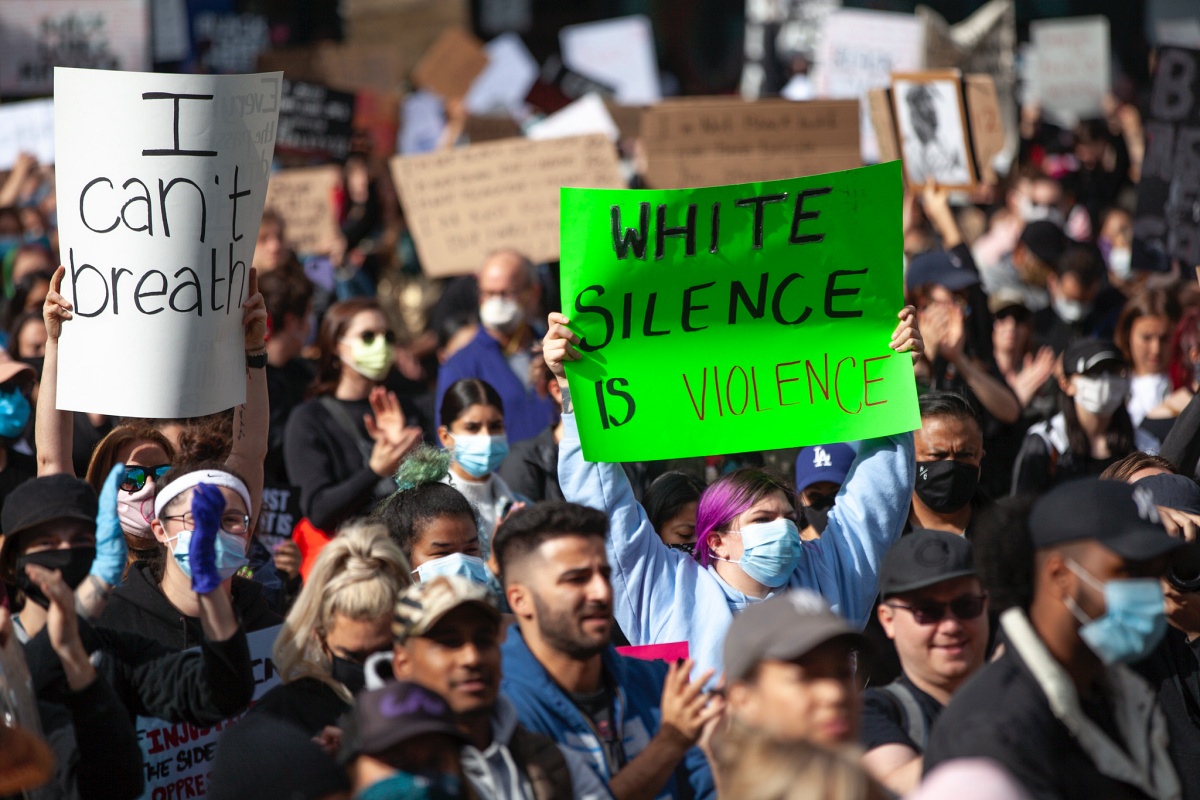
GoToVan • Attribution (CC BY 2.0) • Flickr


Mar 1, 2025 2:54 AM
Updated Mar 1, 2025 9:48 PM
We take courage and inspiration from the long struggle of the Anti-slavery Abolitionists who organized under far more difficult circumstances than we face.
“If you don't understand white supremacy/racism, everything that you think you do understand will only confuse you.” Neely Fuller
To begin with the obvious, efforts to stop Trumpism clearly failed. Miserably. And sure enough, he is reimplementing most of the worst policies in U.S. history, seemingly all at once.
Does that mean that we should now resist by doing what we have been, only harder? Or do something different?
We recognize the attraction of the former. We vigorously support the latter.
Related stories
Once again, we have been rudely reminded that who we are as a nation now is still who we were at the start. “Stamped from the beginning”, as Dr. Ibram X. Kendi teaches, as a society structured for the benefit of white property-owning men. Every step away from that formula followed by a relapse—again and again, the nation has regressed to that mean.
At best, doing what we have always done only harder perpetuates the cyclical pattern. Doing something different might not.
At best, doing what we have always done only harder perpetuates the cyclical pattern. Doing something different might not.
We are not of the same gender or generation. But we have two things in common. We are both white as defined by the racial categories entrenched long ago to sustain white male power. And we’re both dedicated to confronting and repairing the harms of whiteness, settler colonialism, enslavement, segregation and other aspects of the enduring racial hierarchy within ourselves and our white communities. Frank’s journey was initiated by the 1960s Black Freedom struggle; Elizabeth’s in 2014 by the Black Lives Matter movement. We talk regularly.
For a very long time U.S. efforts at social change can be described as pursuing a pendulum theory of change. The idea is that our history see-saws between good times and bad. That’s how it is and how it will always be. It’s an inescapable cage. Or to put it another way—a co-dependent, symbiotic relationship adjusting as needed to perpetuate the original white male power formula.
When we are in the bad times, like now, the argument goes, we must work that much harder, and smarter to push the good side back-up and the other side back down. That way we can better “control” the bad people or at least restrain some of their worst behavior.
Thus, we are now immersed in a teeter-totter struggle between two versions of making America great again. Those who think we are “losing our democracy,” want that amorphous earlier time back. The MAGAs have other “restoration” priorities.
The dominant thinking about how “democracy” can be repaired is to unite people (usually defined as voters since this philosophy is mostly confined within electoral politics, excessively focused on presidential elections) around shared economic interests. And if it seems people aren’t listening when you talk about the price of eggs, that’s when you consider changing. You must find a better way to talk MUCH LOUDER about how if we all get together, we can lower the price of eggs.
Never mind that whether eggs are in a high or low-price phase, violence, racism and patriarchy persist. (It is an enduring fantasy, especially among white people that “fixing” just about anything, anything at all on the social justice smorgasbord will somehow cause racism to dissolve. The record is clear. It won’t. Conversely, working to dismantle the racial hierarchy does have collateral social justice benefits.)
Did the price of eggs have anything to do with the Montgomery Bus Boycott, the birth of the sit-in movement, voter registration in Mississippi in the 1960’s, or the mass movement against the U.S war on Viet Nam? No, it didn’t.
Did the price of eggs have anything to do with the Montgomery Bus Boycott, the birth of the sit-in movement, voter registration in Mississippi in the 1960’s, or the mass movement against the U.S war on Viet Nam? No, it didn’t.
Ok, so what could be different? We are convinced that an approach to the immediate ascendance of Trumpism maps nicely onto an alternative theory of lasting and transformational change.
We share admiration for Rev. Dr. Martin Luther King, Jr. As students of his leadership, we are aware of the arc of his evolution from his iconic 1963 “I Have A Dream” speech to his call for a radical revolution of values in his “Breaking Silence” speech on April 4, 1967.
The 1963 speech placed faith in the false promise of “equality for all.” We say false because, contrary to conveniently misunderstood language, the founders were asserting their equality with their British overlords, not the equality of all humans. Four years later, Beyond Vietnam—A Time to Break Silence and subsequent speeches Rev King described the U.S. as “the greatest purveyor of violence in the world,” and called for “a radical revolution in values.”
Yes, we recognize the improvement in the lives of many Black and other nonwhite people. Public accommodations, voting access, financial opportunities, election to public office and increased housing options are examples. Our assessment, however, is that those gains are always vulnerable because they are built on a foundation of sand.
We also acknowledge the evolution within the Black Freedom Struggle over this period regarding the role of white people in the movement. It was heartening that a few white people – and let us accurately remember, it was only a few – responded to calls to go South in the 1960’s. But we also realize that even fewer took up the challenge to bring the anti-racist struggle into their own white communities when advised to do so.
As a 1966 Student Nonviolent Coordination Committee (SNCC) paper put it: “It must be offered that white people who desire change in this country should go where the problem (of racism) is most manifest. That problem is not in the Black community. The white people should go into white communities where the whites have created power for the express purpose of denying Blacks human dignity and self-determination.”
A few white people, including Frank, did listen, and shifted to working in his community by helping to build People Against Racism from the mid to late 1960’s. His current work is with Change is the Pointe, an organizing effort in suburban Detroit that tackles local racial justice issues to help folks understand and change the place they live. They publish a monthly educational ad, have weekly meetings, and recently contributed to the election of a moderate school board majority that ran against a MAGA-like slate.
Frank’s legacy is rare. It’s what drew Elizabeth, who was seeking a white Elder who had responded to this call. Frank advises Elizabeth’s work, Reckon With, an ongoing peer-support group for white individuals to acknowledge, interrupt and repair racial injustice in themselves, with white family and friends, and within institutions they’re part of every day.
The moment calls for smaller, localized, explicitly antiracist organizing.
In the days following Trump’s second inauguration, Brittany Packnett Cunningham reminded us: “The goal is for us to be overwhelmed and perpetually distracted…. Do YOUR work. Don’t leave it to someone else, and don’t try to do it all at once.” We agree. We take courage and inspiration from the long struggle of the Anti-slavery Abolitionists who organized under far more difficult circumstances than we face.
The moment calls for smaller, localized, explicitly antiracist organizing. Change within our families, our neighborhoods, our places of worship, our school boards and PTAs radiate out as opposed to being imposed from the outside. Calling-in change based in relationship is far less likely to be experienced and mischaracterized as coercive and therefore less vulnerable to the tendency to be subverted and reversed.
The need for mutual protection, practiced for so long by those assaulted by settler colonialism, enslavement, and Jim Crow, is a strength. So can be the collapse of illusion, itself a kind of awakening. It invites the search for clarity. Not clarity as to how to do what’s already been done only harder but by expanding our capacity to imagine alternatives.
If you'd like to learn more about being an anti-racist, click here:
Comments

Powered by RoundtableAn AI/DeFi-powered Enterprise Media Operating System. Learn more at Roundtable.io.© Roundtable 2026. By using this site you agree to the Terms of Use and Privacy Policy