
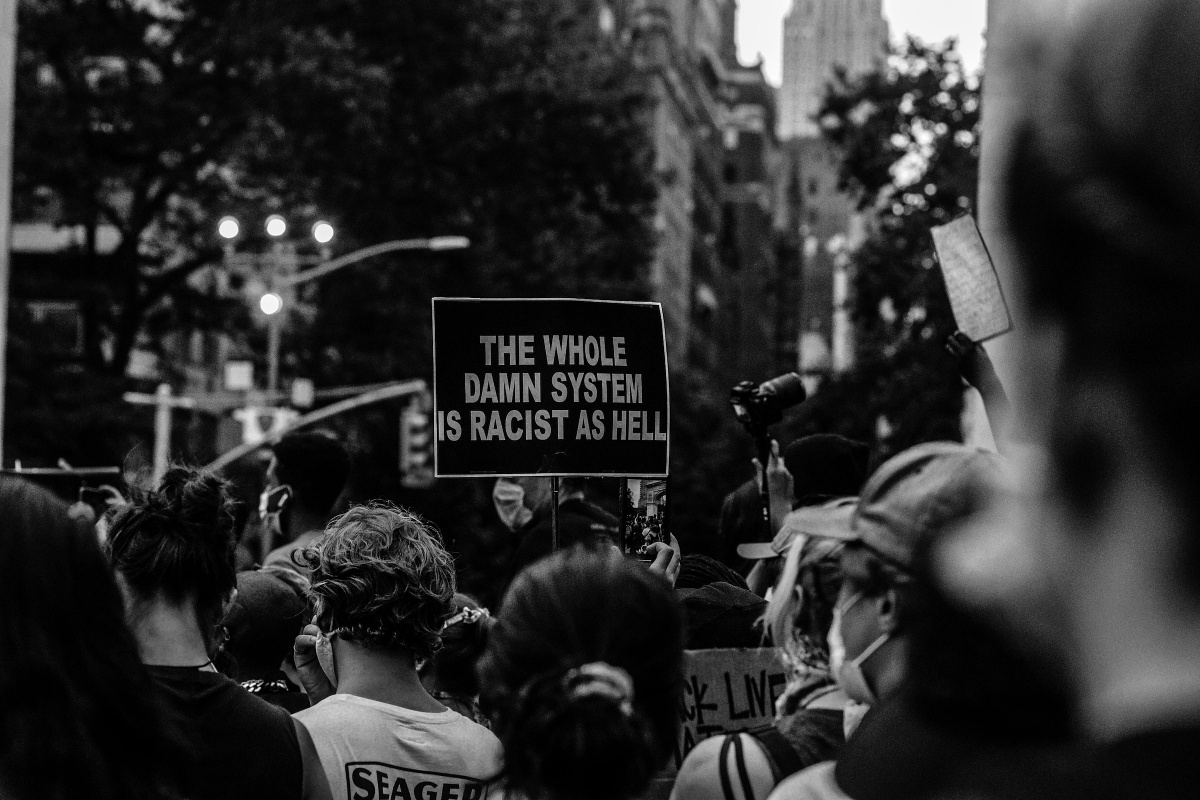
Photo by Jakayla Toney on Unsplash


Feb 22, 2023 1:22 PM
In an age of apocalyptic violence, memory is erased, historical consciousness banished from schools, and critical ideas are labeled as unpatriotic.
America is a country that can no longer question itself, invest in the public good, nor imagine a future beyond the dreamscapes of the rich and ruling elite. Apocalyptic fears, uncertainties, and anxieties feed a rising tsunami of violence that has become the organizing principle of governance, everyday life, and society itself. American society is caught in the daily routines of lies, corruption, and manufactured ignorance; one consequence is the withering of individual and social agency along with civic culture and the public imagination.
The guard rails of justice, compassion, the welfare state, politics, democratic values, and the institutions that nourish them are under the threat of disappearing. Apocalyptic terrors have moved from the realm of fiction into the social fabric of everyday life. Americans now live in an age when historical consciousness no longer functions to inform the present and has become the target of white supremacists and a far-right Republican Party that is silent about the dark past that informs their authoritarian politics.
Historical amnesia has become a political and pedagogical tool of an upgraded fascism. The right-wing banning of books, attack on librarians, censoring of classroom discussions about sexual orientation, and racism is no accident, it is the basis for the Nazification of American education with Trump and Florida Governor Ron DeSantis leading the charge.
Racist violence, in particular, has become visceral, unhinged, and ingrained in the institutions that are designed to serve and protect the public. This is evident in the 2023 savage beating and death of Tyre Nichols, a 29-year-old FedEx worker, by five Memphis police officers. His deadly beating is indicative of how deeply embedded the culture of violence is in American police departments.[1] Nichols was stopped for an alleged traffic violation, dragged from his car, punched, and tasered. While he was handcuffed, lying helpless on the ground, “one officer kicked him in the head and then did so again.”[2] Another officer pulled him up from the ground while another one struck him repeatedly with a baton.[3] Videos from the cop’s body camera and a streetlamp mounted camera show Nichols asking why he was pulled over, stating that he just wanted to go home, and then in the midst of the attack calling out for his mom. Heartbreaking and terrifying and a signpost of the systemic violence being waged against Black people by police forces in the United States.
Related stories
The racist nature of Nicholas’ killing is bolstered by numerous reports that make clear that Black people are disproportionally stopped, searched and arrested by police more than whites when routinely pulled over for traffic stops.[4] The disparity in how the police treat Blacks and whites under similar circumstances was highlighted vividly by Washington Post columnist Eugene Robinson in his comparison of how the police treated Nichols vs. their arrest of Dylan Roof, the white racist who killed nineteen innocent Black church goers. He writes:
Please recall the case of Dylann Roof, the White racist who murdered nine innocent Black victims at Mother Emanuel AME Church in Charleston, S.C., in 2015. Roof fled all the way to North Carolina and was known to be armed and dangerous. Yet police officers, acting on a tip, apprehended him at a traffic stop without incident and without a scratch. And when Roof complained about being hungry, police in Shelby, N.C., bought him food from a nearby Burger King. Those officers in Memphis — who have been charged with second-degree murder — didn’t have to treat Nichols to a Whopper. But they could have listened when he explained that he was going to his mother’s house, just a few hundred feet away.[5]
The numerous deaths of Black people at the hands of the police are part of the DNA of an apocalyptically violent culture of policing in the United States. As Simon Balto observes, the problem of policing needs to focus on the institution and culture, not the individuals who commit violence. Balto adds that the beating of Nichols was not the work of rogue cops. It has to be understood as part of the “institution” and culture “that trained [them] to be violent, paid [them] to be violent and paid [them} to train others to be violent…Police are trained … to use coercive force, are trained to use deadly weapons…. Violence, coercive force, the carry and use of deadly weapons – all of these are central to “proper policing” as the institution of policing in this country currently exists.”[6]
Violence is not random in the U.S. It is systemic, pervasive, racist, and deeply embedded in a fascist politics. It takes place in schools, supermarkets, gyms, dance studios and parades. Although everyone is a potential target, people of color suffer disproportionally from state violence. This apocalypse of violence is amplified by a modern Republican Party that is utterly wedded to destroying the welfare state, accelerating the range of groups considered disposable, and imposing a white Christian nationalist state on America while expanding a bloated military and arms industry. Capitalism is now fully mobilized as a death machine and the Republican Party is committed to
In an age of apocalyptic violence, memory is erased, historical consciousness banished from schools, and critical ideas are labeled as unpatriotic. Fear, manufactured ignorance, engineered panics, and a paranoid racist politics draped in the language of white nationalism and bigotry are now imposed on schools in the name of “patriotic education.” This is the violence of a formative culture that embraces racial cleansing, a white nationalist notion of citizenship, and the undermining of the public and civic imagination. Its endpoint is a rebranded fascism.
As the United States tips over into the abyss of fascism, state violence must be interrogated within the historical conditions that has both legitimated and normalized it over time. It must be viewed with a long durée of neoliberalism and racist violence that has become normalized in almost every aspect of daily life.
The militarization of American society is now readily embraced and revealed in its turn toward a fascist politics. As long as we allow neoliberal capitalism to disconnect the fascist past from the present, the violence will continue as a matter of common-sense. The histories of repressed others must be made visible along with the struggles and resistance they have waged against such repression. In this instance, the apocalypse of violence must be addressed not through limited reforms but through a call for eliminating a capitalist society whose history only leads to mass suffering, staggering inequality, endless injustice and fascism itself.
Michael Yates is right in stating that “The long rule of capital has created profoundly alienated conditions for nearly all of humanify [and we] cannot afford to settle for incremental changes….The radial upending of the social order is now hardheaded realism, the only path forward.”[7] The struggle for revolutionary socialism is no longer a utopian longing, it is an urgent necessity.
References
[1] Radley Balko, Rise of the Warrior Cop: The Militarization of America’s Police Forces,” (New York: Public Affairs, 2013); Alex S. Vitale, The End of Policing (London: Verso2018).
[2] Victoria Bekiempis, “‘I’m just trying to go home’: Tyre Nichols heard pleading in released video.” The Guardian (January 28, 2023).
[3] Ibid., Victoria Bekiempis, “‘I’m just trying to go home’.”
[4] Editors, “Racial and Ethnic Disparities in the Criminal Justice System,” National Conference of State Legislatures (May 24, 2022).
[5] Eugene Robinson, “Tyre Nichols video shows policing must be done with a community — not to it,” The Washington Post (January 28, 2023).
[6] Simon Balto, “The killing of Tyre Nichols was heinous and shocking. It was also not an aberration,” The Guardian (January 29, 2023. Online:
[7] Michael D. Yates, Work, Work, Work: Labor, Alienation, and Class Struggle (New York: Monthly Review Press, 2022), p. pp. 216-217
Comments

Powered by RoundtableAn AI/DeFi-powered Enterprise Media Operating System. Learn more at Roundtable.io.© Roundtable 2026. By using this site you agree to the Terms of Use and Privacy Policy