


Jul 16, 2023 3:55 PM
Eig reminds us that his subject was interested not only in overcoming racism directed against African Americans, but with furthering the common good in general.
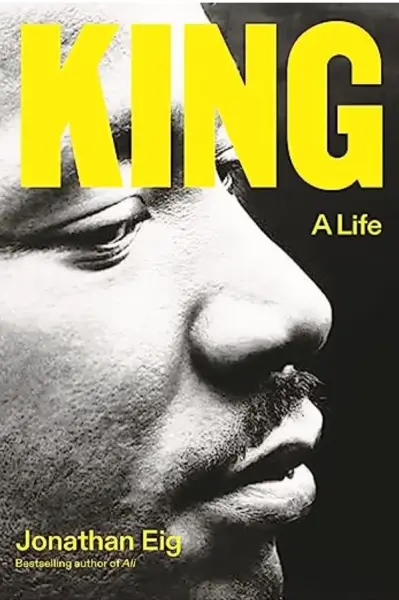
At a time when many Republicans are trying to make it more difficult to vote and the Supreme Court has recently struck down affirmative-action admissions at higher educational institutions, we are once again dealing with a question that we have “been grappling with for years—how to deal with the legacy of slavery” and Southern segregation. At such a time Jonathan Eig’s new biography, King: A Life, is especially welcome, and I have recently written a review of it. Here I will detail why this book is now so timely.
By the time of MLK’s assassination in 1968, it seemed like we had made considerable progress in overcoming the national scars of slavery and segregation—Civil Rights Acts of 1964 and 1968; the Voting Rights Act of 1965; and also in 1965, the beginning of Affirmative-Action policies. As President Johnson said about such initiatives, “This is the next and more profound stage of the battle for civil rights. We seek not just freedom but opportunity, not just legal equity but human ability, not just equality as a right and a theory, but equality as a fact and equality as a result."
Largely as result of the Voting Rights Act of 1965, intense voter-registration efforts, and continued federal pressure, the percentage of Black registered voters increased almost tenfold in Mississippi and more than threefold in Alabama between 1964 and 1969.
The making of MLK day a federal holiday beginning in 1986 (and the final state approval of it as a state holiday beginning in 2000) seemed to indicate that our nation as a whole had accepted MLK as a national hero. Yet, a significant percentage of our citizens remained opposed to some of his policies.
Related stories
Eig writes about MLK in the summer of 1963—60 years ago—that MLK “faced a violent reaction from white segregationists who saw their own definition of patriotism and their vision of American society under attack.” How true these words still seem today—except the reaction has spread beyond segregationists, and MLK has been dead for over a half century! But we still see “white backlash” among so many Trump supporters; among a majority of announced Republican candidates for president and Congressional Republicans; among some Supreme Court justices; and among the majority of whites opposed to Affirmative Action (AA), Critical Race Theory, and so-called “Wokeness”—Republican presidential candidate Nikki Haley decried wokeness as "a virus more dangerous than any pandemic, hands down."
In 1968, the same year MLK and Robert Kennedy were assassinated and Richard Nixon elected, I criticized white Americans who claimed, “OK, slavery and segregation were wrong, but they’re over now and I didn’t harm African Americans, let’s just treat everybody the same.” How I wondered could so many of my fellow whites not see the terrible scars, the lingering economic and social effects, that all those racial acts of hatred and ignorance had pressed, like a crown of thorns, upon our fellow African-American citizens and their descendants. How could they not see that some type of “affirmative action” was needed?
In the decades since then I have continued to observe white hostility to Affirmative-Action policies. It often comes from those who believe they were victims of “reverse discrimination.” That they lost a job or entrance to a university because it was given to a minority—sometimes to a woman, a stipulation included in revised AA guidelines.
In a Pew survey conducted in spring 2023, half of U.S. adults disapproved of colleges and universities taking race and ethnicity into account regarding admissions in order to increase racial and ethnic diversity. Only a third of adults approved. What was striking was the racial and ethnic breakdown. Ignoring the “not sure” category, here is what it was, with approving of AA coming first and disapproving second: Blacks, 47-29; Hispanic, 39-39; Asian, 37-52; Whites, 29-57. Among Democrats or leaning that way it was 54-29; among Republicans or inclined in that direction, 14-74.
The survey indicated something that has become increasingly evident in recent decades—in general, people approve of policies that they think will benefit them and disapprove of actions they think will harm their interests (or that of a group with which they identify).
Such an approach is sometimes referred to as “identity politics.” In a 2018 essay appearing in the leftist British newspaper The Guardian, Amy Chua wrote about “identity politics on both sides of the political spectrum,” leaving “the United States in a perilous new situation: almost no one is standing up for an America without identity politics, for an American identity that transcends and unites all the country’s many subgroups.”
For some time now, a small number of political commentators have been deploring this tendency to forget, ignore, or minimize the common good.
For some time now, a small number of political commentators have been deploring this tendency to forget, ignore, or minimize the common good. And yet it seems to me that, not withstanding the difficulty of agreeing upon it, enhancing it should be the main aim of our politics.
As early as John Adams this was recognized: “Government is instituted for the common good...and not for profit, honor, or private interest of any one man, family, or class of men.” [It must be admitted, however, that our Founding Fathers failed to include the welfare of slaves or Native Americans in their concept of the “common good.”) In a speech in 1937, Franklin Roosevelt stated, “I ask that majorities and minorities subordinate intolerance and power alike to the common good of all.”
Besides some, but by no means all, political leaders who have emphasized the importance of the common good, so too have some political observers. In his The One and the Many: America's Struggle for the Common Good (1997) religious scholar Martin E. Marty decried that too few citizens emphasized the concept. In 2015, in his address to the U. S. Congress, Pope Francis reminded its members that the “pursuit of the common good...is the chief aim of all politics.” Two years later, Mark Lilla in his The Once and Future Liberal deplored the increasing tendency to forget the common welfare. And in 2021 Gary Maring, author of Faith, Social Justice, and Public Policy: A Progressive’s View, in his Seeking the Common Good through Public Policy added this: “I am increasingly drawn to the concept of the common good, which to me means a society where everyone has access to the basic necessities of life—a place to live, food to eat, and access to education, employment, health care, and human dignity.”
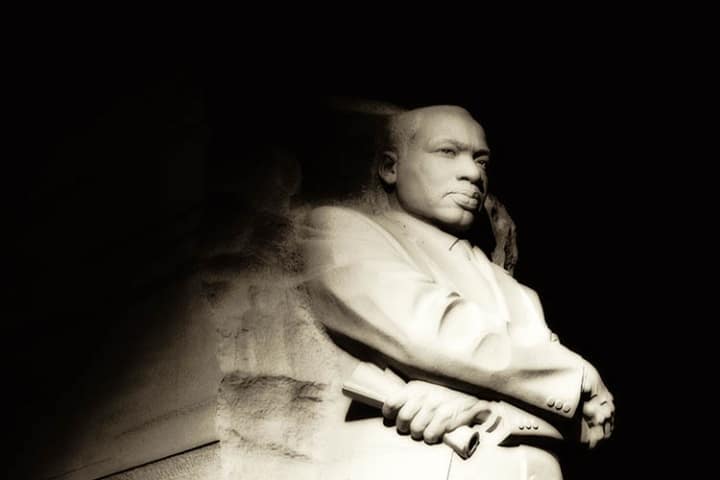
One of the aspects of Eig’s new biography of MLK that is valuable is that he reminds us that his subject was interested not only in overcoming racism directed against African Americans, but with furthering the common good in general. We see this clearly in the closing words to his most famous speech, “I Have a Dream."
I have a dream that one day down in Alabama...little Black boys and Black girls will be able to join hands with little white boys and white girls as sisters and brothers. . . . With this faith we will be able to transform the jangling discords of our nation into a beautiful symphony of brotherhood. With this faith we will be able to work together, to pray together, to struggle together, to go to jail together, to stand up for freedom together. . . . When we allow freedom [to] ring, when we let it ring from every village and every hamlet, from every state and every city, we will be able to speed up that day when all of God's children, Black men and white men, Jews and Gentiles, Protestants and Catholics, will be able to join hands and sing in the words of the old Negro spiritual: "Free at last! Free at last! Thank God Almighty, we are free at last!
In Chua’s article in The Guardian she recognized that “King’s ideals...transcended group divides.” Although he and others on the left were concerned with the “oppression of minorities and the rights of disadvantaged groups, the dominant ideals in this period [the 1960s] tended to be group blind, often cosmopolitan, with many calling for transcending not just ethnic, racial, and gender barriers but national boundaries as well.”
As Eig points out, when told that his criticism of the Vietnam War might harm his civil-rights efforts, MLK indicated that his concerns with peace and justice could not be limited to being just for African Americans. And Eig quotes him as saying just a year before his death that we “needed a reconstruction of the entire society, a revolution of values.” Finally, Eig mentions that in “October 1967 he [MLK] announced that he would soon launch a ‘Poor People’s Campaign,’ a march on Washington, where the impoverished of all races [my emphasis] would set up shelters on the Washington Mall and ‘cripple the operations of a repressive society’ until the federal government granted them an ‘Economic Bill of Rights.’”
Three years ago in LA Progressive, I wrote that “as a nation we have not owned up to the grievous, centuries-long harm we have done to Native and African Americans.” That’s still true today, and that full owning-up is still fiercely resisted by many, especially Trump followers and Republicans. Eig’s King: A Life will not end this resistance, perhaps not even dent it much, but as he writes, our country remains “racked with racism, ethno-nationalism, cultural division, residential and educational segregation, economic inequality, violence, and a fading sense of hope that government, or anyone, will ever fix those problems.” By reminding us of all that—and that MLK fought courageously to overcome these defects—the biographer has offered us a timely reminder that to fulfill King’s dream, we need to keep working.
Comments

Powered by RoundtableAn AI/DeFi-powered Enterprise Media Operating System. Learn more at Roundtable.io.© Roundtable 2026. By using this site you agree to the Terms of Use and Privacy Policy