


Jun 8, 2025 4:51 PM
Updated Jun 11, 2025 2:56 AM
How Presidential Power and Public Protest Shaped Two Very Different Military Responses in LA
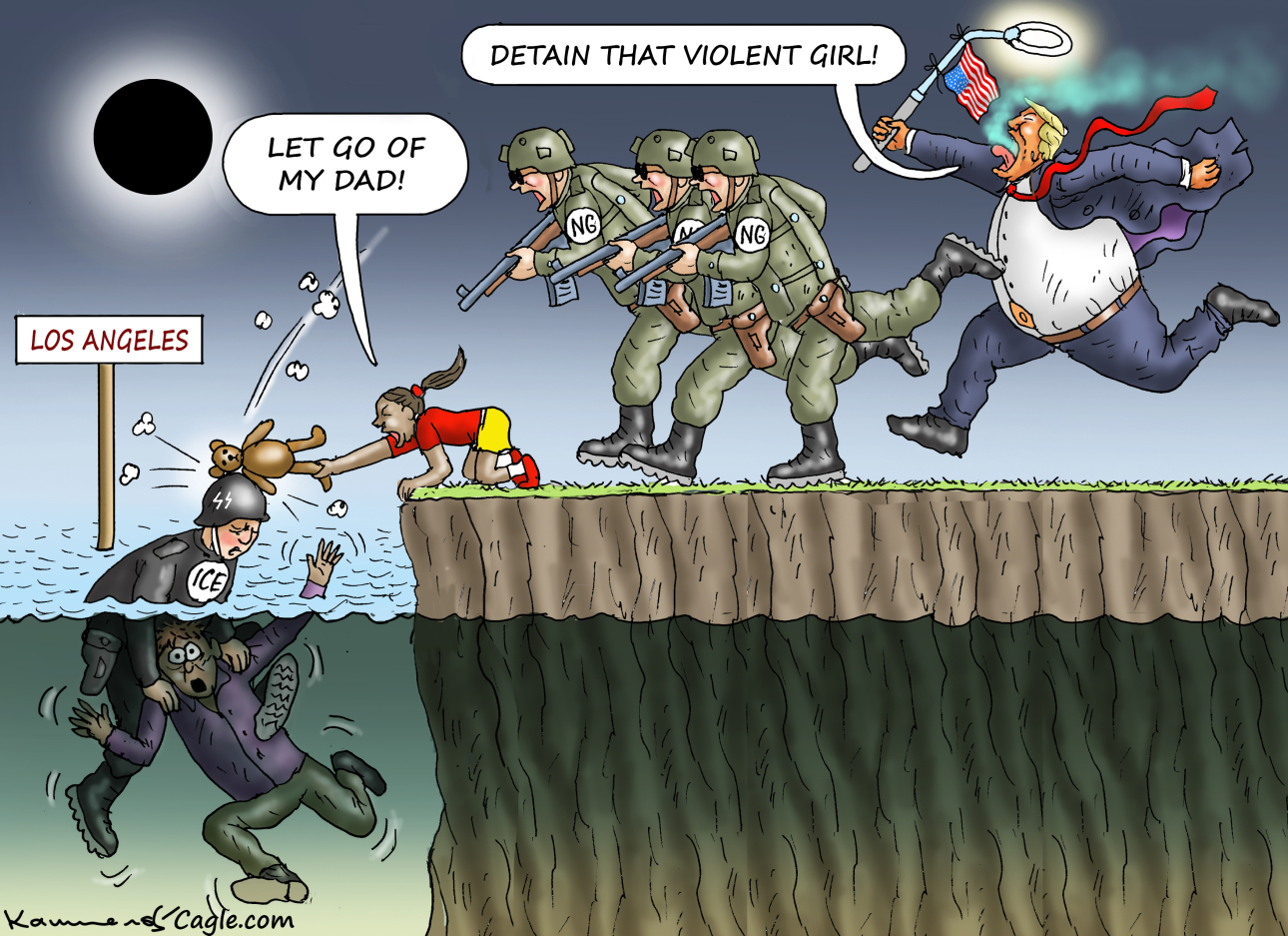
Today, President Donald Trump ordered the deployment of approximately 2,000 California National Guard troops to Los Angeles—a move made against the explicit objections of both Governor Gavin Newsom and Mayor Karen Bass. Citing “violent unrest” stemming from widespread protests against ICE immigration raids, Trump used Title 10 of the U.S. Code to federalize the Guard, bypassing local and state leadership in a maneuver being widely condemned as a dangerous federal overreach.
Tom Homan, a Trump appointee and former Acting Director of ICE, has stated that efforts to impede ICE operations could result in arrest, and that neither Gavin Newsom nor Karen Bass were exempt from that prospect.
This isn’t the first time Los Angeles has seen National Guard troops patrolling its streets. This writer remembers the 1992 deployment like it was yesterday. But the contrast between today’s deployment and the federal response to the 1992 L.A. Uprising couldn’t be more stark.
Two Presidents, Two Approaches: 1992 vs 2025
In 1992, following the acquittal of four LAPD officers in the brutal beating of Rodney King, Los Angeles exploded in protest, fire, and fury. Then-Governor Pete Wilson and L.A. Mayor Tom Bradley—both overwhelmed by the scale of the unrest—formally requested federal assistance.
Related stories
In response, President George H.W. Bush signed Executive Order 12804 on May 1, 1992, invoking the Insurrection Act and authorizing the federalization of the California National Guard. Roughly 4,500 troops were deployed in what became Operation Garden Plot, a coordinated effort under Joint Task Force–Los Angeles (JTF-LA) that also included U.S. Army and Marine Corps personnel.
But what truly distinguished that moment was the deliberation behind it. General Colin Powell, then Chairman of the Joint Chiefs of Staff, counseled Bush against using lethal force, expressing deep personal concern about pitting U.S. soldiers against American civilians. Powell insisted that civilian law enforcement should take the lead, warning against the militarization of a domestic crisis. His advice carried the day, and the deployment remained focused on restoring order while minimizing harm.
2025: No Request, No Restraint
By contrast, President Trump’s June 8, 2025 deployment was unilateral. Neither California Governor Gavin Newsom nor Los Angeles Mayor Karen Bass requested help. In fact, both condemned the move.
“This is purposefully inflammatory,” Newsom said. “It will only make the situation worse.”
Mayor Bass echoed the sentiment, calling the deployment “unwelcome, unnecessary, and likely to escalate rather than calm the situation.”
Trump’s decision was carried out not under the Insurrection Act—as in 1992—but under Title 10, which allows the president to take direct control of National Guard units for federal missions. By federalizing the California National Guard, Donald Trump stripped command authority from California’s elected leadership, placing the troops under his own command, ostensibly to suppress protests, not to restore peace in partnership with local government.
A Defiant Deployment
In defiance of California leadership, Trump invoked Title 10, federalizing the Guard anyway, citing a need to restore order. And, in recent days, figures like J.D. Vance and Pete Hegseth have floated the possibility of escalating the deployment further by calling in active-duty Marines to reinforce the National Guard presence in Los Angeles—a move that would mark a dramatic intensification of federal force in a domestic setting.
The Legal Context: Consent vs. Coercion
The legal difference between 1992 and 2025 is more than technical. The Insurrection Act requires a finding that state authorities are “unable or unwilling” to maintain order. But even then, tradition and democratic norms dictate that the federal government coordinate with state leaders before deploying troops.
In 1992, coordination was the bedrock of the response. In 2025, Trump has rejected coordination altogether, choosing confrontation with California's leadership instead.
A Warning from the Past, Ignored in the Present
What’s chilling is how thoroughly today's events violate the spirit of Powell’s 1992 warning. Powell was “sickened” at the thought of U.S. soldiers confronting their own citizens. He persuaded President Bush to exhaust all civilian channels before escalating to a federal military response.
Today, Trump has done the opposite. He acted preemptively, militarily, and without consent, sending Guard troops onto California streets to confront civilians protesting his immigration enforcement policies.
In 1992, federal troops helped quell a riot that had overwhelmed the city. In 2025, they arrive as an occupying force, not to support California—but to defy it.
A Federal Power Play in a Time of Crisis
This deployment represents more than a tactical response to protest. It’s a constitutional stress test, one in which Trump has chosen to assert federal dominance over a defiant state—politically blue and culturally resistant to his immigration and public order policies.
While the Guard may wear the same uniforms they did in 1992, the context, legality, and legitimacy of this deployment are profoundly different.
In the words of one civil rights observer on the ground: “In 1992, the Guard came to help. In 2025, they’ve come to control.”
Power, Precedent, Public Trust, and Race
In both 1992 and 2025, the National Guard was deployed into neighborhoods primarily inhabited by people of color. In 1992, the unrest emerged from decades of systemic police brutality disproportionately targeting Black Angelenos. In 2025, the protests erupted in response to mass ICE raids that disproportionately targeted Latino communities—many of whom were long-term residents, workers, and families. Notably absent from federal enforcement crackdowns are white undocumented immigrants, including the millions who overstay visas. Despite comprising a significant portion of the undocumented population, they are rarely subject to militarized immigration raids or large-scale public detention. This double standard reveals a racialized system of immigration enforcement and public order—one that continues to equate “threat” with skin color and class status.
Final Thought
At a time when public trust in institutions is fraying and authoritarian instincts are on the rise, the story unfolding in Los Angeles is about more than just troop movements. It’s about the balance between federal authority and local democracy, the use of military force on American soil, and the danger of a presidency untethered from consent.
Los Angeles has seen this movie before—but never like this.
Comments

Powered by RoundtableAn AI/DeFi-powered Enterprise Media Operating System. Learn more at Roundtable.io.© Roundtable 2026. By using this site you agree to the Terms of Use and Privacy Policy