


Mar 21, 2026 7:22 PM
Updated Mar 23, 2026 6:01 PM
A sharp critique of liberal analysis that names power, distrust, and conspiracy—but fails to center race as the system’s organizing force
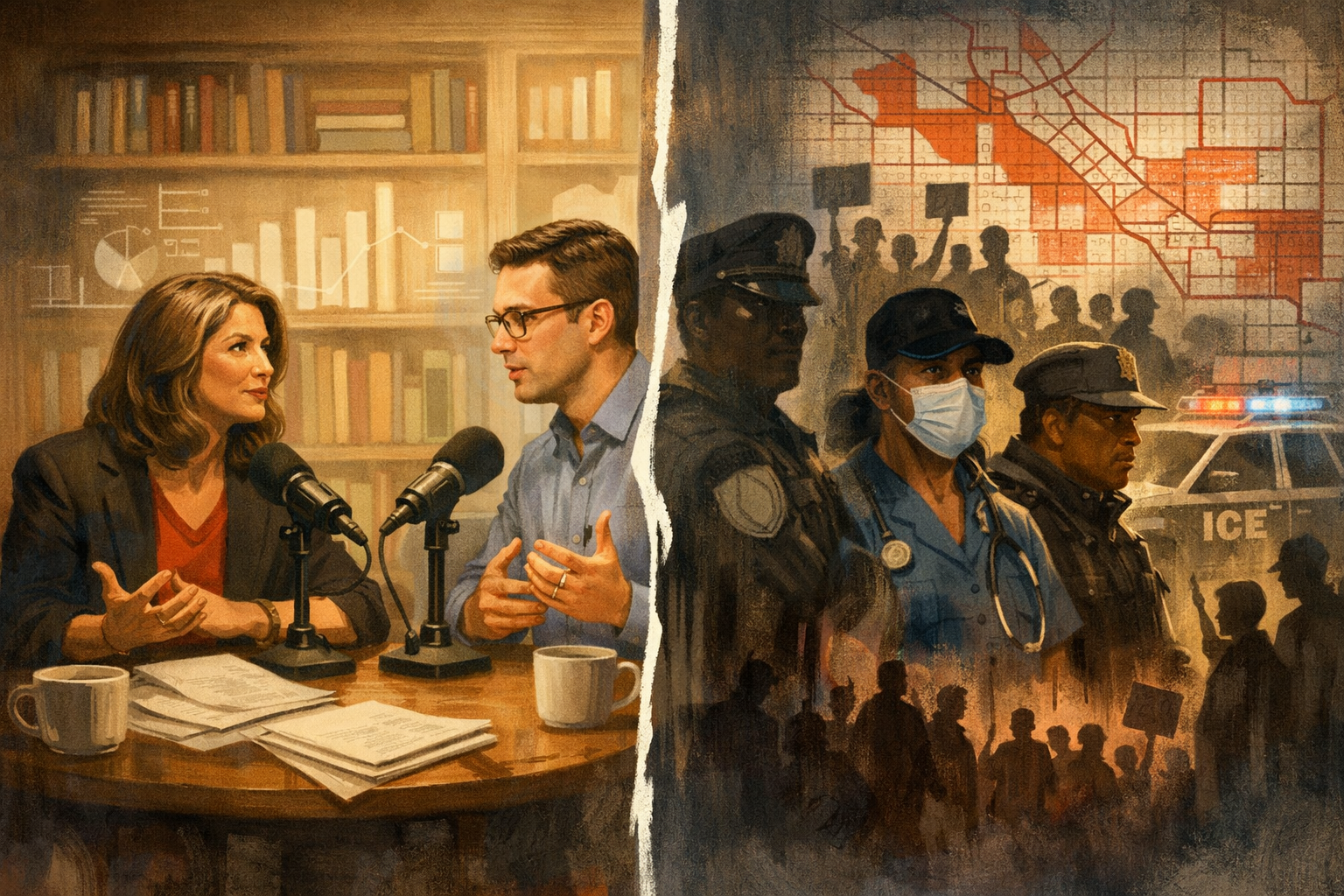
I recently listened to a long-form conversation between Naomi Klein and Ezra Klein—two of the most thoughtful political analysts working today.
They set out to make sense of a disorienting political moment: the rise of conspiracy culture, the strange coalitions forming around Trumpism, and the growing sense that something fundamental in our political reality has broken.
It was smart. It was insightful. It was, in many ways, exactly the kind of conversation we need.
And yet, when it ended, I felt deflated.
Related stories
Not because they were wrong—but because something essential was missing.
Race.
Not as a passing reference. Not as a side issue. But as a structuring force.
What Klein and Klein Actually Said
The conversation can be heard on Ezra Klein's podcast. It centers on Naomi Klein’s concept of a “mirror world”—a parallel political reality where legitimate concerns about power are reflected back in distorted form through conspiracy thinking.
As Noami Klein explains, people are drawn into this world because:
“We all feel that this world is rigged… power and wealth have concentrated so much… and the impunity that follows from that is so extreme.”
In other words, people are not wrong to feel that something is off.
But, she argues, those feelings are redirected into false explanations.
Ezra Klein builds on this, suggesting that liberalism has become too technocratic—too focused on policy and not enough on meaning, belonging, or identity. He describes a population searching for a story about who they are and where they fit.
Together, they identify a set of conditions shaping our politics:
- distrust of institutions
- economic instability
- elite impunity
- a sense that “the system is rigged”
- vulnerability to conspiracy thinking
Naomi Klein also offers an elucidating definition of fascism I'd never heard before—not simply as ideology, but as a reaction:
Fascism, Naomi Klein suggests, is a response by injured elites, a counterrevolution by those who feel their power slipping and seek to consolidate control.
This is a sophisticated diagnosis. This, alone, made the conversation worth listening to, for me.
Yet, it is still incomplete.
Race Doesn’t Enter—Until It Has To
Throughout the conversation, Klein and Klein describe conditions that are not neutral in the United States.
They are deeply racialized.
And yet, race remains largely absent from their conversation —appearing only briefly, then receding.
This is not unusual. It is patterned.
Race enters only when racialized people appear in the narrative.
Otherwise, it disappears.
Race as Outcome Instead of Design
There is a well-established insight in scholarship:
Race did not predate racism. Racism created race.
Race is not a biological fact. It is a system—constructed to organize power.
Through it:
- labor was stratified
- resources were distributed
- social value was assigned
Over time, this hardened into:
- racial hierarchy
- colorism
- economic inequality
If race is treated as an outcome instead of a design, its role in structuring the system becomes invisible.
The Invisible Center: The Nonracialization of White People
Central to that invisibility is something rarely named:
The nonracialization of white people
White people are not typically described as “racialized.” They are simply:
- people
- workers
- voters
- Americans
Race appears only when someone is:
- Black
- Latino
- Asian
- Indigenous
This creates a powerful illusion:
Race exists only when non-white people enter the frame.
But race is always present.
Whiteness has simply been constructed as:
- neutral
- universal
- unmarked
What Happens When Whiteness Is Invisible
When whiteness is not named:
- structural advantages appear natural
- disparities appear accidental
- inequality appears as dysfunction rather than design
So when Naomi Klein and Ezra Klein describe:
- alienation
- distrust
- precarity
they present these conditions as general—shared and evenly experienced.
But they are not.
And when analysis delivered with this level of intellectual authority treats them as such, it doesn’t simply miss something—it reproduces it. It reinforces a way of seeing the world in which race is optional, secondary, or safely ignored.
In that move, whiteness does its most effective work—not through overt assertion, but through absence.
Because when race is not named:
- structure disappears
- history disappears
- accountability disappears
What remains is a flattened story in which:
- instability just happens
- distrust emerges out of nowhere
- precarity is universal
It is none of those things.
It is produced. It is patterned. It is distributed.
For Black Americans:
- distrust is not new
- precarity is not a deviation
- alienation is not recent
It is the baseline.
Not because something went wrong—
but because this is how the system was built to function.
Race as a Diagnostic Tool—If We’re Willing to Use It
The Miner's Canary by Lani Guinier and Gerald Torres offers a crucial insight:
Race is not just a problem to solve—it can be a powerful diagnostic tool.
Those most exposed to harm reveal the dangers in the system first.
But for that to work, white Americans must see themselves as part of the racial ecosystem.
That rarely happens.
Instead, race is treated as something that belongs to “others.”
And that is precisely why the diagnosis fails.
Klein and Klein are studying the system.
But they are not using the tool that would make it legible.
What COVID Revealed—But We Still Haven’t Fully Faced
Naomi Klein describes the pandemic as a “fork in the road”—a moment when society could choose care or accept mass death.
The crisis itself was new.
But the pattern of who was most exposed—and who was most protected—was not.
Early in the pandemic, data quickly showed that COVID-19 was disproportionately infecting and killing Black Americans. That disparity was not incidental. It reflected long-standing conditions:
- frontline labor concentrated among Black and Brown workers
- unequal access to healthcare
- higher exposure risk built into daily life
At the same time, the national response was marked by:
- delays in distributing protective equipment
- inconsistent testing infrastructure
- uneven coordination
And while there is debate about intent, what is clear is this:
The unequal impact of the virus did not trigger an equally urgent, targeted response.
If anything, the disparity revealed something deeper—and more troubling.
It exposed how a system already accustomed to unequal loss could absorb disproportionate suffering without fundamentally changing course.
That matters.
Because when a crisis lands unevenly and the response does not correct for that imbalance, the signal is clear:
some lives are more protected than others.
And that signal does not stay contained.
The United States ultimately experienced one of the highest COVID death tolls in the world.
Not because the virus was unique—but because the underlying system was.
Planned Precarity: The Missing Link
Klein and Klein repeatedly return to the same observations:
- the system feels rigged
- institutions are not trusted
- life feels unstable
They describe this as:
- alienation
- fragmentation
- loss of meaning
But they stop short of asking:
What if these conditions are not the breakdown of the system—but part of how it works?
This is where planned precarity becomes essential.
What Is Planned Precarity?
Planned precarity is the production and maintenance of instability.
It operates through systems that:
- limit access to housing
- constrain wages
- distribute healthcare unevenly
- expose some populations to greater risk
Precarity is not just a feeling.
It is a condition.
The Nexus—and the Warning
What is being experienced now as crisis by some has long been structure for others.
And that is precisely why the racialization of white people—meaning the recognition that they, too, are positioned within a racial system—is essential.
Because when race is seen as something that happens only to others, the warning signs are missed.
The conditions now described as:
- instability
- distrust
- alienation
have long been concentrated in Black and Brown communities.
That was never incidental.
It was instructive.
What happens first to the most vulnerable rarely stays contained.
This is the lesson of the miner’s canary.
And it is the lesson that goes unheard when race is not used as a diagnostic tool.
From Precarity to Power
In the interview, Naomi Klein describes fascism as a response to injured power—a move by elites to protect their position when they feel threatened.
That insight reveals the trajectory.
When a system normalizes hierarchy—when some populations are expected to absorb instability—it creates a foothold for unchecked power.
At first, that power is selective.
It targets the margins.
But, metaphorically like the COVID virus, it does not stay there.
The mechanisms used to control some populations expand outward:
- surveillance grows
- labor becomes more precarious
- democratic participation narrows
And eventually, the structures that once seemed stable begin to erode.
What appears sudden is not sudden at all.
It is the expansion of a system already in motion.
If the canary is ignored, the mine does not become safer.
It becomes more dangerous—for everyone inside it.
Where the Conversation Could Have Shifted
Race could have entered the conversation naturally when they asked:
- Why does the system feel rigged?
- Who has long experienced it that way?
- Who has been excluded from institutions from the start?
- Who identified “real conspiracies” and was ignored?
- Who bore the greatest risk during the pandemic?
At each point, race was not a detour.
It was the missing foundation.
Why This Matters for Democracy
If precarity is unevenly distributed, then so is:
- time
- security
- civic participation
Which means:
democracy itself is unevenly distributed
This is not incidental.
It is functional.
The Deflation—and the Insight
What I heard in this conversation was sharp, serious analysis.
But I also heard the limits of a framework that:
sees the turbulence—but not the architecture
A Different Starting Point
What if we began here:
Race is not a side effect of the system.
It is one of the primary tools through which the system operates.
Closing
Naomi Klein and Ezra Klein are serious thinkers.
But this conversation reveals a broader truth:
Even the most sophisticated liberal analysis can fail—not by denying race, but by not centering it.
And when race is not centered:
- history gets flattened
- inequality gets misdiagnosed
- the system remains obscured
The absence of race in this conversation was not a gap at the margins.
It was a missing foundation.
Comments

Powered by RoundtableAn AI/DeFi-powered Enterprise Media Operating System. Learn more at Roundtable.io.© Roundtable 2026. By using this site you agree to the Terms of Use and Privacy Policy