
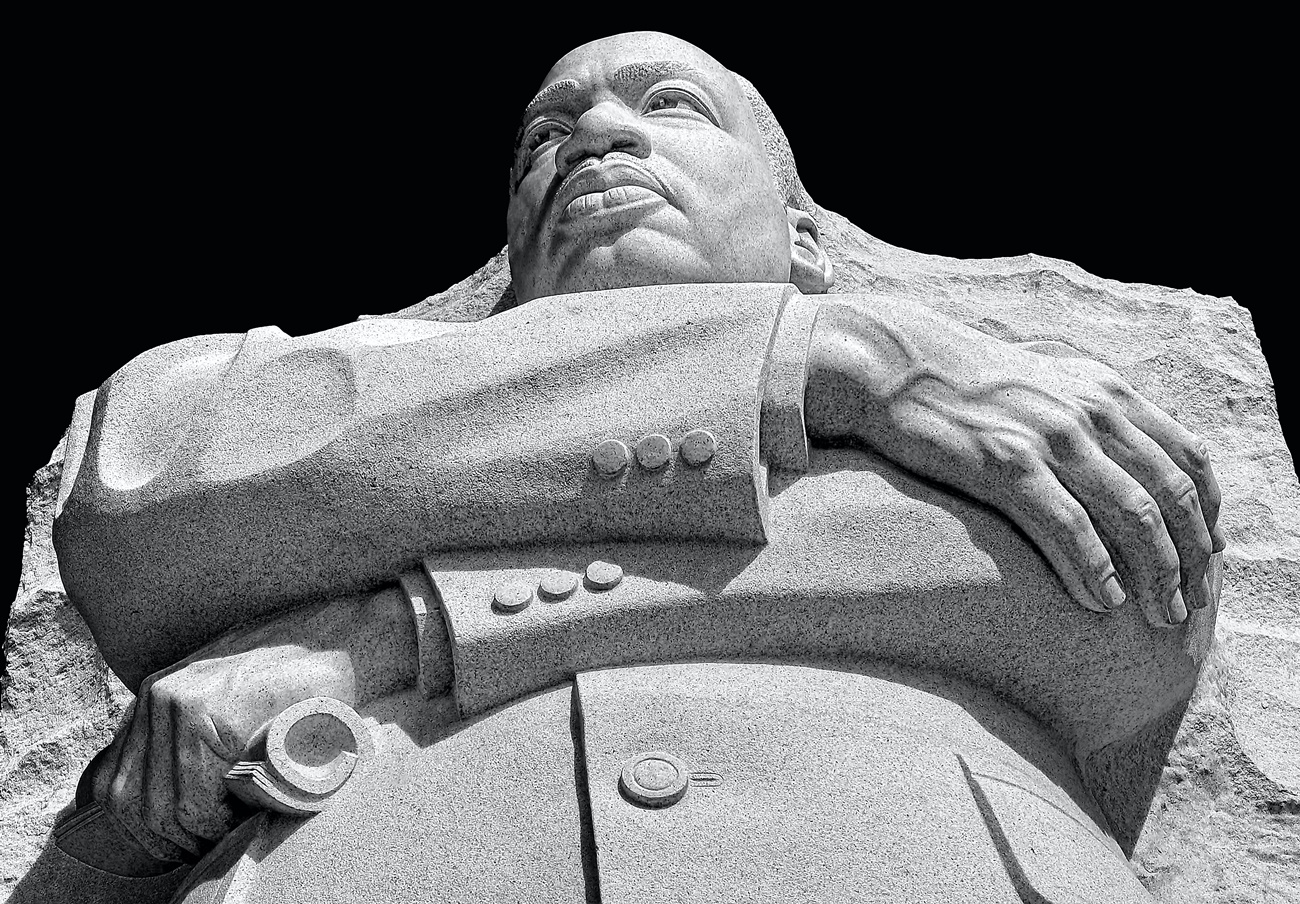


Distorting MLK's Message
Jan 30, 2026 6:08 PM
Updated Jan 30, 2026 6:12 PM
Today, in these woeful Trumpian times, MLK’s dream is not dead—unless we allow it to be—it’s just semi-dormant.
In this land of Trumpian woe, we must hold tightly to remembering that this is also the land of Frederick Douglass, football great Jim Thorpe, poet Langston Hughes, Iwo Jima hero Ira Hayes (like Thorpe, a Native American), Black singer Marian Anderson, Jackie Robinson, Supreme Court Justice Thurgood Marshall, Martin Luther King, Jr., writers Langston Hughes, James Baldwin, and Maya Angelou, and the contemporary gymnast Simon Biles.
Let’s start with Douglass, who goes back a century and a half, back to President Lincoln’s time. What a contrast he is to our current president—Donald Trump! Already in 2019, before the carnage of Trump’s second term had begun, I had pointed out that contrast in “Do We Want the America of Frederick Douglass or Donald Trump?”
In that piece I indicated that the emancipationist insisted that “our greatness and grandeur will be found in the faithful application of the principle of perfect civil equality to the people of all races and of all creeds, and to men of no creeds.” That he advocated a “composite nation,” a concept that historian Jill Lepore calls “a strikingly original and generative idea, about a citizenry made better, and stronger, not in spite of its many elements, but because of them.” In Douglass’s day, there were great fears regarding Chinese immigrants, but he also thought that they could enrich our nation. “Do you ask, if I favor such immigration, I answer I would. Would you have them naturalized, and have them invested with all the rights of American citizenship? I would. Would you allow them to vote? I would. Would you allow them to hold office? I would.”
In my essay, I contrasted Douglass’s approach with that of Trump, but enough is known about the latter’s disgust with many immigrants that repeating it here is unnecessary. Suffice it to cite some of the reporting of the American Immigration Council about Trump’s second term efforts: The number held in immigration detention centers has (by the start of Dec. 2025) “risen by almost 75 percent . . . the highest level in history. . . . The rapid and ongoing expansion of immigration detention has wrought enormous changes on immigration enforcement, trapping hundreds of thousands of noncitizens in an increasingly opaque world of remote jails and private prisons, where U.S. Immigration Customs Enforcement (ICE) can exert ever-greater pressure on the people it is jailing to give up, accept deportation, and forego any chance to remain in the United States.”
Related stories
One might add that in addition to earlier references to Haiti and countries in Africa as “shithole countries,” and his stated preference for immigrants from countries like Norway, in 2025 Trump demonstrated a preference for White South African immigrants, whom he claimed were being discriminated against by Blacks in their country. Also in early 2025, Pope Francis stated that Trump’s plan to mass deport undocumented immigrants was a “disgrace.”
To all this immigrant fear-mongering, I would contrast and argue the following: Much of the anti-immigrant fear is driven by Whites' hostility to Affirmative Action and equity (begun in the 1960s) and the perception that within a few decades they will be outnumbered by the combination of other races. In the 2020 census 57.8% of the U.S. population was White, 18.7% was Hispanic, 12.1% was Black, and 5.9% was Asian. Another 4.1% were people of two or more races. But by 2045 the U.S. Census Bureau projects that non-Hispanic whites will constitute only 49.7% of the population, making them a "minority."
In some fields like professional sports—which U. S. citizens take very seriously—Whites have already become a minority. In football’s NFL only about one-fourth of the players are White/Non-Hispanic; in basketball’s NBA a little less than one-fifth of the players are White. Only in baseball’s MLB are Whites still a majority, consisting of a little less than two-thirds of all players. But even in MLB, non-Whites are becoming more and more prominent—in 2025, the National League’s Japanese Shohei Ohtani—both a pitcher and a slugger—won his fourth Most Valuable Player (MVP). (In college football, Indiana U.’s quarterback Fernando Mendoza won the Heisman Trophy—an MVP-type award—for 2025. All four of his grandparents were born in Cuba and immigrated to Miami after the 1959 Castro-led revolution.)
If we look at nominations for 2025 films at the 98th Academy Awards, we see that “Sinners” and “One Battle After Another” were dominant. The first beamed a light on race and racism in 1930s Mississippi, and the second dealt sympathetically with leftist protests against the type of immigration tactics used by the U. S. Immigration and Customs Enforcement (ICE).
Against the half-century decline of White male prominence in the U.S. world, there has been a backlash, especially among White, rural and small-town, older, and non-college-degreed voters.
One pundit who has written about this phenomenon is conservative Ross Douthat, a columnist for The New York Times. In an early 2017 article—“Who Are We?”—he writes, that by the late 1960s there was “a necessary reckoning with white supremacism....[and] in its place emerged a left-wing narrative that stands in judgment on the racist-misogynist-robber baron past....But meanwhile for a great many Americans the older narrative still feels like the real history. They still see themselves more as settlers than as immigrants, identifying with the Pilgrims and the Founders, with Lewis and Clark and Davy Crockett....They still....assume a Judeo-Christian civil religion....Trump’s ascent is, in part, an attempt to restore their story to pre-eminence.”
Conservative though he is, Douthat was honorable enough to admit that our “reckoning with white supremacism” was necessary. Trump, as an LAP essay of November 2025 pointed out, has not been as gracious. Rather than encouraging historians to tell it like it has been—“the good, the bad, and the ugly,” to borrow from a Clint Eastwood film—the president’s executive order of March 2025 blasted history that undermined “the remarkable achievements of the United States by casting its founding principles and historical milestones in a negative light. . . . Rather than fostering unity and a deeper understanding of our shared past, the widespread effort to rewrite history deepens societal divides and fosters a sense of national shame, disregarding the progress America has made and the ideals that continue to inspire millions around the globe.” As if our historians should gloss over the great evils perpetrated by our treatment of Native and African Americans!
Finally, the Council on Foreign Relations reported that the Trump administration announced on January 14 [2026] that it would indefinitely freeze visa processing for people coming from seventy-five countries,” including “Afghanistan, Brazil, Egypt, Iran, Russia, and Somalia.”
Amid all this anti-immigration rhetoric and actions by the Trump administrations, the House of Representatives in mid 2019 passed a resolution that condemned Trump’s “comments that have legitimized and increased fear and hatred of new Americans.” The House statement also quoted President Kennedy’s 1958 book ‘‘A Nation of Immigrants’’ which stated that ‘‘the contribution of immigrants can be seen in every aspect of our national life. We see it in religion, in politics, in business, in the arts, in education, even in athletics and entertainment. There is no part of our nation that has not been touched by our immigrant background. Everywhere immigrants have enriched and strengthened the fabric of American life.’’
The House resolution even quoted that conservative favorite, President Ronald Reagan, who observed that ‘‘each generation of new Americans . . . guarantees that America’s triumph shall continue unsurpassed’’ through the 21st century and beyond and is part of the ‘‘magical, intoxicating power of America.” And, this is ‘‘one of the most important sources of America’s greatness: we lead the world because, unique among nations, we draw our people—our strength—from every country and every corner of the world, and by doing so we continuously renew and enrich our nation.”
Along with ICE raids (and deaths) in Minneapolis and other cities, it is useful to remember ethnic statistics for some of our major cities. In Minneapolis, Whites are around 60%; Black/African Americans are around 18%; Hispanic/Latino around 10%; and Asian around 5-6%. Somali-Americans in Minneapolis and St. Paul, whom Trump has disparaged, make up roughly 3-4% of the total population.
One of my favorite TV series is “The Pitt,” set in a Pittsburgh emergency room (ER)—I have a special affinity for ERs since my now deceased wife worked in them for over a decade. The ethnic makeup of that city is White, about 63%; Black or African American, about 22 %; Asian, about 6%; Hispanic of Latino, about 4%; and two or more races, about 5%.
The series does a wonderful job demonstrating how a multi-ethnic community—in an ER or a city—can work together. Among the ER staff are several Muslim women. In Season 2 a Jewish woman, Mrs. Kovalenko, is treated and she says to a Muslim staff woman, “You're Muslim? Thank you. After the shooting [in 2018, at Pittsburgh’s Tree of Life Synagogue], it was the Muslims that came together for us in support and . . . walked with us. You raised money. You . . . paid for all the funerals. Anyway. . . thank you.” (See the episode’s transcript for quoted material.) Also in Season 2, a new doctor is introduced, Dr. Baran Al-Hashimi. She is an Iranian-American who can speak Iran’s Farsi language.
I myself recently had a fortunate experience with an urgent care provider of Muslim background. I had a bad fall on my hip, and he (a doctor) provided excellent care for me. He was from Hamtramck, Michigan—notable for electing the first all-Muslim U. S. city council—and his family was from Yemen (a country from which Trump will no longer accept immigrants.)
Before leaving the subject of the ethnic makeup of cities, I should perhaps add that centuries ago—before we seized their lands—Native Americans were the dominant populations in areas like Minneapolis, Pittsburgh, and Hamtramck.
In 1935, the African-American poet Langston Hughes (1902-67) wrote “Let America be America Again.” It contained these lines:
Let America be the dream the dreamers dreamed—
Let it be that great strong land of love
Where never kings connive nor tyrants scheme
That any man be crushed by one above.
(It never was America to me.)
Hughes could state that in 1935 America was not for him the “dream the dreamers dreamed,” but 60 years later in South Carolina mixed race marriages could still not occur. Yet, in 2012 we elected as president a son of such a mixed race marriage (Obama). And he was born in Honolulu, not Kenya as Trump insisted.
Thus, as sad and unfortunate as these Trumpian days are, let’s not forget MLK’s dream: “I have a dream that one day down in Alabama . . . little black boys and black girls will be able to join hands with little white boys and white girls as sisters and brothers. . . . With this faith we will be able to transform the jangling discords of our nation into a beautiful symphony of brotherhood. With this faith we will be able to work together, to pray together, to struggle together, to go to jail together, to stand up for freedom together.”
Today, in these woeful Trumpian times, MLK’s dream is not dead—unless we allow it to be—it’s just semi-dormant. Perhaps the words of another great American (President Franklin Roosevelt in 1933) are pertinent here: “This great Nation will endure as it has endured, will revive and will prosper...The only thing we have to fear is fear itself—nameless, unreasoning, unjustified terror which paralyzes needed efforts to convert retreat into advance. In every dark hour of our national life a leadership of frankness and vigor has met with that understanding and support of the people themselves which is essential to victory.”
Comments

Powered by RoundtableAn AI/DeFi-powered Enterprise Media Operating System. Learn more at Roundtable.io.© Roundtable 2026. By using this site you agree to the Terms of Use and Privacy Policy