


May 6, 2018 4:27 AM
Updated Feb 10, 2022 10:10 PM
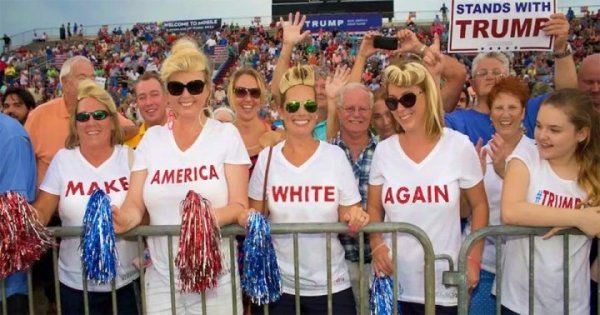
Berry Craig: Trump counted on whites to translate "Make America Great Again" as "Make America White Again." He ran the most overtly racist presidential campaign since George Wallace's 50 years ago.
Even some liberals say that a majority of whites who voted for Donald Trump are not bigots. Rather, these liberals claim, most whites went for Trump because they feared for their livelihoods and believed he would save or bring back their jobs.
New York Times columnist Charles Blow doesn't buy it. "The idea that the primary motivator for Trump supporters was economic anxiety was a false narrative swallowed and regurgitated by a gullible media too afraid to call a thing a thing: racial resentment."
(Most whites who voted for Trump were more affluent folks, not working stiffs who were unemployed or working at low-paying jobs. More on that in a minute.)
Blow doesn't pull punches: "Simply put, Trump is one of the last gasps of American white supremacy and patriarchy. He is one of its Great White Hopes."
Related stories
Blow pointed to “Status threat, not economic hardship, explains the 2016 presidential vote,” the title of new research published in The Proceedings of the National Academy of Sciences.
Trump counted on whites to translate "Make America Great Again" as "Make America White Again." He ran the most overtly racist presidential campaign since George Wallace's 50 years ago.
"The study is not the first to cast doubt on the prevailing economic anxiety theory," wroteThe Times's Niraj Chokshi. "Last year, a Public Religion Research Institute survey of more than 3,000 people also found that Mr. Trump’s appeal could better be explained by a fear of cultural displacement."
Translation: a slew of white folks voted for Trump because they're scared and resentful of non-whites at home and abroad.
Blow quoted the gist of the study authored by Diana C. Mutz, a University of Pennsylvania political scientist: “White Americans’ declining numerical dominance in the United States together with the rising status of African Americans and American insecurity about whether the United States is still the dominant global economic superpower combined to prompt a classic defensive reaction among members of dominant groups.”
Trump counted on whites to translate "Make America Great Again" as "Make America White Again." He ran the most overtly racist presidential campaign since George Wallace's 50 years ago.
(Wallace frightened the GOP into trotting out the "Southern Strategy." The idea was to make Republicans of white supremacist Southern Democrats who hated LBJ and the national Dems for becoming what the GOP had been since the Civil War: the party of federal civil rights activism. Trumpism is the Southern Strategy gone nationwide.)
Trump and Wallace shared "the demagogue’s instinctive ability to tap into the fear and anger that regularly erupts in American politics," historian and Wallace biographer Dan T. Carter wrote in The Times in January, 2016.
Mutz questioned the notion "that personal economic hardship drove Trump support," arguing that, "first and foremost, over many decades of scholarship, evidence of voters politicizing personal economic hardship has been exceedingly rare.”
Second, she said, the timing was wrong. “Trump’s victory took place in the context of an economic recovery. Throughout the year preceding the election, unemployment was falling, and economic indicators were on the upswing.”
Nonetheless, conservatives—and some liberals-- still argue that racism couldn't have amounted to much in Trump's win because America, an almost 77 percent white country, had just elected an African American president twice.
In trying to absolve white Trump voters of racism, conservative, and even some liberal, pundits argued that lots of them had voted for Obama. Washington Post columnist Dana Millbank busted that myth last summer.
“The number of Obama-to-Trump voters turns out to be smaller than thought,�� he wrote, citing multiple sources to back himself up. “And those Obama voters who did switch to Trump were largely Republican voters to start with. The aberration wasn’t their votes for Trump but their votes for Obama.”
Mutz also wrote that even as their share of the population diminishes, whites will likely remain the best-heeled racial group. Yet, symbolically, the shrinking numbers threaten "some whites’ sense of dominance over social and political priorities."
Mutz concluded, "The 2016 election...was an effort by members of already dominant groups to assure their continued dominance and by those in an already powerful and wealthy country to assure its continued dominance.”
Blow wrote that Mutz’s research buttressed an analysis of younger white Trump supporters The Washington Post published last year: “First, white millennial Trump voters were likely to believe in something we call ‘white vulnerability’ — the perception that whites, through no fault of their own, are losing ground to other groups. Second, racial resentment was the primary driver of white vulnerability — even when accounting for income, education level or employment.”
Blow also cited a 2016 analysis, also published in The Post, which revealed that “economic anxiety isn’t driving racial resentment. Racial resentment is driving economic anxiety.”
Concluded Blow: "The distillation of [Trump's]...campaign message was not only to halt the rapid pace of change, but also to reverse it, to undo the Obama-izing of America and restore it to whiteness. It was also to uncouple America from globalizing influences and specifically elevate American whiteness.
"To support Donald Trump was to be pro-America’s past and anti-America’s future. The whole thing was suffused with race....Trump is white anguish encapsulated."<
Meanwhile, in a 2017 Washington Post story, author-political scientists Nicholas Carnes and Noam Lupu debunked another persistent media myth: that blue collar whites elected Trump. "In the general election, like the primary, about two thirds of Trump supporters came from the better-off half of the economy," they wrote.
Added Carnes and Lupu: "The narrative that attributes Trump’s victory to a 'coalition of mostly blue-collar white and working-class voters' just doesn’t square with the 2016 election data. According to the [American National Election Study],...white non-Hispanic voters without college degrees making below the median household income made up only 25 percent of Trump voters. That’s a far cry from the working-class-fueled victory many journalists have imagined."
Nonetheless, the fable still unnerves more than a few Democrats, though since Trump was sworn in, Democrats have flipped a senate seat in Alabama, a House seat in Pennsylvania and ousted Republicans in umpteen state legislative elections, including a blowout in Kentucky, my home state.
"Some Democrats have responded to the widely circulated misconception about why Clinton lost by insisting that the party needs to move away from identity politics -- issues revolving around gender equality and racial justice -- and focus in on economic issues," wrote author-historia n Julian Zelizer for CNN online. "Instead, Democrats should be basing their 2020 election strategy on what is actually true."
He also wrote about Mutz's research, praising it for opening "a window into understanding why President Trump can promote a Reaganesque economic agenda that is so clearly at odds with his campaign promises.
While the President keeps talking about the common man and woman, most of his economic policies, such as his tax overhaul or financial deregulations, have aimed to provide relief to corporations, investors, and families in the upper income brackets."
Studies suggest that some of Trump's voters will not change their minds in response to any kind of economic policies. The only way for Democrats to win those voters over would be to turn their backs on core constituencies, like college-educated, working women, African-Americans, and immigrants, who have been vital to the party for decades."<
Proposed Zelizer: "So, rather than trying to appease the cultural anxieties of white male voters, Democrats should instead focus on offering them economic solutions to their challenges, such as pushing for a robust infrastructure program (polling showed that 53% of white males in states won by Hillary Clinton support an infrastructure initiative), while energizing, organizing, and mobilizing the millions of Americans who were part of the coalition that Barack Obama successfully wove together in 2008 and 2012.

"It was a coalition that understood that the diversity of this country is its strength, not its weakness."
Berry Craig
Comments

Powered by RoundtableAn AI/DeFi-powered Enterprise Media Operating System. Learn more at Roundtable.io.© Roundtable 2026. By using this site you agree to the Terms of Use and Privacy Policy