


Feb 27, 2026 10:30 PM
Updated Feb 27, 2026 11:48 PM
Architect Rick Corsini explains how single-family zoning, political power, and race continue to structure inequality in Los Angeles neighborhoods.
We like to talk about segregation as if it ended with redlining. As if it were crude and obvious — written into covenants and enforced by mobs.
But segregation evolved.
It professionalized. It adopted the language of “neighborhood character” and “homeownership stability.”
When 74% of Los Angeles is locked into single-family zoning, we are not witnessing a natural housing market. We are witnessing policy. And policy is not neutral.
Related stories
If race shaped the city we inherited, race must shape the conversation about the city we intend to build.
That was the underlying theme of my recent interview with architect and urban designer Rick Corsini, founding principal of Corsini Stark Architects.
What began as a conversation about housing design quickly became a conversation about power.
Who Holds the Power to Shape a City?
I asked Corsini a basic question:
Who ultimately holds power in shaping cities — planners, architects, developers, financiers, or elected officials?
His answer was direct.
“It’s a little bit of everybody,” he said. “But the political structure is the armature of the sculpture of the city.”
Los Angeles operates under a weak-mayor system with highly decentralized land-use authority concentrated in 15 City Council districts. Each councilmember wields extraordinary influence over development decisions within their boundaries.
That fragmentation matters.
Because land-use decisions are political decisions — and political decisions shape racial outcomes.
“Single-Family Zoning Was Not an Accident”
During our conversation, Corsini addressed something many Angelenos do not realize:
Single-family zoning was formalized in Berkeley in 1916 as a way to exclude Black residents.
“It was invented as a racial exclusion tool,” he explained. “And 74% of Los Angeles is still governed by it.”
After racial covenants were struck down, zoning became the more durable mechanism for maintaining separation without explicitly naming race.
Today, approximately 74% of residential land in the City of Los Angeles is zoned R1 — single-family only.
One house per lot.
In a city facing a severe housing shortage.
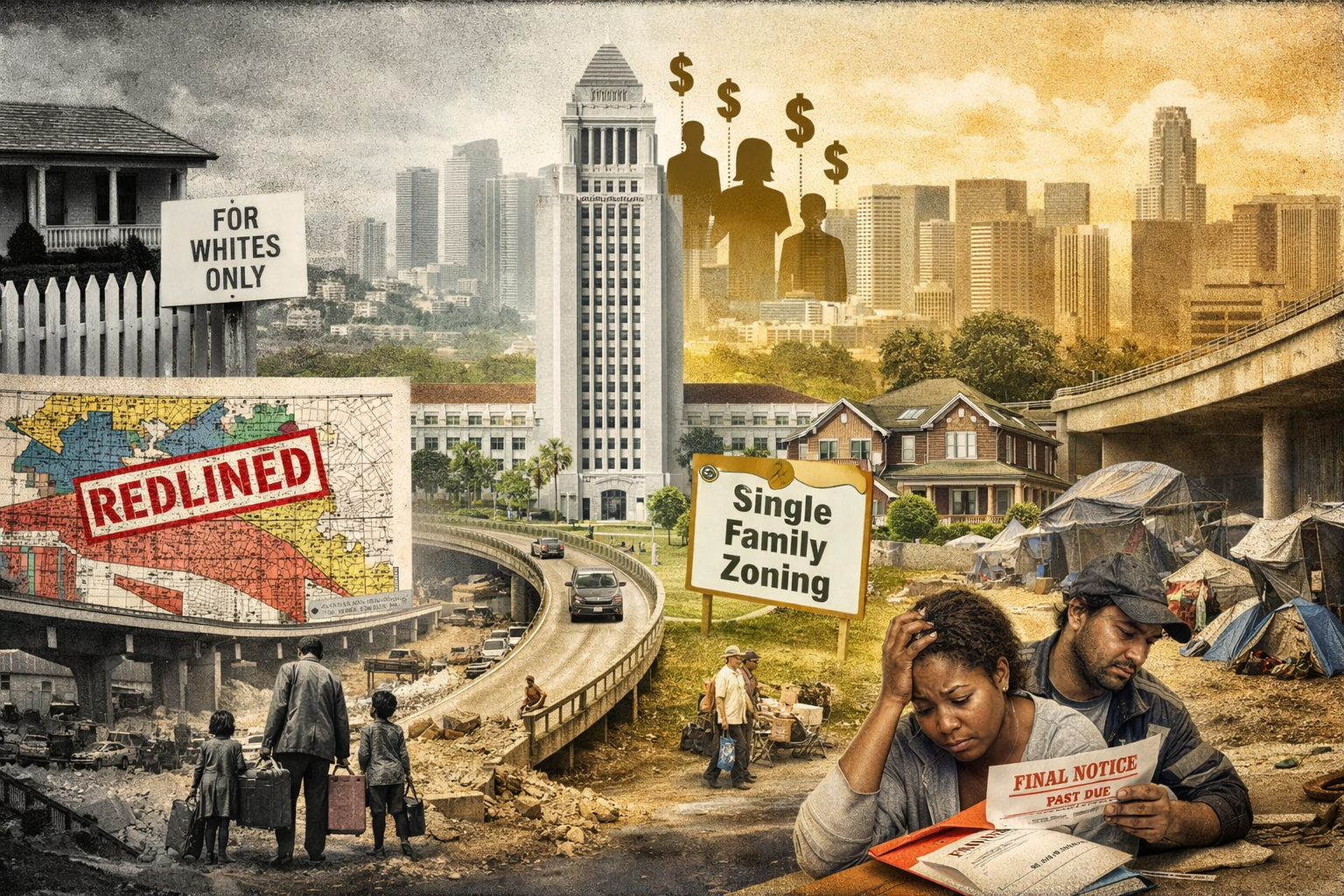
In a city shaped by redlining, racially restrictive covenants, freeway construction that carved through Black neighborhoods like Sugar Hill, and the displacement of Mexican American families in Chavez Ravine.
The pattern is not subtle: restrict density in affluent neighborhoods, concentrate multifamily housing elsewhere, and describe the outcome as market-driven.
But markets operate inside rules.
And rules are written by people.
How Political Structure Reinforces Segregation
Corsini emphasized that Los Angeles’ decentralized governance intensifies the problem.
“With so much land-use power concentrated in individual council districts,” he noted, “there’s an incentive to protect your own territory.”
When I asked whether contemporary planners are conscious of this racial history, he was clear: yes.
The City Planning Department, he said, includes well-educated professionals deeply aware of segregation’s legacy. Recent housing policy proposals attempted to address race equity, environmental sustainability, and transportation integration.
But planning expertise is advisory.
Political authority determines what survives.
The Housing Element That Almost Was
I asked Corsini about the Community Housing Implementation Program (CHIP), which would have effectively lifted R1 restrictions citywide.
To be clear, eliminating R1 zoning would not bulldoze neighborhoods. It would allow duplexes, triplexes, and small multifamily housing on lots previously restricted to one home.
That flexibility, planners argued, could help address supply shortages and reduce exclusion.
But politically, the proposal met resistance.
Homeowners in affluent neighborhoods mobilized. The most sweeping reform did not advance in its full form.
Corsini pointed to a deeper structural factor: in the United States, home equity functions as retirement security.
“That financial structure makes homeowners protective — and politically powerful,” he explained.
The result is a powerful incentive to preserve the status quo.
A Brief Note on Mayor Karen Bass
Mayor Karen Bass has publicly committed to addressing homelessness and increasing housing production. Her administration has supported streamlining measures aimed at accelerating affordable housing.
However, when broader reforms that would have lifted R1 zoning citywide were proposed through CHIP, that element did not move forward in its original scope.
Supporters cite intense political resistance from single-family homeowners. Critics argue that meaningful racial equity requires confronting that resistance directly.
The tension illustrates Corsini’s central point: the design of the city follows the design of its power structure.
Segregation by Density
During our conversation, I reflected on my own experience moving from New York to Los Angeles.
In Manhattan, density forces encounter. In Los Angeles, horizontal sprawl allows separation.
Drive Wilshire Boulevard from east to west and you move through dramatically different racial and socioeconomic worlds within miles.
That fragmentation is not accidental.
It is policy.
Single-family zoning preserves racial geography. It protects wealth enclaves. It limits access to high-opportunity neighborhoods.
It ensures that density — and often poverty — remain concentrated elsewhere.
What This Is Really About
This conversation with Rick Corsini was not about architecture in the aesthetic sense.
It was about governance.
It was about race.
It was about whether Los Angeles will remain a horizontally segregated metropolis — or become a city that permits more people to share space, schools, opportunity, and safety.
We speak of redlining as history.
But zoning is present tense.
As long as 74% of the city remains legally restricted to one house per lot, exclusivity is not incidental.
It is chosen.
And political choices can change.
Homelessness in Los Angeles did not begin with tents. It began with scarcity — and with inequality. It began with rules that constrained who could live where, layered atop racial discrimination in employment, unequal access to credit, predatory lending, medical bankruptcy, wage instability, and generations of housing exclusion. When housing supply is artificially restricted in high-opportunity areas, prices rise everywhere. But the burden does not fall evenly. Black and Brown Angelenos — already facing discrimination in hiring, pay, and healthcare access — are pushed to the financial edge faster and with fewer buffers.
Zoning reform alone will not solve homelessness; services, subsidies, and healthcare access are essential. But a city that legally reserves most of its land for one house per lot cannot credibly claim it is using every tool available to prevent displacement and keep people housed.
Comments

Powered by RoundtableAn AI/DeFi-powered Enterprise Media Operating System. Learn more at Roundtable.io.© Roundtable 2026. By using this site you agree to the Terms of Use and Privacy Policy