


Feb 25, 2024 7:59 PM
Updated Feb 27, 2024 11:29 PM
The LA County Anti-Racism Diversity and Inclusion (ARDI) initiative published an annual report that digs deep, exposing the fault lines that fracture the lives of Black residents.
The sun sets over Lancaster, California, casting long shadows across a city where the American dream feels out of reach for many. Here, in LA County's 5th District, a new report paints a stark picture of racial disparity, revealing a community grappling with the legacy of injustice.
Born from the ashes of George Floyd's murder, the LA County Anti-racism Diversity and Inclusion (ARDI) initiative aimed to shine a light on these hidden inequities. Their annual report, "State of Black Los Angeles County," digs deep, exposing the fault lines that fracture the lives of Black residents.
Lancaster, with its growing Black community, faces these struggles. Despite a significant population (23.1%), the median income lingers in the mid-range, raising questions about economic inclusion. Meanwhile, East Pasadena boasts a high median income and a smaller Black population (4.2%). This stark contrast exposes the deep-seated barriers that continue to hold Black communities back.
The report looks into the historical roots of these disparities, tracing them back to discriminatory practices like redlining and the lingering effects of propositions like 13 and 209. These policies, like invisible fences, continue restricting access to opportunities, perpetuating health, education, and housing inequities.
Related stories
But statistics only tell part of the story. Numbers don't capture the frustration of a young mother juggling multiple jobs to make ends meet or the disappointment of a bright student denied access to higher education. These are the human faces of inequality, the stories that resonate across the 5th District.
The report goes beyond mere observation, offering a path forward. It calls for acknowledging historical injustices, dismantling systemic barriers, and prioritizing policies that promote racial equity. It's a call to action that echoes across communities like Palmdale, Altadena, Monrovia, Duarte, and Pomona, each with similar yet different issues.
In the aftermath of George Floyd's murder in 2020, the Los Angeles County Board of Supervisors responded with LA County Anti-Racism Diversity and Inclusion (ARDI) initiative, published in the spring of 2023.
This annual report emerged as a crucial tool for tracking progress and defining benchmarks in the ongoing battle against systemic racism, drawing attention to urgent issues of racial disparities amidst the rich cultural diversity of Los Angeles County.
Despite its vibrancy, the county faces deep-seated racial inequalities, particularly impacting its substantial Black population.
The COVID-19 pandemic, as starkly highlighted in the report, not only exposed but exacerbated existing disparities in health, employment, and housing.
The geographical dynamics of Los Angeles County, detailed in the report, underscore the migration patterns of its over 10 million residents.
Traditionally concentrated in South Los Angeles, the Black communities saw a significant shift from the 1980s to the 2000s. This resulted in dispersion to suburban areas like Palmdale, Moreno Valley, Lancaster, Fontana, Rialto, and San Bernardino.
Discriminatory practices such as redlining, coupled with the present-day repercussions of Proposition 13 and Proposition 209, contribute to structural barriers. These barriers, the report emphasizes, continue to fuel enduring racial disparities in health, education, and economic outcomes.
Zooming into the 5th District's 'Black-ish' Cities, the report offers a closer look at specific communities grappling with these challenges.
With its 23.1% Black population, Lancaster raises questions about economic inclusivity as the median income remains mid-range at $55,640. In contrast, East Pasadena, with a 4.2% Black population, boasts a high median income of $191,500, prompting an exploration of factors contributing to this stark economic contrast.
In the City of Lancaster, the report notes a Black population of 37,620 (23.1%), a median income of $55,640, and an education level of 18.0% with a Bachelor's degree or higher. Contrastingly, Unincorporated - Altadena reveals a Black population of 9,226 (21.6%), a higher median income of $91,263, and an education level of 33.7% with a Bachelor's degree or higher.
The City of Palmdale, according to the report, holds a Black population of 21,203 (13.8%) and a median income of $66,654, with data missing on education levels.
Unincorporated - Palmdale, with a Black population of 1,027 (12.3%), reports missing data on median income but an education level of 8.8% with a Bachelor's degree or higher. In Unincorporated - Pomona, the report states a Black population of 226 (11.0%), missing data on median income, and an education level of 0% with a Bachelor's degree or higher.
Contextualizing this data with an equity focus, the report navigates through peaks and valleys.
Unincorporated - East Pasadena boasts the highest median income at $191,500, while the City of South Pasadena leads in education attainment at 73.2% with a Bachelor's degree or higher. Conversely, Unincorporated - Pomona needs help with missing median income data and a 0% education level with a Bachelor's degree or higher.
Although a considerable Black population exists, the mid-range median income raises questions. Unincorporated - Altadena, with its notable Black population and high median income, prompts exploration into the accessibility of economic opportunities. Los Angeles - Lakeview Terrace, with a moderate Black population and remarkably high median income, sparks curiosity about factors contributing to this positive outlier.
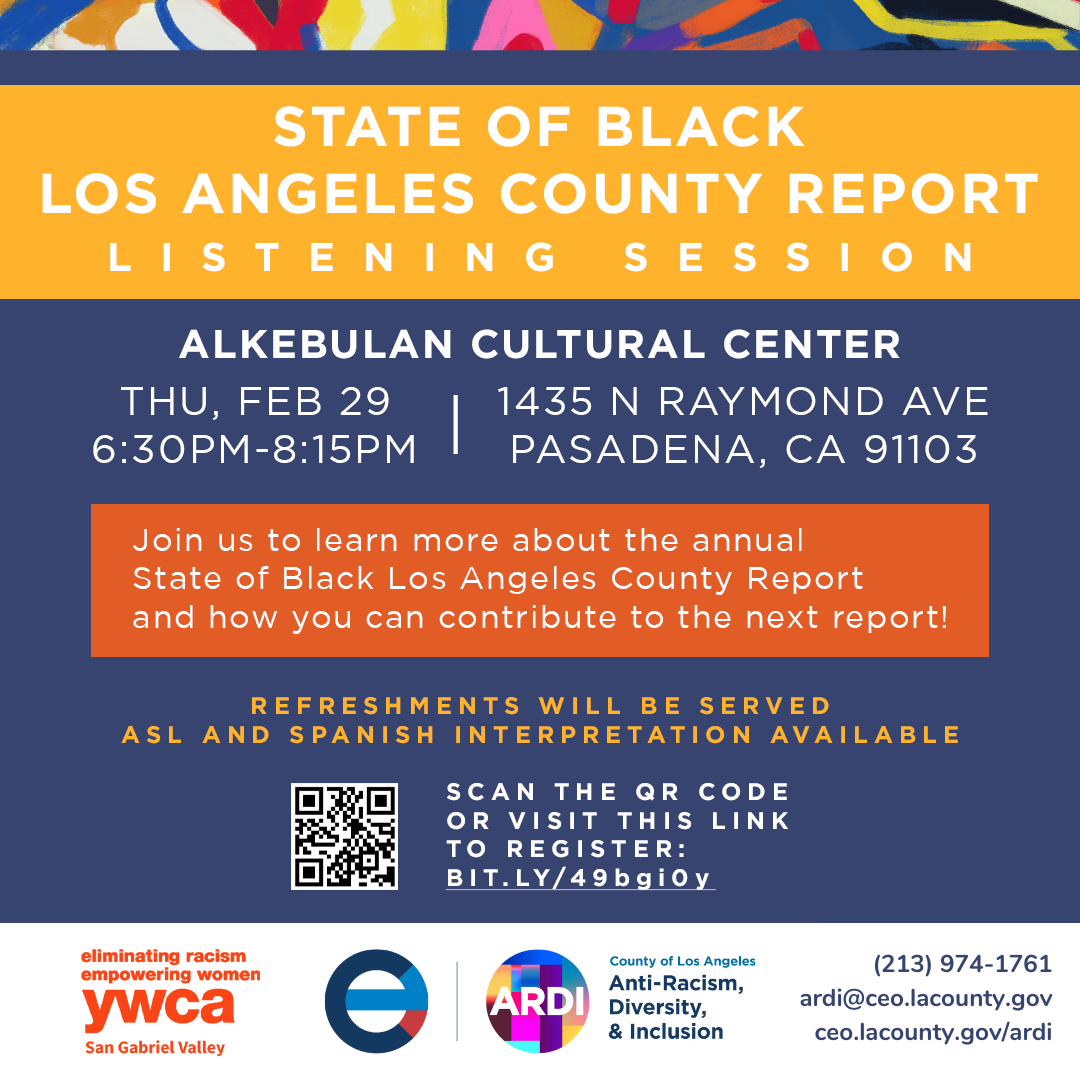
The YWCA SGV has organized a forum in LA County's 5th District. Dr. Scarza, the executive director of ADRI, will guide attendees through the data, examining the underlying dynamics of justice and equity in these communities.
Readers are invited to participate in a listening session on Thursday, February 29th, at 6:30 PM at the Alkebulan Cultural Center in Pasadena. The emphasis is on collective engagement and the significance of understanding the complexities of the issues.
Comments

Powered by RoundtableAn AI/DeFi-powered Enterprise Media Operating System. Learn more at Roundtable.io.© Roundtable 2026. By using this site you agree to the Terms of Use and Privacy Policy